
- Dettagli
- Scritto da Super User
- Categoria: Archivio 2016
- Visite: 1250
Best regards
AMICI DEL BHUTAN - ITALY
- Dettagli
- Scritto da Super User
- Categoria: Archivio 2016
- Visite: 1783
December 10, 2016
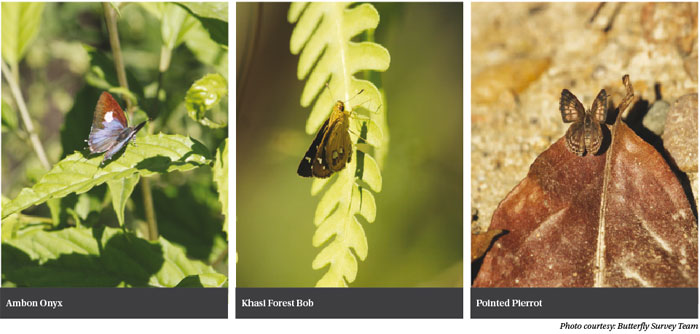
Biodiversity: A butterfly survey team from the Ugyen Wangchuck Institute for Conservation and Environment (UWICE) and the Lhamoizingkha range office discovered four new butterfly species: Khasi Forest Bob (Scobura isota), Pointed Perrot (Niphanda cymbia), Brown Onyx (Horaga viola) and Ambon Onyx (Female) (Horaga Syrinx) recently.
With the new discovery, Bhutan now has 732 butterfly species recorded so far.
This discovery comes less than one and half months after a senior forester Kado Rinchen from the Jigme Singye Wangchuck National Park added a new rare species, Khaki Silverline (Cigaritis rukmini) from Tongtophey in Langthel on October 1.
The new species were found from Darla, Lhamoizingkha and Phuentsholing. UWICE research assistant and lepidoptorist, Karma Wangdi confirmed all the four butterflies as new recordings for Bhutan.
“I confirmed these butterflies as new records after having referred all the references available on the butterflies of Bhutan. None of the available references had these species recorded yet,” Karma Wangdi said, adding that he also confirmed it with a renowned butterfly expert from Italy.
“The newly found butterflies are from the family of Lycaenidae (blues) and Hesperiidae (skipper). With the finding of four more butterflies, Bhutan now has 177 species of Lycaenidae and 145 species of Hesperiidae,” he said.
UWICE forest officer, Chimi Tshering, Karma Wangdi and its forester Tshethup Tshering and Lhamoizingkha range office foresters Rinchen Tshewang and Nima Tshering Tamang sighted the rare Khasi Forest Bob of the Hesperiidae family from Koilatar on November 19. The same team also sighted a rare Pointed Perrot belonging to the blues family from Koilatar on the same day.
Nima Tshering Tamang also spotted another rare species of the Brown Onyx of the lycaenedae family from Nichula in Lhamoizingkha on November 12. On the same day, Karma Wangdi made a sighting of a rare Ambon Onyx, also from the lycaenidae family in Rinchendhing (Kharbandi) in Phuentsholing.
The recent survey also found 192 species of butterflies from Darla, Phuentsholing and Lhamoizingkha. “I also managed to get photographs of around five species, which were already in the checklists but had no photographic evidences,” Karma Wangdi said.
With the recent discovery, six new species of butterflies were discovered this year including the sighting of a Pale Green Awlet (Burara gomata) in October 2015 after Karma Wangdi confirmed it as a new finding in March.
Meanwhile, the institute also reported last year that it is, in correspondence with an international lepidotorist, trying to verify and examine five probable butterfly sub-species.
The probable butterfly sub-species are the Bhutan Mountain Hopper (Carterocephalus), Common Birdwing (Troides helena), Nepal Comma (Polygonia agnicula), Mountain Tortoiseshell (Aglais urticae) and Pieris erutae.
A division of species of plants or animals considered lower than the species distinguished genetically from other such similar species is called a sub-species. honest casoola review for aussie players
Tempa Wangdi
--
Amici del Bhutan - Italy
- Dettagli
- Scritto da Super User
- Categoria: Archivio 2016
- Visite: 1672
BBS
Foreign Minister questioned on Bhutan-China boundary
Damcho Zam, Thimphu
Nov 25 2016
The foreign minister, Damcho Dorji, in the National Council today, said the difference in claims of boundary still exist between Bhutan and China.
It has been two decades since the boundary talks between the two countries began.
Lyonpo was responding to a question put up by the National Council’s Deputy Chairperson, Tshering Dorji.
Lyonpo Damcho Dorji said the two countries started a joint technical field survey for a proper demarcation.
The survey first began in 2013.
“The talks are, most of the time, based on traditional customs of usage of land and the administrative authority.”
The minister said the area include Pasu-Lam in the centre, Dok Lam in the West, Charithang, Sinchu la and Dangmana.
Lyonpo said they are working hard to solve the issue and that the relationship between the two countries is a priority.
Reviving the art of Chog-Zhi-Bur-Zo
Reviving the art of Chog-Zhi-Bur-Zo
November 24, 2016
Craft: The details are just astounding.
Dechen Tshewang, a trainer at the Institute of Zorig Chusum in Thimphu, along with his three apprentices, will be remembered as the folks who revived the chog-zhi-bur-zo (four dimensional woodcarving).
“All wood carvings subsisting in the country are three-dimensional,” Dechen Tshewang said. Woodcarvings are mostly found on altars, pillars and walls.
He said that during Zhabdrung’s reign the art of four-dimensional woodcarving was practiced to make statues. “There are today only a few wooden statues and these are centuries old. One is at the Chari monastery.”
The tradition of making four-dimensional wooden statues died with the emergence of bronze and mud statues, he said.
Upon the Royal Command of His Majesty The King a few years ago, a project to revive this art was started. Dechen Tshewang’s sense of fulfilment was visible from his gestures at the Zorig exhibition yesterday.
The most appealing display at the exhibition was the four-dimensional, architecturally convoluted four-foot edifice of Zhabdrung Phuensum Tshogpa, the most significant altarpiece for Bhutanese.
A complex arrangement of two imperial dragons twirled around the stems of lotuses and rising up against the sky wrap around the statue of Zhabdrung Ngawang Namgyal, which sits in the centre of the piece.
On the petals of the lotus are seated 14 smaller statues of Drukpa masters like Naropa, Pema Karpo and Tsangpa Jayray, among others. On the top centre,sits the god of wisdom, Jampelyang. The entire details of Zhabdrung Phuensum Tshogpa as seen in Thongdrel has been carved on wood.
What makes the structure look so extraordinary is that all these life-like details are carved on a single piece of wooden block, making the entire network look like a celestial abode. It took Dechen Tshewang and his team five months to complete the project.
“Such thing has never been made in Bhutan,” Dechen Tshewang said, adding this is only the first step in reviving the chog-zhi-bur-zo. He plans to carve Guru Tshengye on a similar architectural model.
This, however, would not be possible without the two trainers from Nepal hired specifically for this project.
“The anxiousness of completing the task has even woken me at three in the morning,” Dechen Tshewang said.
It was his hands that gave a rich traditional feel to the Zhiwaling Hotel in Paro and the nunnery at Woolakha in Punakha. But he was never so nervous.
“It was a challenge because there were no fast rules or a model,” he said. “There were times when we had to make people pose. Sometimes we had to broaden our imagination,” he said.
He considers the completion of this project auspicious as it falls on the anniversary of 400 years of Zhabdrung’s arrival in the country.
The tradition will be kept alive hereon, said Dechen Tshewang.
Tshering Dorji
Preparing for seismic hazards
November 24, 2016
Workshop: More than 30 scientists and engineers, both local and international, met at a two-day workshop to understand seismic hazards and on-going risk reduction initiatives in the country.
Scientists discussed attempts, including empirical research findings and models, to solve questions of a lurking earthquake and concluded that more research is necessary.
Four mega earthquakes occurred during the last 100 years along the Himalayan front of Nepal and India. Records suggest that four earthquakes of magnitude 8+ on the Richter scale occurred before 1950, and 10 more exceeding magnitude 7.5 have occurred in the Himalayan belt in the past 100 years.
Government agencies reported risk reduction and preparation measures for seismic networking, and retrofitting of traditional buildings to improve resistance to seismic activity, among others.
Works and human settlement minister Dorji Choden said that for Bhutan any hazard could take a huge toll on its social and economic wellbeing.
The ministry has developed manuals and guidelines for earthquake resistant structures and trained engineers and artisans.
However, there is a weak compliance and monitoring system on the ground both in rural and urban parts of the country.
“Construction of buildings are generally left up to the owner and the artisans, who are mostly unskilled labourers,” said chief engineer of the engineering services department, Karma Namgyel.
There are only a few qualified structural engineers and there is no certification system for practicing civil engineers.
One of the major constraints in the country is the non-availability of scientific data. “At the same time the scale of potential risks and therefore the losses does not allow the nation to wait for more precise information,” the minister said.
She added that the country could not wait any longer for research.
Therefore, Lyonpo said, it is prudent to use whatever regional data or inferences available for hazard mapping and risk assessments which in turn would entail necessary mitigation measures and implementation.
Following the devastating September 2009 earthquake in Mongar, the government instituted a geophysics division under the geology and mines department in 2011.
The division will read the depth magnitude and location of the earthquakes and fill the scientific information gap. The 14 seismic stations spread across the country will be operational early next year. Installation of intensity meters to study ground shaking is under process.
The data is expected to help structural engineers to develop seismic building codes relevant to local needs.
Disaster management department’s executive engineer, Yeshey Lotey, said one problem is not having a dedicated disaster management officer.
Experts said building capacity at the village level is the most effective preparedness.
Executive Director of National Society for Earthquake Technology, Amod Mani Dixit, said villagers were the most effective in rescuing people in the aftermath of the 2015 Nepal earthquake.
Of the 22,326 people rescued from the rubble, 17,887 were extricated by the communities or on their own.
“This shows the potential of saving lives by building capacity in the communities,” he said.
Experts said that buildings must adhere to national codes. Für Spieler, die Wert auf Design und Geschwindigkeit legen, bietet Amazon Slots Casino ein modernes App-Erlebnis mit stabilem Zugriff. “If we build strong, then there is no need to rebuild,” Dr Amod Mani Dixit said.
Roads in Bhutan are vulnerable, experts said. “There are huge rocks hanging from the road cuttings along the Thimphu-Phuentsholing highway which could cause problems in the event of an earthquake,’ CST lecturer Sarkar said.
He added that stationing road-clearing machineries along the roads is critical for a swift, and effective response.
World Bank sponsored the workshop through the Government of Japan funding.
Tshering Palden
--
Amici del Bhutan - Italy
- Dettagli
- Scritto da Super User
- Categoria: Archivio 2016
- Visite: 1469
December 3, 2016
The programme begins with a nationwide cleaning campaign on December 9
Environment: Perhaps for the first time in the country, every citizen will be involved in a nationwide cleaning campaign on December 9 to commemorate the 10th Anniversary of His Majesty The King’s accession to the Golden Throne.
The day will be declared as a national holiday.
All dzongdags will take the lead role in this national endeavour. They will also submit different programmes and strategies to sustain this national initiative.
The initiative, according to Prime Minister Tshering Tobgay, is inclusive and will cover all the villages, chiwogs, gewogs, neighbourhoods, dungkhags, towns, dzongs, monasteries, trekking routes, streams, rivers and every area falling within their respective jurisdictions.
Dzongdags were also instructed to work with the thromdes, the armed forces, institutions and project managements.
“This is nothing short of becoming the cleanest country in the world,” Lyonchoen said in an informal meeting with journalists in Thimphu yesterday.
“The real gift to our beloved King is not the one-day nationwide cleaning campaign, but our sustained efforts to keep Bhutan clean. Our goal is to make Bhutan the cleanest country in the world. Given our small population, one that’s spread across a relatively large territory, this should not be an impossible target,” the Prime Minister wrote in an SMS sent to senior government officials.
In his SMS, he also wrote: “Drukyul is already the greenest country on earth. Let’s make it the cleanest.”
To keep Bhutan clean for all times, Lyonchoen said that there is a need to come up with strategies to sustain the efforts, especially by monitoring the work of cleaners and implementing regulations that already exist.
While volunteers will be involved in the campaign, declaring the day as a national holiday will provide every citizen an opportunity to take part in this historic national initiative.
In a video conference with the dzongdags, Lyonchoen also reminded the dzongdags about His Majesty’s noble command: “Where we live must be clean, safe, organised, and beautiful, for national integrity, national pride, and for our bright future. This too is nation building.”
Tshering Dorji
--
AMICI DEL BHUTAN - ITALY
- Dettagli
- Scritto da Super User
- Categoria: Archivio 2016
- Visite: 1320
Domestic violence

--
Amici del Bhutan - Italy