
- Dettagli
- Scritto da Super User
- Categoria: Archivio 2016
- Visite: 1850
But certain areas still require addressing
Report: About one in five children under the age of five in Bhutan still remain stunted, the UNICEF’s representative to Bhutan, Shaheen Nilofer, said during the launch of the State of the World’s Children (SWC) report yesterday.
Meanwhile, only one in five children aged three to five years in Bhutan have access to early learning in an organised setting such as an early childhood care and development (ECCD) centre.
Of the 20, in eight dzonkhags, only half of three to five-year olds are developmentally on track and 12 percent of the population still lives below the poverty line.
Shaheen Nilofer said that early childhood stimulation and learning can improve school readiness and reduces the chances of repetition and dropouts.
Newborn deaths in Bhutan are still high, accounting for more than half (54 percent) of under-five deaths occurring in the first 28 days of birth, mostly as a result of diseases that can be readily and affordably prevented and treated, Shaheen Nilofer said.
The State of the World’s Children, UNICEF’s annual flagship report, states that significant progress has been made in saving children’s lives, getting children into school and lifting people out of poverty.
Shaheen Nilofer said that in many cases equity gaps have narrowed down the gaps of inequalities. Bhutan too has narrowed down the gaps over the years and has made significant progress.
Poverty in Bhutan has been halved, from 24 percent in 2012 to 12 percent today. Stunting or chronic undernutrition in children under five has reduced from 33.2 percent in 2010 to 21.2 percent in 2015, while the under-five mortality rate has reduced from 134 per 1,000 live births in 1990 to 33 per 1,000 live births in 2015.
However, Shaheen Nilofer said that this progress has been neither even nor fair. The poorest children are more than six times more likely to be stunted than the richest; poorest children are more than thrice as likely to die before their fifth birthday than children in the richest quintile; children whose mothers have no formal education are 63 percent more likely to be stunted compared to children whose mothers have a secondary or higher education.
“In a world of equity, everyone should move forward. More than ever, we should recognise that development is sustainable only if it can be carried on and sustained by future generations,” Shaheen Nilofer said. “We have an opportunity to replace vicious cycles with virtuous cycles in which today’s poor children, if given a fair chance at health, education and protection from harm, can, as adults, compete on a more level playing field with children from wealthier backgrounds.”
Global under-five mortality rates have been more than halved since 1990, boys and girls attend primary school in equal numbers in 129 countries, and the number of people living in extreme poverty worldwide is almost half of what it was in the 1990s.
However, the report also paints a stark picture of what is in store for the world’s poorest children if governments, donors, businesses and international organisations do not accelerate efforts to address their needs.
According to the report, based on current trends, 69M (million) children under five will die from mostly preventable causes, 167M children will live in poverty, and 750M women will have been married as children by 2030,the target date for the Sustainable Development Goals, if the world doesn’t focus more on the plight of its most disadvantaged children.
This year’s SWC report with the theme, “A fair chance for every child,” focuses on three key areas: poverty, child survival and education; that will have a critical bearing on achieving equity for every child by 2030.
National Assembly speaker, Jigme Zangpo, said that the theme focuses on how best to tackle inequity, making the right choices that will break intergenerational cycles of deprivation, marginalisation and vulnerability.
Tshogpon Jigme Zangpo said that the areas in which children experience inequity are many, but this report focuses specifically on three areas that exemplify, both the magnitude of the challenge and the immensity of the opportunity to improve the lives of millions of children.
Tshogpon Jigme Zangpo said that the report comes at an opportune time as Bhutan has started the journey towards achieving the Sustainable Development Goals (SDGs) by 2030.
Tshogpon Jigme Zangpo explained that the SDGs are universal and there cannot be true universality if pockets of the population, especially children, in remote and rural areas are not reached. If they are left without access to the basic necessities that can help these most disadvantaged children grow up to their full potential and become productive citizens and future leaders.
The SWC 2016 report points to evidence that investing in the most vulnerable children can yield immediate and long-term benefits. Inequity is not inevitable, the report says. Better data on the most vulnerable children, integrated solutions to the challenges children face, innovative ways to address old problems, more equitable investment and increased involvement by communities, all these measures can help level the playing field for children.
Dechen Tshomo
--
Amici del Bhutan - Italy
- Dettagli
- Scritto da Super User
- Categoria: Archivio 2016
- Visite: 1461
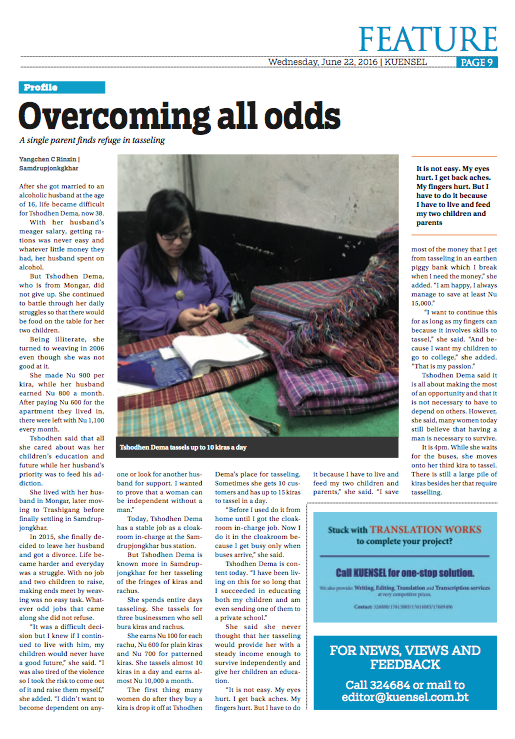
Come uscire dalla spirale di violenza e miseria....
--
Amici del Bhutan - Italy
- Dettagli
- Scritto da Super User
- Categoria: Archivio 2016
- Visite: 1509
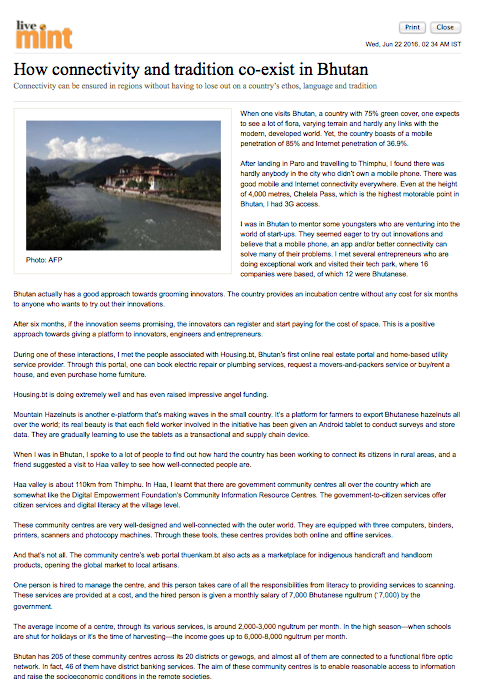
Thought-provoking comprehensive write up about #literature in contemporary #Bhutan... really worth a read!
--
Amici del Bhutan - Italy
- Dettagli
- Scritto da Super User
- Categoria: Archivio 2016
- Visite: 1837
Renovation of the dzong is expected to be competed by 2018
But labour and resource challenges persist
Conservation: The second phase of the restoration of Wangdicholing Dzong in Bumthang is in full swing.
Workers are replacing chams (joists), nampang (ceiling boards), floor planks, windows, and other wooden parts of the dzong.
Project Manager Sonam Tashi said wooden parts of the Lingka Lhakhang have been replaced and the rooms of the Drasha were modified.
In the second phase, conservation work will be carried out only for the periphery buildings (shakor). The utse of the palace will remain untouched. “The Chhukhor Mani will also be renovated during this phase,” he said.
Sonam Tashi said only the conservation work will be completed during the second phase which started in March this year and will end by September 2017.
They are also building doors to link the rooms of the shakor. People visiting the dzong in the future will be able to move directly to other rooms without having to exit the building.
Bhutan Foundation’s programme manager Deepika Chhetri said the second phase of the project is funded by the US Ambassador’s fund for cultural preservation through the foundation. “Bhutan Foundation is also partly funding the project,” she said.
Tashideling construction and consultancy is executing the work and the Department of Culture is monitoring.
Project’s Zopon Namgay, said it is estimated that some 700 chams for the Shakor will be replaced. “Conservation work is done in a very strict manner,” he said.
For instance, the zopon explained that for a door, they would remove only that portion that is destroyed and not the entire structure. He said it is difficult for them to change the chams as they would have to jack up the bidhen (beams placed on the chams) by three inches.
Sonam Tashi said that they are facing acute shortage of skilled workers. This is because private employers in Bumthang pay higher daily wages compared to the project. “People came and worked for the project for about two months and then left finding better wages,” he said.
The project manager said that the project requires 50 workers everyday but can manage only 20-25 a day.
He said they had already have seasoned chams but it is difficult to get stones and sand since there are no quarries in Bumthang.
The restoration of Wangdicholing Dzong, the birthplace of the first Druk Gyalpo, Ugyen Wangchuck is being carried out in commemoration of the 60th Birth Anniversary of His Majesty The Fourth Druk Gyalpo.
The long-term objective of the restoration plan is to establish a special museum that demonstrates the history of Bhutan with Buddhism at the heart of its tradition and culture.
The museum will promote sustainable tourism that will increase financial opportunities within the locality. Additionally, this museum will become a gateway into Bhutan’s cultural heartland, the Bumthang valley, providing opportunities for local Bhutanese to learn their own history as well as for tourists.
The main partner for the project is the division for conservation of architectural heritage sites of the home ministry, and international partners include Tsao & McKown Architects, the World Monuments Fund besides the U.S. Ambassador’s Fund for Cultural Preservation.
The project started in March 2015 and expected to be completed by December 2018.
Nima Wangdi | Bumthang
--
Amici del Bhutan - Italy