
- Dettagli
- Scritto da Super User
- Categoria: Archivio 2016
- Visite: 1701
La nuova Ambasciatrice del Bhutan a Bruxelles!
Maddalena per A.d BH
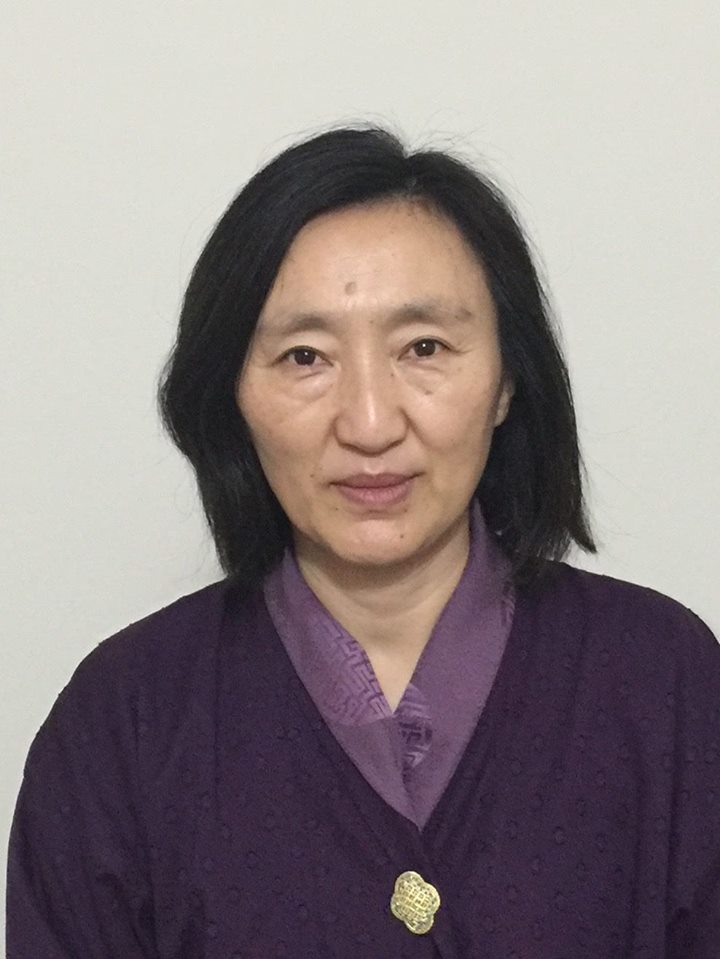
We have the pleasure to inform Bhutanese and friends of Bhutan in Europe that Aum Pema Choden, Bhutan's ambassador to Bangladesh has been appointed as Ambassador to Belgium, the Netherlands, Denmark, Sweden, Finland, Spain and the European Union.
She is expected to arrive Brussels towards end of February 2016.
Aum Pema studied at l'ENA in France and speak good French
Long flights, business meetings, and hours spent exploring the city can leave little room for proper rest, which is why https://massage-dubai.org brings together useful information for those searching for massage in Dubai. It provides a convenient starting point for discovering relaxation options without spending unnecessary time looking across unrelated sources.
- Dettagli
- Scritto da Super User
- Categoria: Archivio 2016
- Visite: 2179
A compassionate movement to save animal lives
Initiative: A quiet revolution is taking birth in Thimphu. And as it matures in time, it will spread out of the capital to the dzongkhags beyond and, hopefully, it will see a roaring success.
This is the vision of one man who saw that going meatless for a day could save the lives of thousands of animals. And thus, he borrowed an idea from an international campaign Meatless Monday that was founded in 2003 to encourage people to not eat meat on Mondays to improve their health and the health of the planet.
And here, it is Jangsem Monday.
Karma Dendup, 35, who is a reporter with Bhutan Broadcasting Service, started this movement on July 7, 2014. Today, this initiative is being supported by Humane Society International (HIS) based in Hyderabad, India.
“This is my most important dream. I will follow this my dream until the end of my life,” said Karma, who is working to register Jangsem Monday as CSO. “We have currently achieved more than 2,000 likes on our facebook page.”
To help Karma achieve his lifelong dream, he has the support of Pema Yangtsho, who coordinates the overall initiative of Jangsem Monday. She puts it admirably succinctly what Jangsem Monday really stands and works for. “Jangsem Monday is all about adding vegetable items on hotel and restaurant menus, not really to subtract meat items.”
Monday was chosen as the no-meat day because Karma found that Monday is the day when most people set new goals to achieve. Also, it is about the number of chances people will get in a year to make decisions.
“There are 52 Mondays to decide on changing their habit,” said Karma. “Ours is a habit forming movement; do something nice and selfless.”
And so, Jangsem Monday has a lot to do. It will have to create awareness and urge institutions, hotels, and restaurants to go meatless on Mondays. That’s just the beginning. The movement will then have to sip into schools and households.
The response so far has been good. Ambient Café and Chha Bistro have already joined the movement. More is expected to follow suit.
Kencho Wangmo, a restaurant owner, said Jangsem Monday is a good initiative. “I will now on focus more on developing vegetable items every Monday. I don’t care if I lose customers, because going meatless even for a day will save the lives of many animals.”
Norbu Zam, a nun from Pema Choling Dratshang in Bumthang, said she eats meat occasionally but praised the idea of going meatless once a week.
“I will stick to this initiative strictly. In the end, it is about saving lives of animals and sowing the seed of compassion in us,” said Norbu Zam.
Karma said that Meatless Monday saved some 400 million animals in America in 2015. Jangsem’s Meatless Monday will save the lives of at least 35 animals every year.
It has just begun, the movement, but Karma can already see the movement penetrate into the farthest hamlet in the country. This is what keeps him going.
Tashi Tobgay
Better prepared, but not there yet
Scientists warn of a massive earthquake in the Himalayan region in the near future
Disaster: In the wake of the recent Manipur earthquake that affected 248 structures in 16 dzongkhags and scientists cautioning of a mega earthquake in the region, the disaster management department is confident of its preparedness.
Although detailed and comprehensive seismic zoning of Bhutan is unavailable, its proximity to the northeastern parts of India, which are in the ‘most active’ seismic Zone V according to Bureau of Indian Standards, indicates that the majority of the country is either in Zone IV or V.
A day after the magnitude-6.7 Manipur earthquake, Indian media citing renowned earthquake authorities warned of an earthquake magnitude of 8.2 or greater on the Richter scale may hit the already ruptured Himalayan region.
Two earthquakes in 2009 and 2011 damaged 153 schools across the country and caused damages worth Nu 3.6 billion. More than a dozen people lost their lives in 2009 Narang, Mongar earthquake.
“In the past few years, we have come a long way in terms of preparedness,” Department of Disaster Management director Chador Wangdi said.
Immediately after the Nepal earthquake in May last year, the Cabinet established a high-level multi-sectorial earthquake preparedness committee comprising 15 members and chaired by the home minister.
The department has trained search and rescue teams in all 20 dzongkhags and provided basic kits to 16 dzongkhags. The rest will be given this year.
It also released guidelines for disaster management and contingency plans of dzongkhags last year.
“We’re now focusing more on the key stakeholders such as health and education ministries, police, and they have developed contingency plans and a few other agencies are developing their plans,” Chador Wangdi said.
The dzongkhags are also developing such plans to deal disasters.
“The situation has definitely improved; we’ve a helicopter, Desuups are trained in search and rescue, and we’re exploring better communication options,” Chador Wangdi said.
One area it still has much to do is in communications, vital in times of disasters.
When the Manipur earthquake hit, DDM officials and disaster focal person in the dzongkhags had difficulty in communicating. The mobile network did not function.
The UNICEF has agreed to supply a satellite phone each to every dzongkhag this year, to improve communication during disasters.
“We’re also negotiating with telecom companies to keep certain phone numbers of key officials during such times,” the director said.
However, Bhutan will have to pray that an earthquake doesn’t hit us for the next eight months. An effective coordination centre will be ready in eight months. The contract was awarded yesterday.
In absence of the centre, the director said an instant command centre that coordinates during emergencies was missing which made it difficult to coordinate even during a small forest fire incident.
DDM awarded the building of its interim command centre to National Housing and Development Corporation to be completed in eight months.
The one-storey prefabricated building will have communication sets, equipped with satellite phones, media conference, and other basic equipment to coordinate in times of calamities.
The September 2009 quake destroyed more than 1,900 homes in eastern Bhutan.
The engineering services department under works and human settlement has been working on strengthening rural homes.
It has completed the first round of training artisans and local government leaders on earthquake resistant building techniques in all dzongkhags.
“This year especially for the rural construction, we’ll complete the manual for confine masonry – the medium construction type between reinforced cement concrete and loadbearing construction,” the department’s chief engineer Karma Namgay said.
This type of construction may not cost much whereas it will be far stronger than the ordinary rural loadbearing house constructions.
Even as the department trains and plans better models, loopholes in implementation on the ground exists limiting the impact of their efforts.
There is no rule requiring all house constructions to seek design approvals from the dzongkhag engineer.
“Things are working, we’re preparing and doing our best with whatever resources are available to us,” Chador Wangdi said.
There were 19 seismic events that have affected Bhutan since 1897. An earthquake with a magnitude of 8.7 in the Shilong plateau, India, 118 years ago, had destroyed Punakha and Lingzhi dzongs and damaged Wangdue, Trongsa, Jakar and Tashichhodzong.
Tshering Palden
AMICI DEL BHUTAN - ITALY
- Dettagli
- Scritto da Super User
- Categoria: Archivio 2016
- Visite: 2790
Dealing with our greatest social malaise
We have a very strong relationship with alcohol. Consumption of alcohol is deeply deep-seated in our culture and is widely accepted as vital part of our society. It is perhaps because of this that we are now facing a serious challenge to deal with diseases and deaths related to excessive consumption of sense-knocking-soul-eating brews.
Alcohol is the leading cause of diseases, social disruptions and economic problems in our country today. Even so, and, pathetically indeed, we have not been able to deal commendably in tackling with the root cause of all these social maladies.
Record with the health ministry shows that alcoholic liver disease is the leading cause of death in Bhutan. Disturbingly still, the prevalence of alcohol consumption is increasing, and, it continues to pose a serious threat to the well-being of the society.
What is pitiful is that we know what we ought to do; only we aren’t doing enough.
We have made alcohol affordable and easily accessible. It’s a no-brainer, really. High per capita consumption and high density of liquor outlets can be directly linked to harmful use of alcohol, violence, injury, and deaths. The per capita consumption of alcohol among Bhutanese is much higher than global consumption rate.
The problem with Bhutanese is that drinking is not only pervasive. Those who drink do so in manner reckless and hazardous. Every 2 in 5 Bhutanese (42.4 percent) drink alcohol and, among them, and 1 in 5 (22.4 percent) engage in heavy episodic drinking.
In 2014, 3,140 alcohol-related health cases were reported in the country. In the same years, 176 people of productive age died of excessive alcohol consumption. Statistics are revealing and we need to be concerned about the health of individual Bhutanese and, at the same time, be worried about what economic repercussions this will bring us to.
The problem now has bloated so much so that it requires wholehearted effort to address the problem. This, in turn, will demand enormous improvement in the implementation of existing alcohol regulations in all the dzongkhags in the country.
There was a time when we considered alcohol a socially acceptable commodity. Not anymore. Today, alcohol is one of the most dangerous drugs that our people abuse in the country. It will be difficult to eliminate the use of alcohol root and branch from the society, but if we are to reduce the use and abuse of alcohol in the country, we need to make alcohol less accessible.
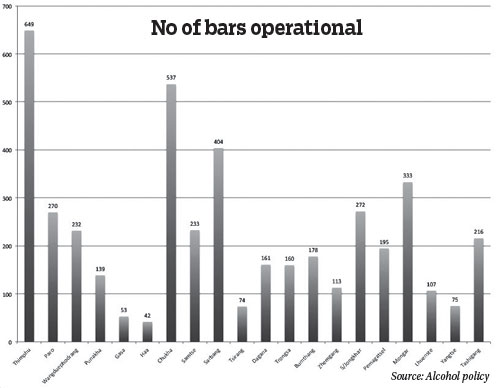
Today, we have 5,407 alcohol outlets – 1 outlet for every 98 Bhutanese above 15 years of age. This is not counting the many illegal (unlicensed) outlets in the country.
The good news is that the cabinet endorsed the National Policy and Strategic Framework To Reduce Harmful Use of Alcohol 2015-2020 with the hope to reduce morbidity and mortality from harmful use of alcohol by 50 percent and to reduce social problems from harmful use of alcohol by 5 percent by the end of 2020.
This shows that we now have a political will to grapple with one of the most devastating abuse our people engage in. But this is not enough. All will depend on how well we are able to enforce the existing alcohol policies and the legal tools.
We will wait too see how successfully we deal with this our greatest social malaise.
Cabinet endorses strong alcohol policy
After four years, the Cabinet endorsed the policy to address the top killer in the country
Health: Volumetric taxation or levying tax based on the alcohol content of products is one of the interventions that would be taken to control access and consumption of alcohol in the country.
Taxation and pricing polices is among the 10 strategies that would be implemented as per the National Policy and Strategic Framework To Reduce Harmful Use of Alcohol (2015-2020), which the Cabinet endorsed on December 2.
The Cabinet’s approval comes four years after work to frame one began in June 2011. According to the policy, the per capita adult (15 years) pure alcohol consumption among Bhutanese at 8.47 litres is higher than the global consumption at 6.2 liters.
It was found that drinking among the Bhutanese was not only pervasive but that those who drink consumed alcohol in a hazardous manner. “Every 2 in 5 currently drink alcohol, and among them, 1 in 5 engage in heavy episodic drinking, which is more than six standard drinks on any occasion,” the policy states.
Globally, if one is drinking about six standard drinks, which are about two beer bottles in one occasion, health officials said that amount is harmful to drinker’s biology as well as behaviour.
Deputy chief program officer at the Department of Public Health and one of the lead writers of the policy, Dr Gampo Dorji said in alcohol control, the best policy is when access, affordability and availability are controlled. “Increasing taxes will touch on affordability while regulating licenses will touch on accessibility and availability,” he said.
Dr Gampo Dorji said it has been found that the most effective control measure in alcohol was not public education such as doctors speaking on air about its ill effects but pricing and policy mechanisms that control affordability and accessibility.
“Taxation as a strategic activity will be taken up by the economic affairs ministry, which in consultation with stakeholders will review the current tax and propose an incremental tax reform,” he said but cautioned that this strategy is likely to take some time.
Taxing alcohol, he said, is not like taxing other products. While some tax by the quality, others tax by alcohol content. “From harm reduction approach, those with higher alcohol content are considered more toxic, which means it should be taxed heavily,” he said.
On whether taxation would control harmful consumption of alcohol since it didn’t have much impact on tobacco, Dr Gampo Dorji said tobacco and alcohol are different products in case of Bhutan. “In case of tobacco, the whole commerce is banned but we are not saying that for alcohol,” he said.
Bhutan did revise the tax on alcohol products but Dr Gampo Dorji said that even at the current rate, alcohol remains one of the cheapest in the region and still accessible. For instance, he said, a bottle of beer costs about Nu 200 in Nepal and at home, it costs about Nu 70 or Nu 50 in places like Trashigang. “Its four times cheaper here than in Nepal and there is room to consider tax as a measure,” he said.
The bigger public policy expectation from this strategy is to prevent the mass from going into excessive use and not really targeting those who are already addicted to alcohol. “We have to consider the overall picture and not just see whether the policy for instance tobacco has stopped people who already smoke from smoking; because that’s probably not the purpose and that may not be effective either.”
Among others, the policy has also defined the roles of each stakeholder especially that of the local government in alcohol control. Dr Gampo Dorji explained that the Local Government Act empowers them to play a role in creating awareness, enforce and control alcohol. “Policy now says that the local government has a bigger role to control and advocate on alcohol,” he said.
Restrict minors
One of the actions mandated for Bhutan InfoComm and Media Authority (BICMA) is to ensure that minors (below 18 years) are restricted from entering entertainment venues such as drayangs and discotheques that exclusively promote alcohol consumption.
The policy also mandates the authority to notify drayangs, nightclubs and other places of entertainment where alcohol is sold to conduct age identification checks to restrict underage entry. The authority will also develop a joint enforcement implementation plan with the economic affairs ministry to enforce the prohibition of sale of alcohol in entertainment venues after 10 PM.
Dr Gampo Dorji pointed out that some of the actions taken on alcohol control such as monitoring drink driving and the moratorium on licensing of alcohol outlets are an outcome of alcohol policy discussions.
The policy mandates the economic affairs, among others, to enforce separation of bars from other businesses including grocery shops except in hotels and restaurants, enforce non-issuance of stand-alone bar licenses to minimize outlets and suspend issuance of approval for alcoholic beverages project proposals for above 8 percent volume of alcohol as per the resolution of the 8th session of the first parliament.
Bhutan’s alcohol outlet concentration at one alcohol outlet per 98 people above 15 years, officials said is one of the highest globally.
Revenue brewed from alcohol
While acknowledging that the revenue earned from alcohol averages about Nu 1 Billion annually, officials point out that one has to discount that amount not just on health cost but on other factors as well.
“There are thousands of alcoholics who are not even seeking medical care- look at their productivity loss, their social burden on the family and premature deaths,” Dr Gampo Dorji said. “If you really discount all these accounts and the costs that has, then the net benefit from alcohol probably may not be that high.”
Bhutan lost a life every two days from alcohol related disease last year. Ever since alcohol has held onto its top position as the top killer in the country for the last six years, it has claimed 12 lives every month.
A policy paper on alcohol control states that records with the National Statistics Bureau show that “the economic burden of alcohol in Bhutan amounted to Nu 5 billion in 2014, four times higher than the Nu 1 billion it earned in economic returns.”
“Sometimes, we tend to make decisions by looking at the revenue generation. But we have to move beyond that,” Dr Gampo Dorji said. “The strategy is trying to address alcohol as an accepted product in our society but trying to reduce it so that we have better a healthier and happier society. Once we start implementing this policy, we will have what we expect – less violence in our homes, less of alcohol related road traffic deaths and injuries, less people getting admitted for alcohol, more people living alcohol free life and drinkers who are still enjoying but are probably more responsible drinkers.”
Sonam Pelden
AMICI DEL BHUTAN - ITALY
- Dettagli
- Scritto da Super User
- Categoria: Archivio 2016
- Visite: 1610
Best wishes
Amici del Bhutan - Italy