
- Dettagli
- Scritto da Super User
- Categoria: Archivio 2016
- Visite: 1640
Mr. Kinga Singye, a seasoned diplomat from the Ministry of Foreign Affairs, has been appointed
as the new Bhutan Ambassador to the UN in Geneva.
Trashidele to him
--
Amici del Bhutan - Italy
- Dettagli
- Scritto da Super User
- Categoria: Archivio 2016
- Visite: 2350
Decreasing black-necked cranes concern villagers
loss of wetland to development activities seen as a main cause
BNC: Declining numbers of Black-necked crane (BNC) arriving in Chumey and Tang in Bumthang, and Menbi and Dungkar in Lhuentse is concerning the communities that are used to seeing the birds in their fields. The issue was raised during a sensitization meeting on BNC in these communities conducted by the Royal Society for Protection of Nature (RSPN) recently.
This year only two cranes arrived in Tang. “The number of crane arrivals is declining again,” Soenam from Gamling said, worried if the cranes would return next year. Last year four birds came. The community is worried because BNC is revered as heavenly and auspicious. Its arrival evokes joy and happiness for the cranes’ visit is believed to harbinger bountiful harvests in the villages in the following year. “When the cranes aren’t around it feels empty as if something is missing,” Soenam said.
An elderly man, Jambay from Gyetsa recalled how as a child he enjoyed watching the cranes dance while herding cattle. “Even here the number of cranes is declining now from over 20-30 I saw as a child,” Jambay said. This year the number of cranes in Gyetsa dropped to 16 from 22 from the last winter.
In Thangbi only two cranes arrived from minimum of nine before. As per data from RSPN, except for an increase in arrival Phobjikha, BNC arrival is declining in wintering grounds such as Khotakha, Bumdeling and Bumthang.
Loss of wetland, the bird’s feeding and roosting grounds, to developmental activities is the leading cause for decreasing number of cranes. For instance, the cranes are no longer sighted in Bajo after the wetland was turned into a town. “The depletion in Tangmachu is attributed to diversion of water from wetland by some people,” RSPN programme coordinator, Tshering Phuntsho said, adding the place also lacks proper roosting grounds.
Earlier a research by UWICE researcher, Rinchen Namgay on habitat usage in Bumthang, found majority of sites where cranes visited for roosting and feeding were encroached by human settlement and institutional infrastructures. “In Chumey, the wetland, where the technical training institute now stands used to be one of the roosting sites,” the study stated. “The cranes left the site since the onset of the institute’s construction.”
Increasing area of agriculture land left fallow is also reducing feeding ground, which adversely affects the turn over, according to the research. In Tang, the decline was attributed to a major flood in 2007. “This year the number has decreased possibly from loss of roosting grounds from floods last summer,” Kizom tshogpa, Lekila said.
The crane arrival in Bumdeling also declined almost by half after floods in 1994 and 2004, which destroyed acres of paddy fields. Attacks from stray dogs, overhead transmission conductors, use of chemicals fertilizers and pesticides, increasing amount of waste are other pressing issues in these winter habitats. “Dog sterilization needs to be carried out urgently to reduce deaths from canine attacks,” Gyetsa tshogpa, Chundu Tshering said, adding transmission conductors also needs to be made safer for the cranes since cranes are flying into it.
According to RSPN, while ensuring complete safety to the cranes is quite impossible, effects to its roosting and feeding grounds from human activities could be reduced. “Villagers must stick to organic farming to minimize harmful effects from chemical fertilizers and pesticides to cranes,” Tshering Phuntsho said. “Conversion of wetland to dry land must be reduced besides avoiding barbed wire fence.”
The villagers, however, called for stringent rules to protect wetlands for safeguarding BNC’s roosting and feeding grounds from encroachments. “BNC conservation would need long-term sustainable plan without compromising livelihood,” Soenam said.
Tempa Wangdi, Bumthang
Full adult literacy by 2020 achievable: MoE
Education: The Ministry of Education (MoE) is readying for the 2020 target of achieving 100 percent adult literacy rate by strengthening the Non-Formal and Continuing Education Division (NFCED) programme.
It is doable, said director general of Department of Adult and Higher Education (DAHE), Tshewang Tandin. “But we will have to achieve the 2017 target first.” MoE has some way to go to take the current 55.3 percent adult literacy rate to 70 percent by the end of 2017. Adult literacy baseline will be out in May.
Tshewang Tandin said that in order to achieve the 2017 target, DAHE will require rationalization of non-formal education centres. The department will also have to strengthen advocacy and awareness programmes to enhance enrolment. DAHE will develop appropriate need-based curriculum materials by incorporating Gross National Happiness (GNH) values and principles. “Our aim is to catch more people who have not gone to the school,” Tshewang Tandin said. “There are many who have not attended school.”
DAHE’s report on implementation status of NFE outlines strategies to strengthen NFCED programmes. The department will carry out literacy mapping in dzongkhags and thromdes to ascertain the number of illiterate population and institute a strategic planning to ensure equitable access to NFCED services.
Among the many strategies, the department will explore and strengthen collaboration and partnership with relevant stakeholders. A strategic need-based capacity-building programme for NFE instructors, including online trainings, will be carried out, and institute a system of regular monitoring and evaluation for NFE programmes at all levels. The report says that initiatives will be launched to promote life skills and life-long learning and to enhance vocational and rural development skills so that beneficiaries can generate income.
NFCED currently has three programmes – NFE programme, Continuing Education (CE) programme, and Community Learning Centre (CLC) programme. NFCED programmes has benefited approximately to 174,000 learners so far. There are 682 NFE instructors in the country – 211 male and 471 female. Monks have also been recruited as instructors. There are 13 CLCs and 14 CE centres with 1,386 learners in the country today.
Rajesh Rai, Phuentsholing
Separating bar and other businesses to control alcohol
Rule to be reinforced and strictly with the new policy on alcohol
Policy: There will be no “Shop cum Bar” while groceries will not be allowed to sell alcohol soon.
The Department of Industry will soon come hard on separating bars run jointly with other businesses.
The recently endorsed National Policy and Strategic Framework to Reduce Harmful Use of Alcohol (2015-2020) directs the economic affairs ministry to enforce separation of bars from other businesses including grocery shops except in hotels and restaurants. According to the policy the ministry also has to enforce licensed alcohol retailers and wholesale shops from selling alcohol for on-premise consumption.
The suspension of issuance of new bar licenses still stands in the meantime. Department of industry’s director Tandin Tshering said the rule of prohibiting joint business with bar was in place long before the endorsement of alcohol control policy. The ministry has remained consistent in enforcing that bar should be separated from other establishments.
He said, while enforcing the rule in urban area was possible because of presence and reach of trade and industry offices, it was almost impossible in the rural corners. With the involvement of local government in monitoring and supervision now enforcing existing rule is expected to be stringent.
“The alcohol policy gives more teeth to the existing rule that the bar and other establishment need to separate,” he said adding that the two establishment must be separated because groceries and bar operation timing are different.
Should the two establishments be allowed, the existing rules in place could be undermined in terms of bar timing. People could come in pretext of buying grocery and quench their thirst for alcohol, he said.
Although rampant, the numbers of such joint establishments were not available. But most bars in the urban areas, the director said are standalones or partitioned and joint businesses are common in rural areas.
Among others, the economic affairs ministry, according to the alcohol policy, will enforce non-issuance of stand-alone bar licenses to minimize outlets. It will also suspend issuance of approval for alcoholic beverages project proposals for above 8 percent volume of alcohol in accordance with the resolution of the 8th session of the 1st Parliament of Bhutan. In the mid 1990s the sale of alcohol had become rampant. The ministry had then frozen issuing of new bar license for few years until January 1, 1999.
Director Tandin Tshering said, prior to the suspension license fee used to be nominal. But after the suspension was lifted, the fee was increased. It was raised from Nu 1,000 to 5,000 depending on places of operation. The increase was following rampant rent seeking behaviour among licence owners.
The ban was lifted only after rules such as illegal hiring of bar licences, banning bar operation near religious and educational institutes, observing dry days, selling liquor before 1 pm and prohibiting bars with other business came into effect. Yet again in 2010, following submission from dzongkhag and gewog administrations urging the need to control bar license, issuing new bar license was suspended in 2014.
After the second ban, owners who failed to renew their licenses on time were cancelled. Numbers of licenses cancelled so far were not available. Number of bar license since then has remained almost same at about 4,500, the director said. “We want to maintain that level,” he added.
But between 2009 and 2010, the licence fee was increased from Nu 5,000 in 2007 to Nu 15,000. The minimum fee then was Nu 3,000. The fee was increased to make holding of bar licenses expensive. At the same time excise duties and sales taxes on liquor was increased, the director said.
“The major problem right now could be as a result of expressive issuance of licenses or affordable access to alcohol,” he said. For instance in the East people need not go to a bar to drink but almost every household is a brewery, which makes alcohol easily accessible. “From the government side, we need to look at accessibility specially from the supply side,” he said. “We’ve to make licence as scarce as possible and every second shop should not sell alcohol.” He added that to control accessibility first step is to control bar license, than enforce rules strictly and make alcohol unaffordable.
According to the alcohol policy, economic affairs ministry will conduct joint inspections with relevant stakeholders such as BICMA, Thromde to enforce the prohibition of sale of alcohol. A procedural manual for conducting field inspections for alcohol retailing practices among outlets will also be developed.
Nirmala Pokhrel
--
Amici del Bhutan - Italy
- Dettagli
- Scritto da Super User
- Categoria: Archivio 2016
- Visite: 4806
Regional delicacies & evolving food culture
MAIN STORY: It has just been over five decades since Bhutan opened her door to modernisation ushering in many changes. One of the significant changes is in food culture.
Due to the country’s difficult terrain and lack of communication, regions developed their own food culture that evolved over the centuries.
The people of Haa and Paro in the west of the country recently celebrated Lomba (new year) with their special local delicacy known as Hoentey – dumpling made from sweet buckwheat flour and stuffed with green turnip leaves, amaranth seeds, cottage cheese and butter mixed with red chili powder, onion and ginger.
When the people of Haa celebrate their new year with Hoentey, Parops do with Jomja – a local version of pizza, which is cooked with rice powder kneaded into dough and garnished with a paste made from walnut, red chili powder, ginger and onion. In the same valley, locals known as Bjawops also celebrate their local festival called Naru with a cake made from roasted rice mixed with butter and honey.
And Nyilo is just around the corner. Nyilo is celebrated in western parts of the country such as Thimphu, Punakha, Wangdue, Haa and Paro, coinciding with the Winter Solstice. This is also an occasion to celebrate the day with special regional food.
During Nyilo, children go around singing Loley to the neighbours. They receive various gifts such as rice, meat, butter, eggs, sugar, tealeaves and cheese. They collect the gifts and go for picnic.
Many western regions celebrate Nyilo with a rice cake garnished with ezay or a feast of traditional Bhutanese food. But the people of Bumthang in the central region celebrate the day with Puta, a noodle made from sweet buckwheat flour and garnished with red chili powder, onion, ginger and amaranth seeds.
In the southern parts of the country, during the festival of Dassain, which is celebrated in the month of October, families prepare Shelroti from the paste of rice flour that is fried in oil in the form of rings. They prepare them for their consumption as well as to give them to the relatives and friends. The families also make other delicacies such as Kheer and Dakani, both made from white rice and milk.
Pema Wangmo, mother of three, said Bhutan has rich and strong food culture. “Food symbolises abundance and prosperity. That’s why they are vital part of offerings on special occasions.”
In Bhutan, formal ceremonies begin with the offering of Zhudey Phunsum Tshogpa and Marchang, which is an offering of rice, suja tea, fruits, nuts, and local alcohol. Other offerings such as dresi, shamdrey and droem dizang are also prepared during special rituals.
Offering food without expectation is also an essence of Buddhism and compassion, which most of the Bhutanese practice, Pema Wangmo said. “The food tradition has been handed down from generation to generation, with each generation making their own modifications and innovations depending on availability of ingredients.”
Although the exact origin and history of Bhutanese dishes cannot be known, the word ‘dru-na-gu’ meaning the ‘nine cereals’ is an indication that our forefathers ate much the same food as we do today.
Today, with the advent of modernisation, several dishes have been introduced in the country through foreign influence, especially from India and Tibet. These dishes have changed the Bhutanese taste and have become very much part of Bhutanese menu. Besides momo, thukpa, roti, bread and Indian cuisines, sandwiches and pizza have made their way into the country.
Zachum Tshoem
(Picnic curry)
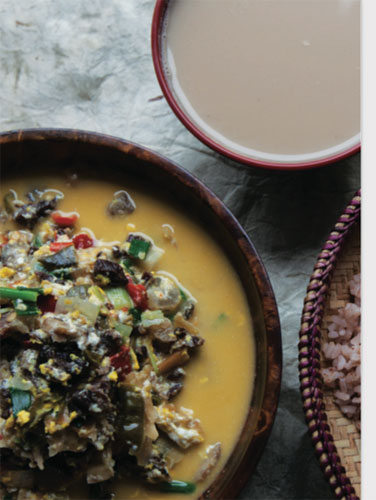
Ingredients
Dried pork – 150g
Dried beef – 150g
2 eggs
1 ball of datse (cheese)
Several spring onion
Dried red chillies/fresh green chillies
2 tbsp oil
Salt
Preparation
Chop meat about half-inch size and cook well with water and oil. Add cheese, chillies, onion and eggs and cook again for about 5 minutes. Mix well and garnish with spring onions. Serve gravy with rice.
Note
This dish can be prepared either dry or with gravy. Chillies can be dried, steamed or fresh. This dish is best enjoyed with rice.
Authentic Bhutanese Cook Book
Buksa Makhu
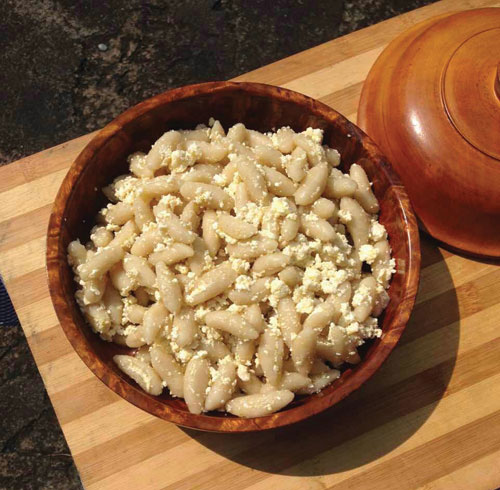
Locally known as Buksa Makhu, it is the Bhutanese version of Pasta. Prepared from fine wheat flour mixed with sugar, it is a special cuisine of the southeastern dzongkhag of Samdrupjongkhar.
Jambuli
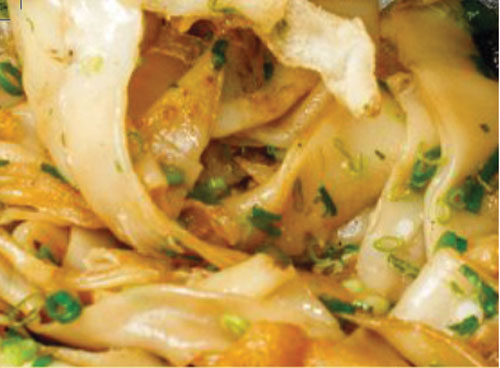
Jambuli or wheat flour noodle is made from wheat flour and is flavoured with a mixture of pepper (thingye) and chillies. It is also considered special cuisine from Bumthang dzongkhag.
Dzongkhags’ specialty list
Thimphu : Shamdray
Paro: Jomja
Has: Hoentoe
Wangle: Nya-Dho-Sem
Punakha: Maykhu
Gasa: Kao-Mar-Ngo
Thongs: Khulay
Bumthang: Puta
Zhemgang: Bum-Pai-Cha (Bamboo shoot)
Sprang: Shel-Roti
Tsirang: Khir and Da-Ka-Ni
Dagga: Thup-Ra-Ro
Lhuentse: Thray-Zan
Monger: O-Ray-To (Bean Rice)
Trashiyangtse: A-ShomThuk-pa
Trashigang: Kha-Rang
Pemagatshel: Yongra-To
S/Jongkhar: Buk-sa Mar-Khu
Chukka: Ema-Kam-Datse
Samtse: Puri Alu-Dham
Thinley Zangmo
- Amici del Bhutan - Italy
- Dettagli
- Scritto da Super User
- Categoria: Archivio 2016
- Visite: 7399
The Raven Crown-History of the symbol of Bhutan’s monarch
In the world of the black birds, the raven (Corvus corax) is the largest; it’s shining black feathers, hoarse voice, and playful nature represent power, mystery, wisdom, and intelligence.
Legon Jarog Donchen an emanation of Mahakala represents the bird in the deity form. As the nation’s protecting deity, the raven is considered so sacred that killing one is more heinous than the murder of a hundred monks. So it is not surprising that the bird’s nests are found on the walls of the monasteries and Dzongs, illustrating the Buddhists’ deep reverence for the raven and its natural elements.
Origin and significance
Bhutan’s Monarchical Crown, designed by the Tibetan “avant-garde” Changchub Tsöngrü (1817-1856), is known as Usa Jaro Dongchen or the Raven-face. Crown because of the Crown’s raven pinnacle. The Crown’s brim is embroidered with motifs of the skull and the Garuda bird. On the bird’s head sit the sun and the moon symbolizing longevity, steadfastness, and enlightenment.
This first version of the Raven Crown was conceived more as a magical helmet than a symbol of royalty. Imbued with the essence of two of the great protector Yeshey Gonpo’s (Mahakala) many forms, namely the linked pair of ‘enemy gods’ (Dralha) called the Northern Demon (Jangdu) and the Raven Headed Mahakala of Action (Legon Jarok Dongchen), it was intended to associate these deities permanently with its wearer.
There was a conscious allusion, surely, to the role played by the Raven Headed Mahakala in the State’s first unification under the founding father, Zhabdrung Ngawang Namgyel (1594-1651). Likewise, the victories which Jigme Namgyel won over his rivals within Bhutan and his success, although temporary, against the British in 1865 are still ascribed to the deity’s powers.
The later crowns, which developed from this prototype, shed their immediate purpose of giving advantage and protection in real conflict, domesticating its symbolism into that of a triumphant royalty.
Back in the olden days, such battle helmets were known as Tschap Jham. These helmets are different from other ordinary helmets because the steel is hidden inside. Several flat pieces of iron are pierced with nine holes that are interlocked; they formed the frame of the helmet. Then several silk scarves known as dhar thoe are woven tightly together to cover the frame.
The frame is then covered with silk and fleece. It was believed to bring powers to the wearer. So Jigme Namgyel wore it in his battles against many rivals within the country and against British who tried unsuccessfully to subdue him.
As stories go, Lam Changchub Tsöngrü is supposed to have selected a black horse for Jigme Namgyel. Wherever he went, the horse would be saddled and led beside Jigme Namgyel. While no one rode the horse, it was believed that the deity Mahakala would be riding it, as evidenced by the animal sweating as if it was carrying a rider.
Jigme Namgyel’s battle helmet was unique and features embroidery depicting three eyes. From records, we know that the Lam blessed the Crown and invoked the special protecting powers of Jangdue and Legon Jarog Dongchen. Over time, it became the unique symbol of authority.
As Mahakala became an important protective deity associated with the country; this particular form too gradually became an important national symbol, especially in times of adversity and external threats. Flags and pennant of the deity were often carried into battle as protective charms.
In his book, History of Bhutan, Lam Pema Tshewang explains the raison d’etre behind choosing the raven head and its design, “The kingdom of Bhutan is a state that upholds the teachings and traditions of Palden Drukpa. The principal protective deities of the Palden Drukpa are Yeshey Gonpo, Lhamo Dudsolma and Laegon Jarog Dongchen. The Crown resembles the face of Laegon Jarog Dongchen.”
Before 1907 the helmet was worn as a part of the regalia for the Trongsa Penlop, a local governor. The battle helmet evolved over time but continued to be the model for all Raven Crowns. The Crown, topped by the head of a raven, became the legacy to his heirs.
The First King, Ugyen Wangchuck (1862-1926) inherited his father’s battle helmet. The first pictures of it were taken during the mission of British Officer Francis Younghusband in 1904, before he became King in 1907.
During this mission, he acted as a mediator between the British and the Tibetans. According to Michael Aris, “The Raven Crown on his head is hidden by a cloth wrapper to protect it from the dust of the journey”. Aris further commented that Ugyen Wangchuck led the Bhutanese to the scared Tibetan city making a grand entrance wearing the Raven Crown.
The First King reinterpreted the Crown by stripping it of its purpose of supernatural protection in battle and turning the symbolism into that of Triumphant Royalty. The Raven Crown worn later by all the Kings of Bhutan as a symbol of the King were modified from the one worn by Jigme Namgyel. However, most of the Crown retained the distinctive raven head, the wrathful eyes of Mahakala, the sun and the moon.
The Designer
In Tibet, Changchub Tsöngrü earned a reputation as the ‘avant-garde’ of the Rime ‘eclectic’ religious movement. In Bhutan, he is more known for his prophesy of Jigme Namgyel’s (1825- 1881) ascension to power. As the main lam or guru of the father of the First King, the lam designed the Jarog Dongchen headgear or the Raven Crown, which has became one of the symbols of monarchy of the country.
The Lam was born in Olka near Gyantse in Upper Tsang in Central Tibet, but died in the Ta Dzong in Trongsa in Bhutan at the age of 39. The Lam was associated with Bhutan from a very young age. He travelled to Bhutan at least six times; Paro being the first place to receive his teachings and then he travelled to Central Bhutan to give teaching there. Changchub Tsöngrü played an important role in the political and religious life of Bhutan in the mid-19th century.
Conclusion
For the Bhutanese, the big black bird with shining feathers, hoarse voice, and playful nature is sacred and is its national bird. More profoundly, it is the symbol of the country’s guardian deity Yeshey Gonpo and the Raven head takes pride of place on top of the King’s Crown. The Raven Crown symbolizes the sacred nature of Bhutanese Kingship.
Desi Jigme Namgyel’s Raven Crown remained in the guardianship of the Wangchuck family. When the Second King died, Mayum Phuntsho Choden Wangchuck became its custodian. Later Mayum offered the national treasure to HRH Ashi Sonam Choden Wangchuck for safekeeping. After having looked after it for several years, in 1975, Ashi Sonam presented it to the National Museum in Paro.
The inventory of the Museum says that it received the Usha or crown of Jigme Namgyel under office order No RPH (B) 4/TS/717 dated 28/8/1975. This priceless piece of history has since been housed at the National Museum in Paro for the general public to view and reflect upon.
Contributed by Tshering Tashi
Amici del Bhutan - Italy
- Dettagli
- Scritto da Super User
- Categoria: Archivio 2016
- Visite: 1920
ALD the top killer disease still
Health: With one death in every two days, alcohol liver disease (ALD) continues to be the top killer disease in the country.
From 1,217 ALD cases in 2005, health centres across the country recorded 3,140 cases in 2014.
Records indicate a steady increase in both ALD cases and deaths since 2005.
In 2005, about 92 deaths were recorded which increased to 176 in 2014. Since 2005, the highest deaths from ALD were recorded in 2011 and 2014 with 169 and 176 deaths respectively.
The Cabinet on December 2 endorsed the National Policy and Strategic Framework To Reduce Harmful Use of Alcohol (2015-2020), four years after work to frame one began in June 2011.
Health officials are optimistic that the comprehensive policy would help reduce alcohol availability, accessibility and affordability.
The policy states that the per capita adult pure alcohol consumption among Bhutanese above 15 years is 8.47 litres higher than the global consumption of 6.2 liters. Drinking among the Bhutanese was not only pervasive but that those who drink consumed alcohol in a hazardous manner.
Although a proper economic analysis of the alcoholic disease and injury burden has not been conducted so far, the cost may be hundreds of millions of ngultrum, the policy states.
The annual hospital treatment cost of alcoholism alone, which represents a fraction of the total burden, was estimated at Nu 29 to 30 million from 2005 to 2009. The policy also states that alcohol consumption and poverty is a reinforcing loop.
Citing the examples of the communities of Lhuentse and Mongar, it states that staple grains are used for producing home-brewed alcohol and problems are compounded by the poor spending their meager cash income on commercially produced alcohol which is becoming popular in the rural areas.
While revenue from the sale of alcohol is substantial, the policy states that alcohol revenues do not compensate for the economic losses incurred as a result of alcohol-related harm, loss of productivity, and premature deaths occurring in our society.
Health ministry’s public health director Dr Pandup Tshering said that the strategies to reduce harmful use of alcohol would focus more on the youth.
While alcoholics will continue to receive treatment from health centres through the existing programmes, Dr Pandup Tshering said that advocacy would be continued to reduce harmful use of alcohol among the population.
“The cost implication on health from ALD is huge,” Dr Pandup Tshering said.
Alcoholic-linked problems
The policy states that the two common sources of alcohol products in Bhutan are homebrewed and industrial distilled alcohol. Among rural people, ara is widely consumed while industrial alcohol is quickly penetrating the rural areas as a consequence of the alcohol industry’s effective marketing and distribution system. While in urban areas, industrial alcohol is the main source, the policy also highlights that alcohol is cheap in Bhutan compared to neighboring countries.
“Over the years domestic production of alcohol has increased along with the alcohol outlets such as wholesale, retail and bars,” the policy states.
There are 5,407 alcohol outlets in the country today or one outlet per 98 Bhutanese (aged 15 and above). “As unlicensed outlets are believed to be ubiquitous in the country, the population per outlet is considerably higher with illegal outlets included in the numerator.”
Thimphu referral hospital has recorded a fourfold increase in admissions for alcohol dependence.
About seven percent of the road accidents in the country are attributed to drink-driving while police records and Thimphu referral hospital’s forensic unit reported an increase of domestic violence cases related to alcohol. However, the police recorded a drop in alcohol related crime in the country by about five percent from 2012 to 2014.
Alcohol is also reported as a contributory factor to homicides in the country. Police report indicates an increasing trend in crime committed by adolescents, mostly under the influence of alcohol in urban areas.
RENEW reports also indicate that 70 percent of perpetrators of domestic violence were committed under the influence of alcohol. Alcoholism, adultery, and domestic violence are also noted as the main reasons for the increasing trend of matrimonial court cases. “A 2014 assessment of a five-year suicide rates from 2009-2013 revealed its association to alcohol use,” states the policy.
The policy also linked alcohol use to teenage pregnancy given the negative effect on negotiation skills and use of contraception. Teenage pregnancy, which is more prevalent among rural women, accounts for 11 percent of all births in Bhutan. About 58 percent of high school students aged 15-20 were sexually active in 2000.
“Alcohol can also aggravate HIV/AIDS epidemic by its negative influence on ability to have safe sex,” states the policy. “The continuing spread of HIV/AIDS can present a serious obstacle to Bhutan’s development as more than 60 percent of the country’s population is less than 25 years of age.”
Kinga Dema
Phobjikha grows South American quinoa
RDC plans to try quinoa adaptability in other parts of the country
Agriculture: Evaluation has found that two varieties of quinoa (chenopodium quinoa wild) in Phobjikha, Wangdue was a success.
Quinoa is a high nutrient grain crop grown primarily for its edible seeds. As a member of the Amaranthaceae family, it is related to and resembles amaranth (Zhimtsi).
Research Development Centre (RDC) Bajo conducted the evaluation as part of the nation-wide test for local adaptability.
Researcher with RDC Bajo, Cheku Dorji, said that because the crop was tried for first time, it was tested at Phobjikha. The crop grows at an altitude of 2,980 metres above sea level.
Quinoa seeds are sown in March and the crop is harvested in November last year, he said. A total of 24 kg seeds were collected for further testing. The seeds were sown uniformly and, at later stage, the plants were thinned to maintain a plant-to-plant spacing of 25 cm. It was observed that there was enough moisture and irrigation was not necessary after sowing.
About 200kg farmyard manure was used to grow the crops and manual hand weeding was done once a month. Due to more rainfall last year, day temperature remained low and affected the plant growth. The crop maturation was delayed by about 80 days.
If the climate remains normal, the crops can grow well, said Cheku Dorji, adding that it may take some time before seeds can be distributed to farmers for enhanced production. “But we are now sure that the two varieties will grow in places sharing same altitude as that of Phobjikha.”
The centre, Cheku Dorji said, is in the process of trying the seeds in other parts of the country. The seeds were brought from South America through Food and Agriculture Organization of the United Nations.
Quinoa is known for its genetic variability, wide adaptability and high nutritional quality. Quinoa is used to make flour, soup, breakfast cereal and alcohol.
Dawa Gyelmo, Wangdue
Amici del Bhutan - Italy