
- Dettagli
- Scritto da Super User
- Categoria: Archivio 2016
- Visite: 2367
Ranked the most equal society
Happiness: Bhutan may be known as the happiest country in the world, but according to a UN happiness report, it is ranked 84 out of 157 countries around the world.
Roughly 3,000 respondents in each country including Bhutan were asked to evaluate their current lives on a scale where 0 represents the worst possible life and 10, the best possible. Bhutanese complained about their quality of life.
Overall, Bhutan scored 5.196 in the “happy index”. The happiest country in the world, Denmark scored 7.526 points.
The report was released yesterday in Rome by the Sustainable Development Solutions Network for the United Nations.
The report comes days ahead of World Happiness Day on March 20.
Bhutan tops the “equality index” with 1.294 points, which means Bhutan is world’s most equal society.
The first World Happiness Report was published in April 2012, in support of the High Level Meeting at the United Nations on happiness and well-being. “Since then, we have come a long way. Increasingly, happiness is considered to be the proper measure of social progress and the goal of public policy,” the report states.
Among the South Asian countries, Bhutan is the happiest country followed by Pakistan (92), Nepal (107), Bangladesh (110), Sri Lanka (117) India (118) and Afghanistan (154).
People who live in the happiest countries have longer life expectancies, more social support and more freedom to make life choices. They have lower corruption incidences and experience more generosity and have a higher gross domestic product per capita.
Only two regions—the Middle East and North Africa, Latin America and the Caribbean— have more unequally distributed happiness.
Differences in social support, incomes and healthy life expectancy are the three most important factors taken for the ranking. “The main innovation in the World Happiness Report Update 2016 is our focus on inequality,” the report states.
According to the report, the year 2015 was a watershed for humanity with the adoption of Sustainable Development Goals (SDGs) by heads of state at a special summit at the United Nations in September 2015, on the 70th anniversary of the UN. Sustainable development is a holistic approach to well-being that calls on societies to pursue economic, social, and environmental objectives in an integrated manner.
The report states many countries in recent years have achieved economic growth at the cost of sharply rising inequality, entrenched social exclusion, and grave damage to the natural environment.
Denmark knocked Switzerland into second place. Denmark and Switzerland were closely followed by Iceland, Norway and Switzerland.
The lowest ranked country included in the survey is Burundi in Africa.
MB Subba
--
Amici del Bhutan - Italy
- Dettagli
- Scritto da Super User
- Categoria: Archivio 2016
- Visite: 1865
Most tour operators and hoteliers witnessed a drop in arrivals this spring
Tourism: If the spring season is an indication of the international tourist arrivals in the country, the tourism industry is not in for a good year with the numbers not encouraging in the first quarter, from January to March.
Most tour operators recorded a drop in international tourist arrivals this spring season while hotels are complaining of low occupancy.
Tourism Council of Bhutan refused to share the arrival figures, but tour operators and hoteliers said that there is not much improvement in arrivals this year compared with the same period last year.
Last year was no better. Despite rigorous marketing and promotional activities, the visit Bhutan year last year recorded a drop in international tourist arrivals. It dropped by about 12 percent with about 51,000 arrivals. In 2014, the country recorded 58,022 international tourists.
A tour operator said spring was not encouraging for his company. “We used to get visitors from Europe in spring but this time, we didn’t,” he said. “As we’ve been marketing the Japanese offer, we expect a slight increase in arrivals during the offer period.”
The ongoing Paro tshechu, according to tour operators, failed to draw tourists unlike the previous years. There were more cancellations from Japanese tourists who have postponed their trip to avail the offer.
“2016 will not be better than last year. There could be a slight increase in arrivals given the Japanese offer but not in terms of yield,” another tour operator said.
Some tour operators attributed the drop this season to the negative feedback by tourists on the road conditions. “We received complaints from our counterpart tour agents to whom tourists complained of the bad road condition from Thimphu to Bumthang,” a tour operator said. “Hopefully international tourist arrivals should pick from 2018 onwards.”
Some tour operators and hoteliers are relying on the Japanese offer that was launched early this year. As part of the offer, Japanese tourists visiting Bhutan during the months of May, June and July will not have to pay the mandatory minimum daily package rate of USD 200 per person. They will only pay the daily royalty of USD 65 per person per night.
The offer is to commemorate 30 years of diplomatic ties between the two countries. The offer includes 50 percent discount on airfare besides discount of up to 50 percent on the hotels.
Hotel Druk’s general manager in Thimphu, Dilu Giri said they recorded a drop in arrivals in the first quarter of this year compared to the previous years. “We are hopeful that the situation will improve by April or May,” Dilu Giri, who is also the vice chairman of Hotel and Restaurant Association of Bhutan, said.
When asked if the Japanese offer would improve occupancy for hotels, Dilu Giri said they are hopeful that the offer would benefit all tourism stakeholders. “Not just hoteliers,” he said.
A Paro hotelier said there was a drop in bookings even for the Paro tshechu. “Business has slowed down this year,” she said, not sure of reasons behind the drop.
Similarly, Guides Association of Bhutan’s (GAB) chairman Garab Dorji said many guides especially the freelancers were not employed this season. During peak seasons, GAB usually arranges freelance guides for tour operators when the demand soars.
“Guides visiting our office have been inquiring about tours,” he said. “Some have not even handled a single group so far.”
Garab Dorji attributed the drop to the Nepal earthquake last year. “As an expensive destination, international tourists have to plan well ahead to visit Bhutan, which they combine with other destinations like Nepal and India.”
Kinga Dema
--
Amici del Bhutan - Italy
- Dettagli
- Scritto da Super User
- Categoria: Archivio 2016
- Visite: 1931
Taking ownership of resources
Villagers of two gewogs in Pemagatshel have submitted a petition to the dzongkhag office. They want the dzongkhag to intervene and stop felling of trees in the catchment area.
If the request is not influenced by any reason other than on environmental grounds, as claimed by the villagers, we have to laud the villagers. If they are aware of the impact of rampant logging on the environment, there is every reason for them to ban the activity.
For those making decisions, it is one of the easiest requests that can be granted. Such a petition could be as scarce as timber at a time when timber is in huge demand and expensive, a result of the rapid economic development. Foresters are monitoring illegal logging and quite often villagers are apprehended for illegal felling trees. Authorities are always on their toes as rural timber subsidy is misused and forest exploited.
Therefore, when such requests come from villagers, it is encouraging.
We have had the good fortune of being a late developer and to learn from others’ mistake when it came to environment conservation. We have strict legislation that protects our resources and the environment, but when economic opportunities clash with the environment, implementing the laws and regulations becomes a challenge.
The best way to protect or to ensure sustainable use of our natural resources is giving or taking ownership of the resources. If people understands the value of the environment and take ownership, it is better than any legislation.
This value is there with our ancestors. When they made people believe that cutting down trees around a lake could enrage the local deity and bring misfortune, it was one way of discouraging people from cutting down trees.
Today, the logic might have changed, but the purpose remains the same. With reports of drying water sources, decreasing water in lakes and water catchment areas coming under threat, taking ownership of local resources is the best solution. It will ensure that the resources are not consumed by one greedy generation and the next pays for it.
It is also an indication that the consistent campaign is having an impact, that people understand the value of a pristine environment and that this is now being converted into action.
A good example is the community forest, where the community takes ownership of the local forest from management to resource sharing. Community forest has become so popular that those after commercial timber are finding that communities own every inch of forest. Across the country, 200 community forests have covered 24,996 hectares of forestland. And this is as of 2009. There are many waiting to be handed over to the community.
The saving grace, however, is the realization that taking ownership of natural resources can benefit communities at large, while the scarce resources is managed sustainably.
Survey to determine elephant population
Wildlife: Asian Elephant (Elephas maximus), the wild giants people revere and forebode as well have long been misery for the farmers south of the country. Yet we do not know how many of them are there in the wild.
Pinning down on number is essential, not only for the formulation of conservation policies, but also to help farmers protect their crops from the marauding quadrupeds.
Good news is the Department of Parks and Services (DoFPS) launched first nationwide elephant survey on March 3 at Singye in Sarpang to mark World Wildlife Day. While International Union for Conservation of Nature estimates that there are about 200-500 elephants in Bhutan, the country lacks its precise population figure. Thus, the survey will help determine the population of Asian elephant in Bhutan.
Park manager of the Royal Manas National Park (RMNP), Tenzin Wangchuk said as of there is no authentic figure on elephant population in Bhutan.
“The main objective of the survey is to determine elephant population in Bhutan,” Tenzin Wangchuk said.
Forestry officials will survey the southern belt from Samtse in the southwest to Jomotsangkha in the southeast, through the protected areas such as RMNP, Phibsoo and Jomotsangkha Wildlife Sanctuaries.
Species conservation and monitoring section senior forestry officer, Sonam Wangdi said forestry official would have begun the study from March 8. “The study is the first systematic survey conducted to determine the population of elephant,” Sonam Wangdi said.
At RMNP, officials are already prepared to venture to the fields. “We have completed grouping, field protocol and logistics arrangements. Some teams are already on their way to the survey areas,” Tenzin Wangchuk said.
The nationwide survey will use dung method, which is considered suitable and efficient technique globally for elephant survey. The technique draws Deoxyribonucleic acid (DNA) from dung to determine the population.
“The animal population can be determined through collection of DNA from as many dung, which tentatively is planned to be sent to Guwahati in India,” Sonam Wangdi said.
Tenzin Wangchuk said that the survey will also enable DoFPS to understand which region of the country has the highest concentration of elephants.
“By understanding the migration pattern, we can mitigate human conflict with elephants,” Tenzin Wangchuk said.
The outcome of the study will also help manage human-wildlife conflict holistically in the long-run without having to fence the animal off Sonam Wangdi said.
The senior forestry official said the survey is also to understand threats to the elephant from developmental activities like road constructions and agricultural expansion.
Earlier, officials found construction of road between Bangtar and Samrang through elephant route unfriendly for the giants. Constructions have created steep slopes, making it difficult for the herd to cross.
“The survey will help reduce such habitat damages through sensitization and awareness programmes to people” Sonam Wangdi said.
DoFPS has also recently GPS collard its fifth elephant from RMNP. This will help department officials to understand the animal’s home range, migration pattern and habitat utilization. So far, two male and three female elephants from Samrang, Sarpang, Phibsoo and RMNP have been radio collared after DoFPS started first collaring in March 2014.
The radio-collaring programme will also help officials understand whether the elephant is completely dependent on agricultural crops.
Sonam Wangdi said elephants in Bhutan suffer no threats from poaching. But habitat loss due to developmental activities and electrocution are two serious threats to elephants in Bhutan.
“So, electric fence is given to the communities sharing habitat with elephant in order that no live current is used to fence their farms, which could risk the lives of elephants,” Sonam Wangdi said.
Hotels in Bumthang goes meatless on auspicious months
Some 70 hotels and eateries in Bumthang have offered meatless menu since the first month of the Bhutanese calendar.
In June last year, members of the Bumthang Hotel Association concurred on the move of not serving meat meals to guests during auspicious months of the Bhutanese Calendar. First and fourth months are auspicious months.
According to the President of Bumthang Family Run Hotel Association, Pema Dawa, this initiative has helped hoteliers in reducing wasteful expenditure as they need not have to buy meat in bulk. Furthermore, the president said it will save lives of animals.
Some hotel owners said at first, customers asked for meat items but eventually they were fine with the no meat menu.
Meanwhile, Bumthang’s representative for Bhutan Chamber of Commerce and Industry, Ugyen Sangay added that hoteliers have unanimously agreed and signed a petition to not to serve meat items. Bumthang’s Thromde Thuemi, Karma Lekden also shared till date, none of the hotel owners have disliked the initiative.
Other than hotels and eateries, the Dzongkhag Administration has refrained from serving meat at official congregations and events. Few years ago, the government banned the sale of meat products during the auspicious months in the country. But, hotels and restaurants were allowed to serve meat products.
--
Amici del Bhutan - Italy
- Dettagli
- Scritto da Super User
- Categoria: Archivio 2016
- Visite: 1793
PELING TSHECHU
Dedicated to His Royal Highness The Gyalsey.
Date: 2nd to 4th May 2016
Venue: Kuenselphodrang, Thimphu.
Sacred dances from all Pema Lingpa traditions in the country will be performed by over 200 dancers for the first time in Thimphu.
All are Welcome!!!
--
Ass. Amici del Bhutan - Italy
- Dettagli
- Scritto da Super User
- Categoria: Archivio 2016
- Visite: 1951
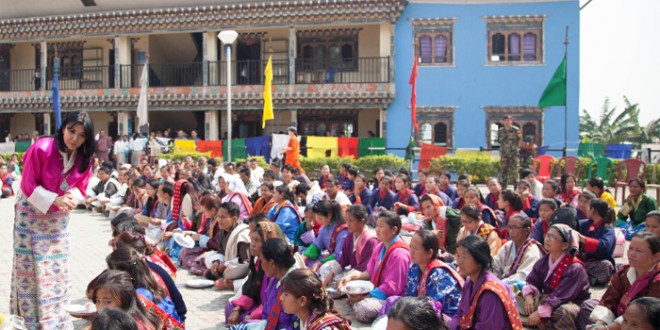
Her Majesty Gyalyum Sangay Choden Wangchuck interacts with the people of Sampheling gewog at Chumigthang MSS, Phuentsholing
Teach your sons to respect women: HM Gyalyum
HM Gyalyum Sangay Choden Wangchuck joins students of P/Ling to observe IMD
IWD: Observing the International Women’s Day (IWD) yesterday, Her Majesty Gyalyum Sangay Choden Wangchuck underlined the importance of parental roles and country’s HIV status to the student crowd Chumigthang Middle Secondary School and villagers of Sampheling gewog, Phuentsholing.
Her Majesty said that parents have greater responsibility to teach their sons to respect women.
“Fathers are role models sons look up to,” she said. “It is your duty to show and tell your sons that a woman deserves respect and love and should never be abused.”
Young boys must understand that if they are more powerful or stronger, they have the responsibility to protect those who are weaker and not abuse them, said Her Majesty.
IWD is observed globally to encourage greater women’s participation, contribution in all development spheres.
Her Majesty said that a total of 480 people have been detected with HIV positive in the country.
“Many more remain undetected in our communities, who may be unwittingly spreading the virus,” she said. “The epidemic continues to outpace national response and numbers continue to rise.”
Her Majesty urged health ministry and other relevant agencies to accelerate their responses to control the spread of HIV in the country.
Her Majesty said that Bhutanese women are fortunate and enjoy a greater degree of freedom and equality compared to women in many countries.
“Our Kings have always given the highest priority to women and children’s development, their health, and well-being,” said Her Majesty.
Her Majesty also highlighted violence against women. Despite collective measures to prevent, protect, and assist victims, violence against women is prevalent in the country.
“The number of cases of sexual and gender-based violence is increasing year after year and is a growing national concern,” said Her Majesty. “Unfortunately, children are often caught up in the midst of these situations. They are either witness to, or experiencing some kind of domestic or sexual violence each year.”
UN System’s resident coordinator, Chirstina Carlson, expressed her appreciation for the government’s efforts to promote gender equality in the country.
“Prime Minister was among those who pledged to STEP IT UP and committed to end discrimination against women by 2030 and announced concrete and measurable actions to kick-start rapid change in their countries,” she said.
Chirstina Carlson said that Prime Minister has pledged that the government will increase representation of women in governance and decision-making at all levels and strengthen targeted programmes for the economic empowerment of women.
“Spread the word among your friends and family that violence against women and girls at home or anywhere else should not be tolerated,” said Chirstina Carlson. “When mothers, sisters, aunts and other women are empowered to pursue a future of their choosing, this promotes a stronger and healthier society.”
Lyonpo Dorji Choden, who is also the chairman of the National Commission for Women and Children, highlighted issues related to domestic violence, rape cases, early marriages, and divorce. She said that all should work together to reduce and eradicate such problems.
Gender equality and full enjoyment of human rights remain elusive for millions of girls. Nearly 14 million children are forced into marriage every year — 37,000 girls being denied their fundamental human rights every single day.
Every day, 7.3 million babies in developing countries are born to mothers who are 17 or younger. One in three women are subject to gender-based violence, and 200 million women and girls alive today have undergone female genital mutilation.
Rajesh Rai, Phuentsholing
The high cost of connecting Bhutan’s remotest gewogs
Establishing a community centre in these gewogs could cost at least Nu 8 million each
Community: The establishment of community centres in five remaining gewogs may not be possible given high costs, it was pointed out by the Department of Information Technology and Telecom during its mid-term review (MTR) held last month.
The five gewogs are Soe, Naro, and Lingzhi in Thimphu, and Laya and Lunana in Gasa.
The department recommended three options: that the government approve additional funds for the establishment of centres in the five gewogs, provide the gewogs with public services through mobile connectivity, or reduce the target to 200 gewogs.
The government plans to establish a centre in each of Bhutan’s 205 gewogs.
Of the five gewogs, only Laya is connected with electricity while the remaining are off-grid.
The average cost to construct a community centre that is connected to a motor road is around Nu 2 million. As the four off-grid gewogs are not connected by motor road, the construction cost is expected to double to around Nu 4 million.
“We can’t really say what would be the actual cost of construction in these gewogs until we get the estimate from the dzongkhag but our assumption would be double the estimate from the past only for the construction,” said Department of Information Technology and Telecom ICT officer, Jamyang Sonam.
As the community centres are off-grid, a power source would also have to be provided. One of the options being considered is solar energy.
Information and communication secretary, Dasho Kinley Dorji said that the cost of providing solar energy equipment to the off-grid centres would be around Nu 4 million each. This would mean that the total cost of one centre would be around Nu 8 million. This excludes costs associated with equipment and last mile wireless technology.
“We are exploring alternatives for the community centres, draft proposal providing laptop and printer with alternative power generator or solar which ever is cheaper, in these gewogs,” Jamyang Sonam said. He added that DITT is also exploring two technologies, VSAT, which is a satellite communications system, and radio, to connect the off-grid gewogs with internet.
Dasho Kinley Dorji said that most community centres were not economically viable but that the four off-grid ones are basically unaffordable. He added that the communities that would be served by the four centres are also very small.
Lingzhi, the remotest gewog in Thimphu is connected by a mule track and has a population of 495, followed by Naro with 189, and Soe with 183. There are a total of 174 households and 41 villages in the three gewogs.
In Lunana, an eight-day walk from Gasa dzong, the population is around 705, with 155 households. Laya has a population of 1,200 and 149 households.
Dasho Kinley Dorji added that the four gewogs would not be dropped completely from the plan and that once electricity reaches, community centres could be provided.
DITT is hoping to establish a community centre in Laya by next year.
“The fund for the construction of a CC in Laya gewog has been proposed in next fiscal year and hopefully we can start the construction work in the beginning of next fiscal year,” Jamyang Sonam said.
However, there may be some hope for the three off-grid gewogs in Thimphu. Thimphu dzongdag, Dasho Tshewang Rinzin, said that work is ongoing to connect the four gewogs with electricity. He said that the effort may take a year.
Currently, to ease the burden of obtaining public services by residents of the three gewogs, applications are collected by the gewog and brought down to the nearest point connected to the internet.
Gyalsten K Dorji
--
Amici del Bhutan - Italy