
- Dettagli
- Scritto da Super User
- Categoria: Archivio 2016
- Visite: 2057
Tshering Dema, Thimphu
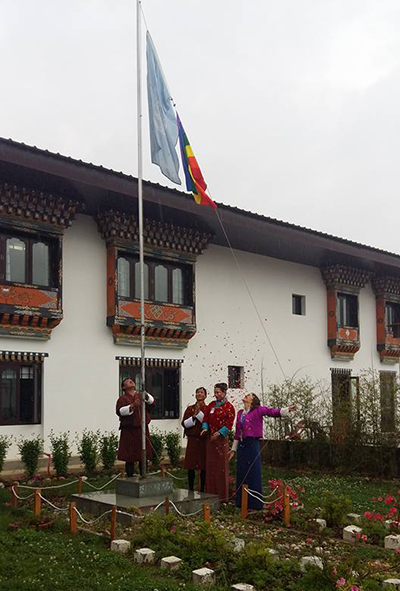
A rainbow flag, an icon for Lesbian, Gay, Bisexual, and Transgender (LGBT) rights was flown in the country for the first time, today.
The flag, commonly known as LGBT pride, went up at the UN House in Thimphu as the LGBT community observed the International Day against Homophobia, Transphobia and Biphobia.
Chimi, who came out as transgender seven months ago, said he couldn’t sleep out of excitement, last night. “This is my first time celebrating me being me, publicly.”
Chimi was bullied for being a transgender, throughout. “After I came out on BBS TV, things changed for me.”
Many lesbian, gay, bisexual and transgender are making their identity known in the country
From eight in 2014, the number has increased to 36 now.
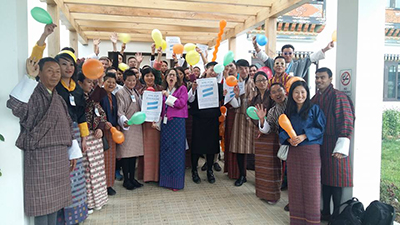
They say discrimination against the LGBT community has lessened in the country making it easier for them to be who they are.
The first transgender to reveal her identity in 2008, Dechen Shelden said she now feels less discriminated.
“The situation was different during my time. There was a lot of discrimination.”
Dechen Shelden said advocacy and awareness programme has made Bhutan more aware of LGBT.
“Coming out of the closet is just a personal choice. And, we have to choose what makes us happy,” said Passang Dorji, who came out as gay, last year. “For me, this is my happiest moment as I am celebrating my one year of coming out.”
They have formed a LGBT community under a Civil Society Organisation, Lhak-sam.
--
Amici del Bhutan - Italy
- Dettagli
- Scritto da Super User
- Categoria: Archivio 2016
- Visite: 1782
Kuensel reporter Tshering Palden spoke with the US Ambassador to India Richard Rahul Verma on his second visit to Bhutan in two years. Excerpts of the interview.
Q&A: What is the purpose of your visit?
It is good to be in Bhutan. As you probably know we administer some programmes from the embassy in New Delhi in the areas of education, clean energy and cultural preservation. It is good to come back from time to time and see how we are doing and what we can do more. To meet with the government leaders and people here and learn about what is happening and how we can work together in the future. So that was really the purpose of the visit.
We had a terrific visit with His Majesty The King and the Fourth King and with the Prime Minister.
What were some of the pertinent discussions you had with our leaders?
We were talking about what is happening with the US and our policy in Asia. How our Act East rebalance policy is going with our collaboration with India and the bilateral relationship. We talked about some of the programmes we are doing here and how we can do more. So we talked about our Fulbright Programme for example, our educational exchanges, work in renewal and clean energy, specifically on hydro and what we could do in this area. The discussions were on how do we deepen our relationship across a range of areas.
We are also here to thank Bhutan on its leadership on climate, conservation and the strong signal it sent at the Paris Convention.
Tell us more about the education exchanges?
We have certain number of faculty and student exchange programmes. We also have something called the international visitor leadership programme (IVLP). So we would like to do more in each of those areas. We think this notion of academic exchange is really important because we get to learn a lot from the people of Bhutan. Bhutanese, whether it is government officials going as part of the programme or young people going to study I think that it will benefit not only for those people but also for us as well.
How do you see Bhutan’s journey with democracy so far?
Well this is what we have also been saying to the Prime Minister and government officials. In the past we worked on a parliamentary training programme so we have been talking about other ways that we can work together again. These are technical in nature where in other countries we help build the capacity of lawmakers or institutions. We have been so happy to be a partner and to see the progress that has been made. We have been working on this for 275 years so democracies are so critical to the people and we want to do what we can to help Bhutan.
What can Bhutan learn from US democracy?
I think we can learn from each other. Every country is different and you can adapt your democracy to the demands of the people. It has been interesting to learn that the Prime Minister has been all over the country meeting people to make sure that democracy delivers. That is an important message whether in Washington, here, or somewhere else.
What do you think of initiatives in addressing climate change?
We look at Bhutan as an example. What you have done for conservation, the commitments made to reduce carbon outputs and use of advanced technology. When you use hydropower you do it in a way that does not have a huge impact on the rivers so we can all learn from that. We are really grateful to His Majesty The King and The Fourth King for setting such an example on environmental protection and being great stewards of the environment.
Most people outside think of Bhutan as a happy country. What is your view?
I think that the fact that the US had the highest number of tourists coming in for the last several years reflects a strong interest in the American people to come here and learn about Gross National Happiness. Bhutan has again made an example that gross domestic product is one measurement that a lot of countries use but one has to take a look at all the factors. Again there we can learn a lot from what you are doing in Bhutan.
--
Amici del Bhutan - Italy
- Dettagli
- Scritto da Super User
- Categoria: Archivio 2016
- Visite: 2525
A significant number of cases have ben detected since 1997.
Health: Although Bhutan achieved the leprosy elimination phase in 1997, a significant number of new cases detected over the years has left health officials worried.
This year from January until May, the Gidakom hospital recorded seven new cases of leprosy. Of the five new cases, one female and four males were reported from Pemagatshel, Punakha, Sarpang and Gasa. The youngest patient was aged 24 while the oldest was 54. All the cases are in multi-bacillary (MB) stage.
Gidakom hospital also serves as the national leprosy and rehabilitation centre. Records with the hospital show 59 leprosy cases were treated from 2013 to 2015. There are 15 cases on treatment currently.
Gidakom hospital’s chief medical officer Dr Chencho Dorji said that although Bhutan has achieved the elimination phase, the number of new cases detected to date is a concern.
Health officials said leprosy patients are provided Multi-drug Treatment (MDT), which is the only chemotherapy that kills the bacilli. A high proportion of bacilli are killed within a few days after initiation of the treatment.
“MDT contains a combination of three drugs. The treatment with MDT is very effective,” he said. Multi-bacillary patients are treated for 12 months and pauci-bacillary (PB) patients are treated for six months.
There are 130 cases under surveillance as of 2015. Health officials said that the duration for surveillance for PB leprosy is four years and 10 years for MB leprosy.
At total population of 720,679, leprosy prevalence rate today stands at 0.29 per 100,000. In 2011, it stood at 0.40 per 100,000.
Dr Chencho Dorji said the deformity rate has shown an increasing trend, which is worrying as it indicates delay in case detection. “The patients are presenting with a high bacilli load, which indicates that it’s highly infectious and therefore must have been spreading in the community,” he said.
Challenges
Stigma associated with leprosy in the community, according to health officials, prevents the patients from seeking health care. They said patients conceal positive family history to the health workers in most cases.
Health officials agree that even today leprosy is often overlooked clinically and is diagnosed as a skin disease in the early stages.
Dr Chencho Dorji said that many health workers and people are of the impression that leprosy is completely eradicated, which is a distant dream given the fact that more MB leprosy cases are diagnosed.
Patient carrying many leprosy bacilli are called multi-bacillary patients and they are the main source of infection. Since incubation period for leprosy can be as long as 30 years, he said Bhutan will still continue to have a few cases of leprosy even after 30 years from now regardless of the country’s developmental status.
“We need more awareness on the disease to general public,” he said. “The social consequences for those affected with leprosy and for their families is devastating,” he said.
Health ministry’s programme officer for national leprosy control programme, Dorji Khandu said that of the various programmes to combat leprosy, the focus is on awareness programmes at the district level. The programme is also encouraging people with leprosy symptoms to come forward.
“We also conduct focus survey in places where the new cases are detected besides contact tracing of family members,” he said. “Training programmes for health officials are also being continued.”
Causes and symptoms
Health officials said that leprosy is a chronic infection of the skin and peripheral nerves caused by the obligate intracellular bacterium, mycobacterium leprae, also known as “Hansen’s Bacillus”. Similar to Tuberculosis, leprosy bacilli are mainly transmitted through infectious droplets that are spread by an infectious individual through coughing and sneezing.
Symptoms include pale or reddish patches on the skin with lost or impaired sensation for heat, cold, fine touch and pain on pinprick besides numbness or tingling and weakness of hands and feet, and painless ulcers in the soles and palms.
The World Health Organisation states that leprosy was recognised in the ancient civilisations of China, Egypt and India with afflicted people often ostracised by their communities and families.
The first breakthrough occurred in the 1940s with the development of the drug dapsone. The duration of the treatment was many years, often a lifetime, making it difficult for patients to adhere to it. In the 1960s, M leprae started to develop resistance to dapsone, the world’s only known anti-leprosy drug at that time. In the early 1960s, rifampicin and clofazimin were discovered and subsequently added to the treatment regimen, which was later labelled as MDT. haal veel meer winst uit pinocasino nederland met een welkomstbonus
Kinga Dema
--
Associazione Amici del Bhutan - Italy
- Dettagli
- Scritto da Super User
- Categoria: Archivio 2016
- Visite: 2114
Labour ministry looking into Qatar case
Bhutan’s embassy in Kuwait is also involved in finding out why the Bhutanese employees in Qatar have not been paid
Employment: A joint team from the labour ministry and the Royal Bhutan Embassy (RBE) in Kuwait could leave for Qatar shortly to address the issue of the unpaid Bhutanese employees.
At least 50 Bhutanese are currently working at the Quality Hyper Market in Qatar.
On May 9, one of the employees in Qatar wrote to the ministry about their problems with the company.
In the employee’s letter to the ministry it is alleged that false assurances were provided by the Bhutanese agent, Global Recruitment Overseas Employment Agent, prior to them being sent to Qatar.
The agent sent 67 Bhutanese between July 2013 to March this year. Another Bhutanese agent, Employ Bhutan Overseas Agent, sent 10 Bhutanese to Qatar, of which some are working at the Quality Hyper Market, during the same period.
Оформлення https://textessay.com/pozika-pid-0-vidsotkiv/ відкриває доступ до фінансів без будь-яких націнок, адже відсоткова ставка дорівнює нулю. Це чудовий вибір для тих, хто вперше користується онлайн-кредитами і хоче отримати досвід без додаткових витрат. Простота умов та швидкість оформлення роблять таку позику дуже популярною серед позичальників.
Issues related to food and accommodation as a result of the delay in salary are also mentioned.
As the Global Recruitment Overseas Employment Agent is currently under suspension, the ministry is taking the responsibility to investigate the case and consider other possible placements for the Bhutanese workers in Qatar.
The ministry has requested the embassy in Kuwait to help gather more information on the issue.
One of the Bhutanese working at the Quality Hyper Market, Pema Wangchuk, said that an official from the embassy had asked for their phone number. “A few of our friends including myself have given our numbers but there was no call or any response after that,” he said.
Pema Wangchuk said that the company is aware about their comments to the Bhutanese media and fears that very soon they might have to face consequences.
“A Bhutanese who works in the human resource department in the same company told us that the management keeps discussing our complaints to the Bhutanese media,” said Pema Wangchuk. “Soon we’ll be called and made to answer for our actions,” he added. “In worst case scenario, we might also face similar consequences like our Nepalese friends who were terminated for raising questions regarding their salaries.”
Для тих, хто шукає нові можливості, варто звернути увагу на нові МФО України. Такі компанії виходять на ринок із привабливими умовами для клієнтів: знижені відсоткові ставки, бонуси для новачків, а часто й перші позики без переплат. Це гарний шанс отримати вигідний кредит, оцінити рівень сервісу та скористатися конкуренцією між фінансовими організаціями на свою користь.
They are also looking at several new initiatives such as comprehensive medical insurance policy, developing closer contacts with law enforcement agencies, embassies, consulates, and employers of the host country. The ministry is also identifying focal persons to look after the welfare of Bhutanese workers in places where Bhutan does not have missions or embassies.
Younten Tshedup
--
AMICI DEL BHUTAN - ITALY