
- Dettagli
- Scritto da Super User
- Categoria: Archivio 2016
- Visite: 2068
More than just bark
Passang, Thimphu
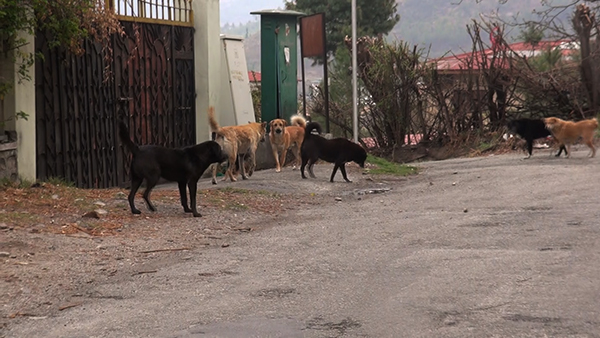
Stray dogs are not just nuisance to the tourists and are bothering locals but causing a significant dent in the government’s coffer. The JDWNR Hospital has treated more than 700 people, amounting to Nu 500,000, for dog bites from Thimphu, this year alone.
The number of strays in the country was expected to go down after a mass sterilisation.
The national survey conducted in 2015 says an average of over 70 percent sterilisation and vaccination coverage has been achieved across Bhutan.
“After castration, the number won’t drastically go down at once because we are operating not eliminating. So it will take time,” said Dr. Kinley Dorji of Thimphu Veterinary Hospital.
He said on an average, lifespan of dogs are 12 years. But some live more than 20 years, depending on the race. “So, when castrated dogs die after reaching their lifespan, then only the number will come down.”
A resident of Thimphu, Kala Tshering said mass sterilization of stray dogs may not have worked. He said they must have missed many dogs. “Even if they miss one, it will bear a litter of eight to nine puppies.”
He said they cannot go for a walk in the evening for the fear of stray dogs biting them. “It is worst at night. They gang up and fight causing us to lose sleep. They even get inside our house.”
Is our law criminalising youth?
Kuenga Tashi, Phuentshogling
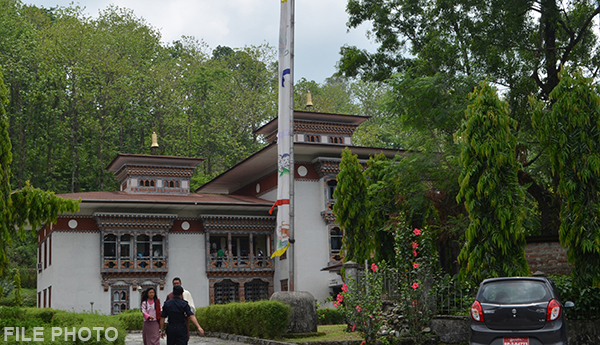
Many youth say the amended Narcotic Drugs, Psychotic Substance and Substance Abuse Act, instead of helping, is criminalising them.
Of the 119 drug related cases recorded last year in Phuentshogling, majority were of 18-25 years.
A youth in Phuentshogling, Subash said his classmate, who was a topper and suffered from drug-addiction, got terminated from school.
“Instead of rehabilitating, he was put into jail and treated him as criminal. Now, I see him loitering in the town asking money for drugs.” Subash said whenever he sees him, he wonders how he could have helped and how the society could have helped him.
Possessing seven grams of cannabis/hashish can imprison a person for one to three years for illegal possession while two grams of cocaine can attract a minimum sentence of five to nine years.
Instead of criminalising a youth suffering from addiction, another youth in Phuentshogling, Kinley said a society should make use to technology to help them
One of the Drangpons said although the punishment is severe it has not deterred youth from indulging in illicit abuse or trafficking drugs.
He also said as a public officer working for the court of law, they only interpret and convict those involved as per the law.
On the other hand, Bhutan Narcotics Control Authority’s Director General, Phuntsho Wangdi said Bhutanese law is not stringent as compared to other countries.
“Ours’ is more on the lenient side. Nevertheless, if we don’t have a strong law, there is a risk of the country being flooded with people carrying out drug business and a number of people getting into drug addiction.”
But, he said people who suffer from addiction are not criminalised.
“I wouldn’t say our prisons are flooded with youth who are into drugs. In fact, youth who are into addiction are all given the opportunity to treat themselves. They are detained but they are not imprisoned. Even the court gives them the opportunity to treat.”
He said if they undergo treatment successfully, they are not criminalised. “The ones who are caught and imprisoned would be the ones charged and convicted for drug related trafficking cases and illicit trafficking.”
Most the 29 arrested for drug related cases in Phuentsholing this year are between 18-25 years old.
--
Association Loi 1901 fondée 1987
www.amisdubhoutan.fr
www.amisdubhoutan.net
www.amisdubhoutan.org
- Dettagli
- Scritto da Super User
- Categoria: Archivio 2016
- Visite: 1723
Enjoy
--
AMICI DEL BHUTAN - ITALY
- Dettagli
- Scritto da Super User
- Categoria: Archivio 2016
- Visite: 1949
Kuensel
Duke and Duchess of Cambridge arrive today
Royal visit: At the invitation of His Majesty The King, the Duke and Duchess of Cambridge, His Royal Highness Prince William and Kate Middleton arrive today for a two-day visit.
Her Royal Highness Princess Chimi Yangzom Wangchuck will receive Their Royal Highnesses at Paro airport.
They will be welcomed with a Chipdrel traditional ceremonial procession at Tashichhodzong where Their Royal Highnesses will receive an audience with His Majesty The King.
The Royal Couple will also witness traditional games at Changlimithang later today.
His Majesty The King and Her Majesty The Gyaltsuen will also host a private dinner in Their honour at the Lingkana Palace.
The two Royal Families represent the past, the present and also the future as both the Royal Couples are parents.
“That’s the continuity and for Bhutan that continuity means survival into the future,” information and communications secretary, Dasho Kinley Dorji said. “The Royal Families are the most powerful ambassadors of the country,” he added. “Even culturally they become the proponents of cultural identity.”
“Both the Royal Couples are charismatic well known figures around the world,” Dasho Kinley Dorji said. “For Bhutan the story of the Royal visit transcends all the glamour.”
“As new parents the Duke and Duchess of Cambridge will no doubt be very happy to meet another new baby HRH The Gyalsey,” the British Honorary Consul, Michael Rutland said.
“The Royal Couples will have a great deal to talk about ranging from parenthood to the environment,” he said.
“The Royal Couples have the great gift of being able to interact warmly and sympathetically with their peoples,” he added.
“The Duchess is concerned with the welfare of children with both mental and physical disabilities and will be delighted to meet children from the Draktsho Centre and Ability Bhutan Society,” Michael Rutland also said. “She is the patron of a charity called Place2Be, which provides counselling services to young people with problems.”
Her Majesty The Gyaltsuen is the patron of Ability Bhutan Society and shares the same concerns and is actively engaged in other charity and conservation works.
While His Majesty The King travels to every nook and corner of the country to improve the welfare of the citizens, the Duke of Cambridge Prince William is a search and rescue pilot who saves lives.
Both the Royal Families have been strong proponents of the environment as well.
Bhutan’s constitutional monarchy system shares the same structural format as the British Westminster democracy.
More than 70 foreign media, the majority of them from the United Kingdom, are accompanying the Royal Couple.
The visit is expected to help tourism in Bhutan with publicity for the country as a holiday destination and add to the international image of the country.
The visit is also expected to have a positive effect on the image of the country on the official and diplomatic levels.
“It will, we hope, form the beginning of a personal friendship between the present King and Queen of Bhutan and the future King and Queen of the United Kingdom,” Michael Rutland said.
The visit also cements a long-running relationship between the two countries and the Royal Families.
A long relationship
The connection between the Royal Families of the two countries began with the awarding of the Knight Commander of the Indian Empire to the first King of Bhutan, Gongsar Ugyen Wangchuck and the Knight Commander of the Star of India to His Majesty the second King of Bhutan, Jigme Wangchuck.
The awards were high marks of recognition and respect from the United Kingdom to Bhutan in the person of Their Majesties, said Michael Rutland. “It represented the excellent relationship between the two kingdoms after the creation of monarchy in Bhutan,” he added.
That relationship continued with frequent visits by British Royal Family members to Bhutan.
The Prince of Wales, Prince Charles visited Bhutan in 1998 and walked halfway up to the Tiger’s nest, Taktshang. His son and wife will walk all the way to the monastery.
Princess Michael of Kent visited Bhutan on a private holiday, and Prince Andrew the Duke of York visited the country in 2010 at the invitation of the His Majesty The King.
His Majesty The King and The Gyaltsuen visited HRH The Prince of Wales and the Duchess of Cornwall three years ago and took tea with them in Clarence House.
His Majesty The King then invited Prince William and the Duchess of Cambridge to visit Bhutan.
His Majesty The Fourth Druk Gyalpo studied for a year at a school in the United Kingdom.
His Majesty The King studied three years at Magdalen College, University of Oxford.
HRH Prince Jigyel Ugyen Wangchuck graduated from St Peter’s College Oxford University and HRH Prince Khamsum Singye Wangchuck graduated from the Royal Military Academy Sandhurst, England.
The third King spent a short time in Scotland for informal studies.
The British High Commissioner to India Sir Dominic Asquith and other senior officials of the British High Commission in New Delhi are accompanying Their Royal Highnesses.
Tshering Palden
If you want to see photos of the visit, go to the Facebook page of Les amis du Bhoutan
- Dettagli
- Scritto da Super User
- Categoria: Archivio 2016
- Visite: 1768
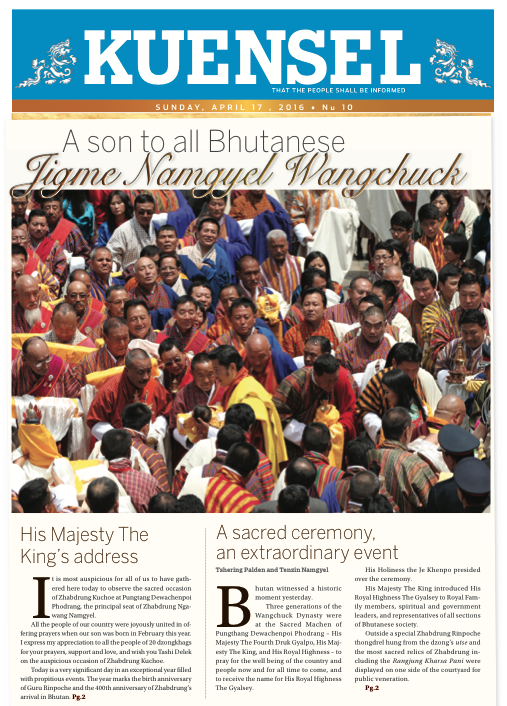
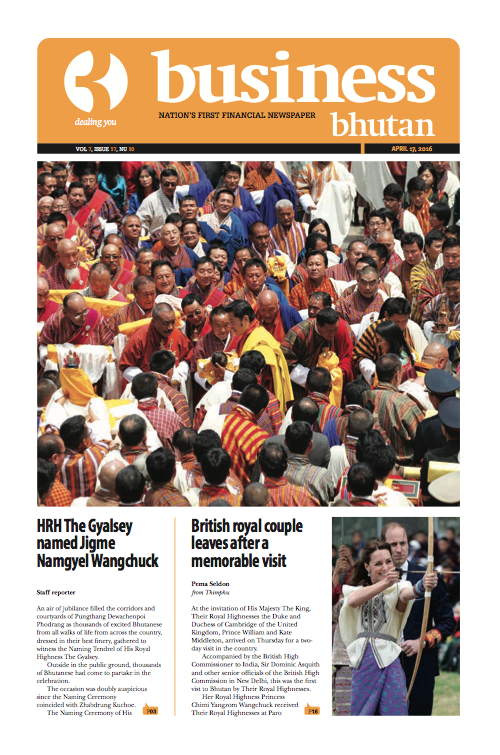
Speciale edizione sulla cerimonia di attribuzione del nome all'erede al trono del Bhutan e sulla visita di William e Kate d'Inghilterra.
Amici del Bhutan - Italy
zie je geld meteen verschijnen in casino princess uitbetaling na verzoek
- Dettagli
- Scritto da Super User
- Categoria: Archivio 2016
- Visite: 1804
Sonam Choden, Thimphu
Some children, as young as 12 years old, are compelled to do hard labour, not just to earn a living for them, but also to support their families.
A labour force survey 2011, found 4,400 Bhutanese children aged 13 to 17 years working outside their homes.
Another survey conducted in 2013 found 7,304 people between 15-19 involved in different vocations. However, the report says it is difficult to to know how many fall in the age group of 15-18 years.
Purna Bahadur Tamang left his home to fend for his mother and four siblings when he was a mere 12-year-old child. He began working as a waiter in a restaurant.
Now at 17, he works as a mechanic at one of the workshops in Thimphu.
“I have to work to pay the expenses of my siblings. When I grow up, I want my mother to quit her Job in the National workforce. If I can, I want to become an entrepreneur and open my own workshop.”
He said his father died when he was young and that he will do whatever he can to help his family. He earns a meagre salary of Nu 5,000, a month.
Like Purna, there are about eight, below the age of 18, working in various workshops in Thimphu.
The Labour and Employment Act of Bhutan 2007 do not specifically categorise children working in workshops as child labour.
However, officials at the labour ministry said underage children working as mechanics in workshops fall under child labour.
If found flouting the rule, an employer will be fined a minimum of Nu 11,250, states Regulations on Acceptable Forms of Child Labour.
--
Amici del Bhutan - Italy