
- Dettagli
- Scritto da Super User
- Categoria: Archivio 2016
- Visite: 2884
Surjaman Thapa, Trongsa
Powerful sound waves and tremors, originating from blasting carried out to widen East-West Highway, could damage the centuries-old Trongsa Dzong, locals fear.
Locals residing nearby say deafening sounds from the blasts that echoes throughout the valley every night could cause irreparable damage to their historical fortress.
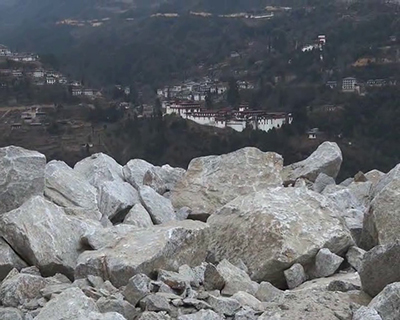
The highway’s widening is underway at a place called viewpoint; where travelers and tourists stop to admire the age-old fortress from.
It provides a clear view of the dzong, which is on the other side, about 500 metres away; measured in a straight-line.
The local residents say the sound from the blasts is jarring and that they are kept awake throughout the night sometimes.
“We feel the strong vibration and fear that our houses might just collapse on us,” said a resident, Lemo.
“I stay in Sherubling and I can still hear the sound and feel the vibration from the blasts,” said another local, Karma. Sherubling is about is about 13 kilometres away from the viewpoint.
Another local resident, Dendup Passang said blasting activities being carried out these days is manifold compared to 2013 and that the repercussion could be double.
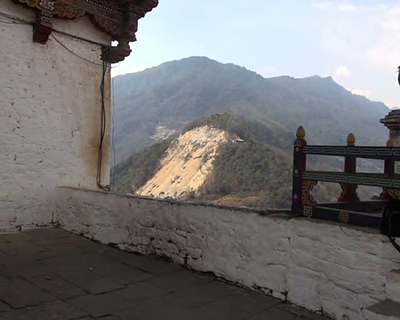
Just like Dendup, the fear among many locals stems from a similar experience in 2013 when the historical fortress had sustained hairline cracks on its wall.
The studies were carried out could not conclude the cause. The locals had suspected the cause to be blasting from the construction of Mangdechhu Hydropower Project’s dam.
MHPA had later approved over Nu 30 M as their social corporate responsibility to renovate the Dzong.
Thromde Thuemi, Pema Letho said they were told the blasting is being controlled. “I don’t think so.” He also said unlike before, the local residents aren’t making an issue out of it.
Recently, the Trongsa Dzongkhag Administration had met with the contractor, Gyalcon Infra Private Limited, responsible for the widening work. The administration had advised the contractor to carry out controlled blasting.
“This is a government project and we have to break through. But we are doing controlled blasting,” said the Project Manager, Ugyen Dorji.
He explained during a controlled blasting they use only three emuldine, that is ammonium nitrate, instead of 11. Likewise, he also said they have also reduced the number of holes being drilled.
“Each hole produces sound. So by reducing the holes we are also reducing the sound waves so that the impact is very less.”
It has been about two months since the cutting of a 100-metres rock began at the viewpoint and about complete.
Ugyen Dorji said they could have finished the work in about a month’s time had it not been for controlled blasting.
--
Amici del Bhutan - Italy
- Dettagli
- Scritto da Super User
- Categoria: Archivio 2016
- Visite: 1959
With 18 national and a few days in every dzongkhas, Bhutan is among the top holiday lovers
Holiday: March heralds the season of cheerfulness, warmth and beauty. There is a lot to look forward to, except perhaps public holidays – it is one of the two months in 2016 without a single holiday.
But there is nothing to feel sad about. Those working in the government and public offices have had a holiday-filled February. And there are plenty more in the calendar coming.
There are plenty of government holidays in Bhutan. Although not featured in the list of countries with most public holidays, with 18 government holidays, Bhutan hits among the top five. The number goes to 23 days depending on where you live and work.
With every dzongkhag celebrating tshechu for three days and some taking rest during the first snowfall, thick or thin, public holiday average 22 days in all the dzongkhags. In 2015, there were 23 public holidays in the capital city, including those that fell on the weekends.
In the same year, civil servants and public corporation employees worked for only 318 days after subtracting the 24 Saturdays and Sundays and excluding the casual and earned leave employees are entitled to.
There were two long weekends: one in February (five days) and another in September (six days in Thimphu during the tshechu). March and August were the only months without any public holiday.
This year, there are 24 public holidays, including the holiday during the Thromde elections in January. If Dassain on November 11 fell on another day, it would be 24 days and, if the Nyilo and National Day dates were not on weekends, the number would increase to 27 days in a year.
In Thimphu, those working will contribute for only 317 days out of the 365 days in a year. The longest public holiday will be in October (from 11 to 13). If employees take off Monday, October 10, the break will be six days, including the weekend.
Seven public holidays fall on either Saturday or Sunday in 2016. While some might rue this coincidence, those in the private sector like fewer public holidays.
Public holiday coinciding with working days hampers work, says a contractor. “When it is for days, it is worse. All transactions are blocked,” said the contractor. For them, it is the banking sector that affects them most.
Tour companies plan their schedules in advance. “But if there is a mistake in the documents and needs amendment, it is a big problem when offices are closed for holidays,” said a tour operator.
Some sectors that are crucial for business collaborate and open for a few hours. The Bank of Bhutan and Druk Air open for business on government holidays even if it is for a few hours.
Private sector also remains closed on important occasions like the birth anniversary of His Majesty the King and on National Day. “We plan and take turns or make use of flexi time on other holidays,” said the tour operator. https://nimfo.net
Tshering Palden
--
Amici del Bhutan - Italy
- Dettagli
- Scritto da Super User
- Categoria: Archivio 2016
- Visite: 1759
It is hoped that the youth will be encouraged to join the construction sector as a result
Employment: The government will recruit unemployed youth to construct dzongs to address youth unemployment and address the labour shortage at construction sites.
Works and human settlement minister, Dorji Choden, said the initiative could achieve two goals. It could address youth unemployment and professionalize the construction sector.
The labour ministry will deploy youth to construct the Pemagatshel, Trashigang, and Gasa dzongs. The project managements of these dzongs were consulted on how much work force they will require.
The youth will be employed through the Guaranteed Employment Programme.
“We selected the dzongs because they are massive constructions and need lots of workers for a long time,” Lyonpo Dorji Choden said.
The National Housing Development Corporation will also recruit youth to maintain government structures near the Tashichhodzong.
Chumey Technical Institute trainees will maintain government offices in Bumthang.
“We looked at the annual budget for the maintenance of the government offices, and realized it could be done,” the minister said.
Pemagatshel dzong construction project manager, Lhaden Dorji welcomed the initiative.
“There is shortage of labour and we’re managing somehow for now,” he said. He needs at least 80 helpers.
The minister said the initiative has come after much homework.
“After a lot of background work, the government thought this could be done as the dzongs require labour force for a longer period,” Lyonpo Dorji Choden said.
A task force advised against the government’s initial plan to encourage private companies employing only local youth for the project.
The task force after studying the issue, proposed that instead of going directly with the private sector, the government should pilot the initiative with works that are implemented by the ministry’s department.
“We explored how we can encourage youth to take part in works executed by the government,” lyonpo said. “We want to see how it goes on trial.”
The government is trying to see if it can establish a system or a mechanism to encourage our youth into the construction sector, she said.
Following an executive order issued by the works and human settlement ministry, a subcommittee was formed with members from the finance, home, and works and human settlement ministries.
“We’ll also provide basic amenities and try to make it enjoyable for them to work,” Lyonpo Dorji Choden said. A guideline for recruitment is already in place.
The labour ministry is also working on the wage for the workers.
Labour minister Ngeema Sangay Tshempo said that the ministry will send the first batch to Pemagatshel soon and recruiting will be carried out in Trashigang.
“Gasa is too cold now no one would want to go, but we’ll work on that too,” lyonpo said.
Should this initiative be successful, the government will consider giving it to the private sector.
Tshering Palden
-
Amici del Bhutan - Italy
- Dettagli
- Scritto da Super User
- Categoria: Archivio 2016
- Visite: 2207
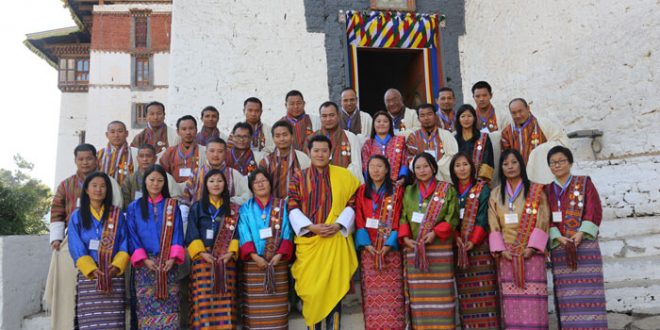
The group will arrive in Tashichhodzong on March 3
Good men cometh, from afar
Changcha: Rogues all – nine of them – come throwing themselves sincerely prostrate, hitting their stony forehead on the hard, burning asphalt – rogues – they come.
It has taken them 185 hours – eight full days, more or less – from Paro to this dusty patch of Khasadrapchu roadside from where a slender tarmac lane branches off towards Jemina. And they trudge on, tired but unaffected, grime-smothered entire but not in the least bothered – the severely devoted rogues – they come.
Now the sun is leaving the sparsely clothed ridge belt of rocks and scrawny pines speckled, fading quietly into the horizon. Some good distance from here, before the highway cuts into the village of Namseling, they will rest and call it a day. Far below the road, down the sad and howling gorge, the roiling Wangchhu rumbles on.
These are good rouges, deeply penitent former addicts, who have come all the way from Paro and will end their journey at Tashichhodzong, doing changcha (full prostration). Led by Tshewang Tenzin, himself a former addict and now the programme coordinator with Chithuen Phendey Association (CPA), the changcha team is made up of staff, members and clients of CPA.
Tshewang Tenzin was in Chumphu in Paro, soaking in hot steam blissfully with his friends, when the idea hit them. And the good news came, very good news indeed – The Gyalsey had been born! The team woke up early and offered prayers; they concretized the idea and headed towards Kyichu.
As in all things, the beginning had to be auspicious, so they started with blessings from Khamtrul Rinpoche and Lam Neten of Paro. The biggest changcha group to be seen trailing along the road in the fashion of supremely liberated mendicants of rare order had just about started banging their head on the tarmac when people they met began asking what monumental sins had they committed in their many lives that they had to repent so. They did not answer. They had little time to meditate on such vastly mundane and painfully appalling trivialities of life. They kept going, unhearing, unseeing – prostrating, rising, prostrating…
Then the first blisters began appearing on their palms and knees. Still they moved on, gathered thick grime on their forehead, their masked face kissing the good earth. All these aches and hardships they dedicated to the 400th year of Zhabdrung’s arrival in Bhutan and to Guru Rinpoche because this year – Fire Male Monkey Year – is the birth year of the greatest tantric saint that ever walked the face of earth, and to the peace and prosperity of the country and the people.
Intense sun burnt and cold winds chaffed their skins, but there was no stopping these dedicated and highly charge rogues of the road. It didn’t rain, but even if it had, they would have just scoffed at it and plodded on, these deeply ardent rogues. The first day nearly had them done for good. Two of them are sitting in a white Bolero pickup, sick and injured.
It has been nine years since Tshewang Tenzin gave up alcohol and abstained from any kind of addiction. He is married and has two sons; the younger one is just a month old.
“We started with the idea of having just two meals a day, but that’s very difficult. But this is our prayer for all, parents and people we have known and hurt. This is kind of our way to say that we are really deeply sorry,” says Tshewang Tenzin.
Karma Tshering, 28, is from Lobesa, Punakha. He is a counsellor with CPA. He has been three years clean now. He picked up drinking habit early on. Soon he realised that he had become a hardcore addict. “I really felt that I should stop drinking. My addiction has hurt many people. I let them down. This is my one chance to say to my King, country and the people that I regret the way I spent my life,” says Karma. One of the guys in the group has parents living in Khasadrapchu. As he throws his wooden hand guards on the hard tarmac, making a clacking sound, his parents don’t come to meet him.
But people do come along the way to greet the group. Some contribute money, others stuff to eat. Sometimes people sponsor lunch for the group. The group has received financial and other supports from Ugen Tsechup Dorji and KS Dhendup. From the monetary contributions, the group wants to construct a statue to mark their success. These good rogues have a dream.
Sonam Rinzin, 33, is from Shermuhung, Mongar. He has been an alcoholic for nearly 20 years. “ We’re all feeling really good. It’s tiring but a very fulfilling experience. This shows the power of determination. All things work if one is determined.”
Nima from Wangdue is the group’s oldest. He is 60. He’s got bloody marks on his mask and something ominously red is oozing from his mouth. It’s the betel juice. Nima doesn’t drink regularly but when he does he goes on with it heavily for weeks without meal. His loving and worried daughter encouraged him to join rehabilitation centre in Paro. There he met his friends who are on the road with him today, doing changcha and pulling on.
Says Nima: “I can’t handle too much stress. I didn’t even know that an organisation like CPA exists. I come from a different era, you see. But now we are like real good brothers. I am happy that we are making really determined effort.”
It’s a new day. Sun is back and the rogues are on their feet. In a week’s time, on March 3, the groups will reach Tashichhodzong, their final destination. There, their friends, well-wishers and family members will be waiting to greet them. It will be an emotional moment for most of them.Slowly but surely, the good rogues are coming.
Jigme Wangchuk
Використовуючи онлайн кредит на карту, клієнти отримують сучасний інструмент для вирішення фінансових питань. Не потрібно їхати у відділення чи чекати годинами — достатньо заповнити заявку, і гроші вже за кілька хвилин будуть на рахунку. Це рішення підходить для різних життєвих обставин: від дрібних побутових витрат до серйозних потреб, коли важлива швидкість і надійність.
Amici del Bhutan - Italy
- Dettagli
- Scritto da Super User
- Categoria: Archivio 2016
- Visite: 2051
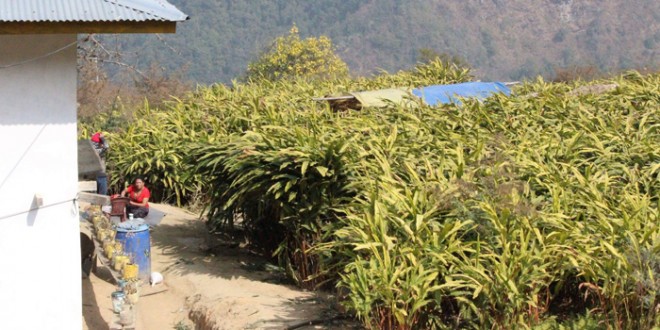
Dovan is one of the gewogs in the south that grows cardamom in large quantities
Development lures people back to roots
Rural: Gungtong may be a rising issue in the east of the country but exactly opposite is the reality in the south. People who abandoned their ancestral homes in the past are now returning from the urban centres where they have been scraping a living for a good many years.
Many factors seem to play a part in luring the people back to the land they belong to, but it is chiefly development that has now come to the once vastly disturbed places south of the country. There is now peace, and roads and electricity have come. Cardamom business is growing more lucrative by the day.
Uma Kant Suberi, 57, left Lhayul (Maugaon) in Sarpang for Thimphu a decade ago to work as a mason. Life in the capital wasn’t easy as he thought it would be. He made Nu 10,000 a month, which was barely enough to keep the household running.
“There was no school, neither a health facility hospital in my village then,” remembers Uma. “There were no economic opportunities to speak of. So I decided to leave. But now development has come and life here is much easier.”
It’s been two years since Uma returned to Lhayul. The journey to his village took almost two days from Gelephu then. Now it’s just a matter of a few hours. A farm road snakes just past Uma’s house.
In the land that measures about two acres, Uma has planted cardamom.
Ram Chandra Bhattarai’s story is not much different from Uma’s. He left Chudzom for Gelephu about the same time as Uma left for Thimphu because he has to admit his five children to school. At Pelrithang in Gelephu, he worked on somebody’s land. Now that his children are in Norbuling Middle Secondary School, Ram has returned to his fertile land.
“Cardamom is a blessing for the farmers here. It requires hard work, but the return is good,” said Ram.
Jigmechholing and Chudzom in Sarpang and Dorona in Dagana are the main cardamom growing gewogs in the south.
Chudzom Gup Mon Bdr Ghalley said that until a few years back, before cardamom cultivation flourished, almost 60 percent of the 820 houses were empty (gungtong). Most of the people have now returned. Only those who have bought land elsewhere have not come back.
“Besides roaring cardamom business, opening of schools and coming of electricity and road networks are the main factors luring the people back,” said Mon Bdr Ghalley.
Almost all the villagers of Dorona gewog in Dagana are engaged in growing cardamom. Of the 230 households, almost 180 rely on cardamom as main source of cash income.
About 40kg of cardamom, which is worth Nu 50,000, can be harvested from one-acre of land, said Gup Bikash Gurung. “Here, cardamom is gold.”
Far down south, in Jigmechholing, farmers used to grow paddy, maize, millet, mustard and wheat until recently. Livestock products were the main source of income in the gewog. Here too now the people are all into growing cardamom.
It’s been just over two months since Indra Prasad Dhimal and his family returned to their village, Dhungay. His wife and mother could not cope with urban lifestyle in Gelephu.
“Village is where we belong. Everything we need is here now. Life has become easy,” said Indra Prasad. He is busy preparing a plot for cardamom as yhe season sets in.
Jigmechholing’s Gup Sherab Jamtsho said that at least 40 households have returned to their village. “It’s a good thing that they are coming back. It is as life has returned to the village.”
Nirmala Pokhrel
--
Amici del Bhutan - Italy