
- Dettagli
- Scritto da Super User
- Categoria: Archivio 2016
- Visite: 1903
Almost 300 lhakhangs to install CCTVs
The lhakhangs will purchase the equipment at their own cost
Security: A total of 296 kyonyers (caretakers) have agreed to install CCTVs (close circuit television) in their lhakhangs following a nationwide sensitization on lhakhang and choeten vandalism that the police conducted last year.
Installation of CCTVs in lhakhangs is being pursued to prevent robberies and vandalism, among other crimes.
The police have already identified two firms that will supply CCTV equipment to the lhakhangs at a reasonable rate. The two firms will supply the equipment for Nu 49,400 and Nu 53,296 each.
Besides the 296 lhakhangs, all superintendents of police (SP) have been asked to coordinate with lhakhang caretakers in their respective dzongkhags to install CCTV.
RBP’s spokesperson, deputy chief of crime and operations Colonel Dorji Wangchuk said that the caretakers could buy the CCTV equipment directly from the suppliers with the help from the SPs.
Chief of police Brigadier Kipchu Namgyal said that the installation of CCTVs will prevent vandalism and burglary. “It can be monitored through mobile phones even if a lhakhang is managed by a lone caretaker,” he said, adding that it is a convenient and useful method. “A minimum of two cameras each is recommended for each lhakhang.”
Brigadier Kipchu Namgyal also said that the installation of the CCTVs would not cost the national exchequer, as the cost will be borne by the respective lhakhangs.
Police said that even prominent monasteries don’t have CCTVs while those in place are not functioning.
Records with the police show that offenses against the Ku-Sung-Thukten is one of top seven crimes in the country and one of the most heinous. Last year, 129 such offenses were reported from 230 the previous year.
Police attributed the drop to the hard work of the special investigation team that was formed following an increase in such cases. Last year the team forwarded 140 offenders to the court of which 78 were convicted.
“We are taking it (choeten and lhakhang vandalism) seriously and the special investigation team will continue its crackdown,” Brigadier Kipchu Namgyal said.
In the last 27 years, about 4,000 choetens and lhakhangs were vandalized, which translates to 148 a year. In 2014, police recorded a 12 percent increase in cases involving offenses against the Ku-Sung-Thukten or statues, scriptures, and lhakhangs.
On the monitoring and implementation part, police said that with recording facilities it would not be difficult. However, it would be further discussed with the respective caretakers.
“The cameras will have to be placed at strategic locations and the quality of the image should be good without which it will not serve the intended purpose,” Colonel Dorji Wangchuk said.
Changangkha Lhakhang installed six CCTVs last month at a cost of Nu 76,500.
Changangkha Lhakhang’s Lam Yeshey is hopeful that people will be more cautious within the lhakhang premises besides preventing robbers from entering.
Lam Yeshey also said that currently he monitors the lhakhang from his house without having to go around the lhakhang premises. “In future, we will upgrade the system so that we will be able to monitor it from our mobile phones,” he said.
Similarly, Dechenphu Lhakhang also has plans to install CCTVs to safeguard the lhakhang.
Kinga Dema
--
Amici del Bhutan - Italy
- Dettagli
- Scritto da Super User
- Categoria: Archivio 2016
- Visite: 1874
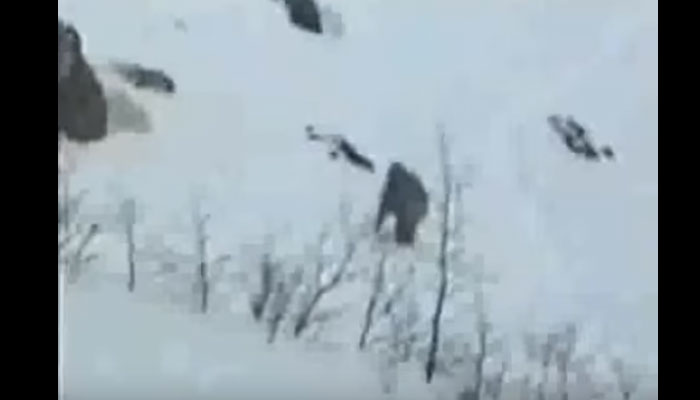
Yeti mystery solved? Trekker 'captures' movements of Abominable Snowman in Bhutan
Last Updated: Monday, February 1, 2016 - 15:35
Zee Media Bureau
New Delhi: Despite making a tremendous advancement in the science and technology, the Yeti or the Abominable Snowman continues to remain a mystery so far. But an English trekker has claimed to have solved the mystery. But according to a report in the Mailonline, a trekker has claimed to have unravelled the mystery.
According to the trekker Steve Berry, the footprints in the photographs, taken at depths of the remote Bhutan mountain, are of a Yeti. He said that the marks are bigger than that of the human footmarks and the mountain, where the photos were taken, was untouched by any human being so far.
The footmarks, which are made in a straight line, cannot be made by a snow leopard or any four-legged animal. It would be impossible for a beer to make such footmarks as it cannot walk with such precision with a bulky body.
The tracks were spotted in October 2014 on Gangkhar Puensum, the world’s highest unclimbed mountain.
Berry also runs a adventure company which specialises in Himalayan treks.
The "Abominable Snowman" was coined in 1921. In the same year Lieutenant-Colonel Charles Howard-Bury led the 1921 British Mount Everest reconnaissance expedition. Later, in his book, Mount Everest The Reconnaissance, he mentioned seeing footprints probably caused by a large 'loping' grey wolf, which in the soft snow formed double tracks rather like a those of a bare-footed man.
- Amici del Bhutan - Italy
- Dettagli
- Scritto da Super User
- Categoria: Archivio 2016
- Visite: 1595
Interesting article on private sector
- Amici del Bhutan - Italy
- Dettagli
- Scritto da Super User
- Categoria: Archivio 2016
- Visite: 1923
Enjoy

--
Amici del Bhutan - Italy
- Dettagli
- Scritto da Super User
- Categoria: Archivio 2016
- Visite: 2511
Bhutan harnesses wind power for electricity
A wind farm of two turbines in Wangdue is expected to be expanded
Energy: Bhutan is now also generating electricity using the wind instead of only water.
At least 300 houses were provided with wind powered electricity from yesterday following the inauguration of two 300kw wind turbines in Rubesa, Wangdue.
“This is a historic day for renewable energy in Bhutan,” said Prime Minister Tshering Tobgay, who commissioned the two wind turbines.
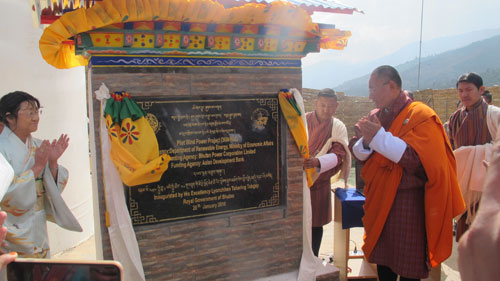
Lyonchoen Tshering Tobgay inaugurates the wind turbines yesterday
The two turbines were developed at a total cost of Nu 177 million (M). The Asian Development Bank providing financing with a grant of Nu 163M (USD 2.7M). Construction of the two turbines began in 2014.
The two turbines can generate electricity for 300 households, said officials with the renewable energy department. This is calculated on the basis that each households consumes 2kw.
Up to 24 wind turbines of 300kw capacity each could be installed in the Rubesa area, however, officials said this could not happen because the proposed sites fall under private land.
However, the government is determined to work with the concerned landowners and explore up-scaling the scheme under various development models.
Officials said it is necessary to gain practical experience in planning, constructing and operating the wind farm, before up-scaling the technology.
Rubesa was selected over Tsimasham in Chukha and Chelela in Haa following three years of assessment.
Officials said that the development of a wind farm requires careful selection and various criteria had to be fulfilled.
This project was developed with the primary objective to demonstrate the technical feasibility of generating wind power. It is expected that wind power can alleviate power shortage Bhutan experiences during the lean seasons.
The project was executed by the renewable energy department and implemented by the Bhutan Power Corporation (BPC).
The project was handed over to BPC for operation and maintenance.
The two turbines were initially scheduled to be inaugurated on National Day, last year, however, it was delayed due to logistical problems.
The economic affairs minister Norbu Wangchuk, health minister Tandin Wangchuk, Punatsangchu managing director, Wangdue dzongda and other officials attended the ceremony.
Dawa Gyelmo, Wangdue
Judiciary to prevent inconsistencies in laws
Highlights major challenges
Law: The Judiciary will never remain free from deciding whether the country’s legislations are coherent with, or offends the Constitution.
This, as per the Judiciary’s annual report, comes with the concept of Constitutional supremacy over Parliamentary supremacy.
Highlighting what His Majesty had said; “The Judiciary cannot seek solace in the arguments that defects in laws are a legislative responsibility, and remain a mere spectator,” the report states that the High Court and Supreme Court has till date engaged to prevent inconsistencies in the laws affecting common people.
For instance, when the Supreme Court decided the first Constitutional case in 2011, apart from the verdict, the court also cleared the confusion with regards to the money bill. It interpreted that the assembly might consider recommendations of the council, but need not necessarily incorporate them on mater pertaining to money bill.
Likewise, sources said that the Judiciary has been informally holding dialogues with parliamentarians to amend certain laws that offends the Constitution and contradicts other laws.
Challenges
However, in doing so, the judiciary is confronted with few challenges. In interpreting the vague or conflicting statutes instead of merely applying the provision, providing effective and efficient resolution of complex disputes is seen as a major challenge.
The judiciary, the report states will also have to adapt to the evolving social change and retain its social position of independence and public trust. The Judiciary also highlighted that increasing public understanding on the role of judges and court system is important but considers challenging.
The report points out that Bhutanese have limited understanding of the operation of court systems and perpetuating public trust in changing society is identified as a recurrent challenge.
For example, appeal system to the higher judicial authority is designed to remedy the aggrieved litigants. But this has been associated with silly complaints against the judicial personnel.
Without considering facts and circumstances, the report stated that over the years, people started to allege baseless, generic and stereotyped criticisms.
High Court justice Lungten Dubgyur’s recent book, “Wheels of Laws” sheds some lights on the generic criticism the courts face when decisions of lower court and appellate court varies.
“Disparities in sentencing are perceived as an indication of judicial bias or a discrepancy in legal skill,” he wrote. In some circumstances, he wrote, inconsistency can arise when there are overlapping or contradictory provisions of law, causing difficulties in application of law.
He also mentioned that the unpredictable and changeable nature of laws undermines broader values of rule of law in ensuring that government and individuals are kept to the law.
It was also mentioned, in the report, that some litigants use the appeal system to harass the other party while some, mostly on monetary cases, use it as tactic to delay judgment.
The present practice of liberal application of appeal provisions by the court, according to the report, has let most of the cases to go for appeal and burdened the appellate courts by accepting unnecessary appeals.
Particularly in small society like Bhutan, making value-based decision is difficult in practice. The report states that assuring the judges to maintain distance, but preventing their isolation from community in which a judge lives, is a judicial challenge.
Unconfirmed comments on social media are also reported to pose threat to credibility of the judicial system. find top rated tables around casoola near Perth for great live action
Undertaking educational initiative and creating awareness on the court system on regular basis also comes at the cost of delays and adjournment of regular court proceedings because of human resource shortages.
Tshering Dorji
Ura farmers urge government to subsidize electric fencing
The farmers have been losing crops to wild life despite guarding their fields overnight
Agriculture: As the potato cultivation season draws closer, villagers of Ura in Bumthang are beginning to prepare their fields for potato cultivation in March.
Sounds of tractors drown out the songs of birds as villagers prepare their farmlands.
“People have begun tilling their fields, which were hardened by the cold winter frost,” Tashi Peljor from Pangkhar said. “Everyone is busy.”
This year, the winter was rewarding. It snowed twice and hopes are high for a bountiful harvest in the fall.
But crop depredation by wild animals remains a concern. The villagers will experience sleepless nights over a five-month period, guarding their potatoes from the wild life.
“We have to guard the fields from the day the seeds are sown to the end of the harvest or else the wild animals wouldn’t spare anything for us,” Gyetsa tshogpa, Chundu Tshering said.
“Gyetsa still doesn’t have an electric fence to protect the fields save for one patch of land, which received one on trial sometime back,” the tshogpa said. Despite the electric fence’s efficacy in combating human-wildlife conflict, villagers cannot afford it.
Around 30km of electric fence has been constructed in Bumthang but this covers only 194 of the 1,544 households. The farmlands of over 1,350 households are not protected by electric fences.
“Loss of crops to wildlife is still a major problem for farmers,” Chundu Tshering said.
Last year some households in Gyetsa were left with almost nothing after wild boars ravaged over seven acres of barley. In Ura, wild animals damaged potato and buckwheat fields.
“Every year crops are lost to wildlife despite guarding the fields sleeplessly every night,” Chundu Tshering said. He added that this occurs even after some opt to guard the fields rather than take care of the sick in their family. He said it is a depressing situation.
Records show crop damage from wildlife amounting to over 754 truckloads across the country from July 2013 to June 2015.
Farmers are urging the government to subsidize electric fencing.
Chundu Tshering said that way the electric fence can still benefit those who cannot afford it.
“Right now because the fields are situated in same area if someone in the village couldn’t afford everyone has to drop the plan of electric fence as its costly for a handful to bear the expenses,” Chundu Tshering said.
In absence of budget for electric fence in the 11th Plan, Ura gup, Dorji Wangchuk said the fencing must be incorporated in the annual plans.
“Until now in Ura, electric fences were issued either with funding from projects or were procured by re-appropriating funds from other activities or from gewog development grant,” he said.
The dzongkhag meanwhile is increasing the span of electric fence by 32km in June through funds from the commodity programme to reduce human wildlife conflict and reclaim the fallowing lands.
“Electric fences were given only for groups, communities, far flung farmlands and for households with acute labour shortage for coverage of larger area,” dzongkhag agriculture office (DAO), Gaylong said.
From this year the dzongkhag will fund only energizer, solar panel, controller and Gavanised Iron wire but farmers would have to buy nails and polythene pipes on their own, he said.
Gaylong also said plans to incorporate electric fence in annual and FYP plans is being deliberated. “Avenues to replace wooden posts with non-wood posts are also being explored to reduce tree felling,” the DAO said.
Tempa Wangdi, Ura
- AMICI DEL BHUTAN - ITALY