
- Dettagli
- Scritto da Super User
- Categoria: Archivio 2016
- Visite: 1712
Tshering Zam, Thimphu
The number people suffering from mental illnesses have doubled in the last decade. National Referral Hospital in Thimphu alone diagnosed more than 6,000 cases in last 10 years.
Mental illnesses include depression, anxiety and somatoform disorders.
A report on Crime and Mental Health Issues among the Young Bhutanese People, the mental health issues was more common among the youngsters.
A Psychiatrist at JDWNR Hospital, Dr. Damber K. Nirola said the younger generation is facing increasing societal pressure. He said a lot many people have graduated shrinking the job market.
“There is lot of pressure from the parents and among themselves. I think we have made our young people, sort of, feel that there is no sort of alternative to education.”
From 61 mental disorders cases recorded in the hospital, anxiety is one of the common disorders that people of Bhutan suffer from. Anxiety is a disorder that causes a feeling of fear and worry.
Dr. Damber K. Nirola said anxiety has overtaken depression.
The hospital spends more than Nu 15,000 treating a patient for 10 days.
AMICI DEL BHUTAN - ITALY
- Dettagli
- Scritto da Super User
- Categoria: Archivio 2016
- Visite: 2139
More than a thousand Bhutanese sign the HeForShe Pledge
The pledge advocates gender equality
Gender: More than a thousand Bhutanese have now joined the HeForShe movement for gender equality, the latest being National Assembly Speaker, Jigme Zangpo, according to a UNDP press release.
Eighteen members of parliament became HeForShe advocates, yesterday.
The HeForShe campaign is a global solidarity movement in support of women’s rights and full equality between women and men.
“Over 60 percent of civil servants are women. Where we are lacking is in Parliament. Parliament only has 8 percent (women) and we are rigorously working with UN agencies to increase women’s leadership role in parliament,” the Speaker said.
In Bhutan, UN Women and RENEW are working together to spread the HeForShe campaign throughout the country. Their work puts men at the centre of activism and dialogue to end persistent inequalities faced by women and girls throughout Bhutan.
“The role of men and boys in achieving gender equality is often overlooked,” said Christina Carlson, UN Resident Coordinator in Bhutan. “Yet men also recognise that when women are empowered, the whole of society benefits. HeforShe is a way for men to show their support,” she added.
At the inauguration of the HeForShe campaign, Secretary General Ban-ki Moon highlighted that HeForShe has signed up fathers who want to raise empowered daughters; leaders who know their societies will be stronger when there are as many women in parliament and in business as men; and ordinary people who are fed up with violence and discrimination against women – and want to be part of a global force for change.
Over the last 18 months, the global campaign has mobilised more than a billion men and boys as advocates and agents of change for gender equality.
Staff reporter
Alcohol and drugs trigger crime among young
Research: While the country attempts to curb problems caused by drugs, it is proving a lucrative business for some, including rural folks.
A focus group discussion involving nine drug addicts and abstainers conducted by the National Statistic Bureau (NSB) exposed several issues.
Participants of the discussion revealed the presence of not less than 50 drug peddlers in Paro alone making it easy to obtain the narcotic drugs.
The participants made it known that some villagers earn money by selling marijuana hashish to young people in Thimphu, who become suppliers of narcotic tablets and other drugs to the rural youth.
“The participants said that the popular market deal was to exchange hashish (moulded in a camera shape) with samsung mobile phones,” it is stated in the NSB’s study on crime and mental health issues among young Bhutanese.
The use of heroin and cocaine, participants had said, occurred among people belonging to rich families. It was also exposed that the narcotic drugs are smuggled in from the Indian border towns and even from the Chinese frontier and sold to the Bhutanese at three times the actual price.
Cannabis plants, as per the study, are being exported to India illegally, concealed in trucks. It is then processed in India and sold back to Bhutan in different forms such as chur and charas.
Alcohol and substance abuse was reported as the “top factors” pushing young people to commit crime. The study has delved into criminology over the past couple of decades.
The NSB’s study revealed that 40 percent of the crimes among young people were committed under the influence of alcohol, and 12 percent under the influence of controlled substances. It thus indicates that abuse of alcohol and illicit drugs were the main triggers for criminal deviancy among young people.
According to the report, the country’s total recorded crime has increased by over 100 percent from 1986 to 2013.
In 2013, the RBP recorded 2,925 crimes against 1,243 crimes in 1986. Until 2008, the reported crime has remained relatively stable with an average of 1,672 crimes per year. However, there was a sudden rise in the reported crime beginning 2009, reaching a record high of around 3,500 cases in 2010.
While there is a general conception that youth related crime increases during the winter vacations, NSB’s study ascertained that crime among young people was a year round phenomenon.
NSB’s study shows that more crimes were recorded on Mondays, Tuesdays and Fridays rather than during the weekends.
The study revealed that registered crime increased by age until the age of 19, a small drop at the age of 20 and 21 was recorded. Crime, again, increased from age 22 to 24.
“The observations conform to the theory that the crime tends to peak in adolescence or early adulthood, and then decline with the increase in age,” the study stated.
Crime committed by young people (less than 24 years) mainly involve offences against a person, offences against property, and miscellaneous offences. It was reported that commercial crime, fraud, corruption and related offences and the offences against state and public order were relatively less.
On further segmentation into the crime sub-categories, offences related to controlled and other harmful substances was the most common offence among youth followed by assault, battery, and related offences and then larceny, robbery, armed robbery and related offences.
There was not much variation in the nature of offences between the two age groups: adolescents (10-19 years) and young adults (20-24 years). The most common offences between these two age groups were “controlled substances, assault, battery and related offences” and “larceny, robbery and related offences”.
More adolescent offenders had committed “larceny, robbery, armed robbery and related offences,” and “burglary, trespassing and related offences”. Sexual offenses, money laundering and smuggling occurred relatively more often among young adults.
It is a combination of multiple factors pushing young people to commit criminal offenses, says the study. For instance, family breakdown could be further linked to a range of problems like unstable social environment.
“Families seemed to have induced the anti-social behaviour such as drug and alcohol abuse and personality disorders (stress, hopelessness, estrangement, and revengeful attitude), triggering in them deviant behaviour like truancy, poor academic performance, escaping unstable homes (to be with deviant peers or to lead underground lifestyles), and to finally carry out various counter-law activities.”
It was highlighted that some individuals become criminally deviant for the reason that they do not see the benefits of adhering to conventional norms and social values.
Another factor, the study points out is the social environment, such as weak or broken family bonds, hostility towards school and community or unfavourable social and economic conditions, evoke criminal behaviour.
Using the information and data from the Royal Bhutan Police, NSB found that, more than half of the offences reported have been committed under peer pressure and in companionship. Another 12 percent of young offenders reported poor socio-economic conditions necessitated them to commit crime. About seven percent of young offenders reported unemployment as the main reason.
The study is a part of the thematic studies of the NSB on the issues of policy importance and in areas where research gaps exist.
Tshering Dorji
Amici del Bhutan - Italy
- Dettagli
- Scritto da Super User
- Categoria: Archivio 2016
- Visite: 2198
Business Bhutan
Bhutan moves up 10 places in press freedom ranking
Reporters Without Borders has been calculating indicators of the overall level of media freedom worldwide; the higher the figure, the worse the situation
Lucky Wangmo from Thimphu
Bhutan has moved up 10 places in the World Press Freedom Index report compared to last year’s 104 released by the Reporters Without Borders this week.
Bhutan is ranked 94 out of 180 countries in Reporters Without Borders’ World Press Freedom Index, which measures the level of freedom of information in 180 countries.
It has scored a total of 34.57 out of a possible 100, the higher score being the worse.
“The number of privately-owned media is still low but pluralism seems to have been developing since a transition from absolute to constitutional monarchy in 2008, and foreign journalists with official accreditation are able to operate,” states the report.
Among the SAARC (South Asian Association for Regional Cooperation) countries, Bhutan tops the list followed by Nepal (105), Maldives (112), Afghanistan (120),India (133), Sri Lanka (141), Bangladesh (144) and Pakistan (147).
Last year, Bhutan’s ranking fell by 12 places from 92nd position in 2014 to 104th position.
Bhutan’s ranking has been constantly changing over a time period of 15 years. Records with the Reporters Without Borders show Bhutan’s ranking from 2002 till 2016. Bhutan was given the worse ranking in 2003 at 157th position with a score of 77.33, while the best ranking was given in 2010 at 64th position with a score of 17.75 out of a possible 100.
Talking to Business Bhutan, the Director General of Department of information and media (DOIM), Ministry of Information and Communication (MOIC), Kinley T. Wangchuk, said that the possible reason that improved the ranking must have been because of the policies that are already in place and the ones that are coming up.
“Another reason could also be because of the trainings that are being provided by the DOIM and also for assisting the Journalist Association of Bhutan,” he said, adding that felicitating the foreign journalists and making arrangements for them to make their mobility easier might also be some factors that help improve the rankings.
On the other hand, the Executive Director of Bhutan Media Foundation (BMF), Dawa Penjor, said that though the ranking has gone up, there has been no significant difference in the score.
“Unlike other countries, we are enjoying better freedom,” he said, adding that the interaction with international media and Bhutanese news reaching the international arena could be the reasons for the better ranking this time.
The Scandinavian countries of Finland, Netherlands, Norway and Denmark are ranked the top four spots, while Syria, Turkmenistan, North Korea and Eritrea and in the last four places.
According to Reporters Without Borders, there has been a deep and disturbing decline in respect for media freedom at both the global and regional levels.
The global indicator has gone from 3,719 points last year to 3,857 points this year, a 3.71% deterioration. The report published annually since 2002 measures the level of freedom available to journalists in 180 countries using the following criteria-pluralism, media independence, media environment and self-censorship, legislative environment, transparency, infrastructure and abuses.
--
AMICI DEL BHUTAN - ITALY
- Dettagli
- Scritto da Super User
- Categoria: Archivio 2016
- Visite: 2331
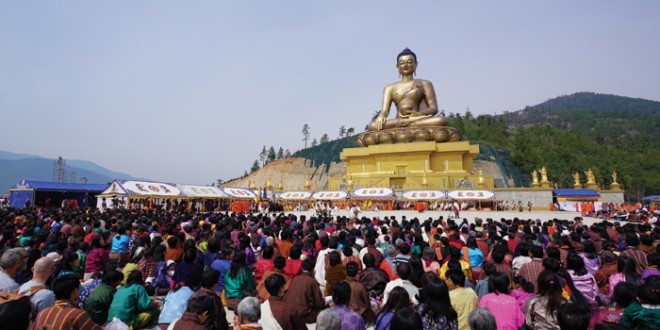
His Majesty The King and Her Majesty The Gyaltsuen, along with His Majesty The Fourth Druk Gyalpo, and members of the Royal Family graced the Peling Tshechu held at Kuenselphodrang before the statue of the Buddha Dordenma. Thousands of people attended the first day of the Peling Tshechu, which showcases the sacred dances of the Peling tradition of Terton Pema Lingpa. The event was organised by the People’s Initiative in Celebrating the Sixtieth Anniversary (PICSA) with the home ministry, and is dedicated to His Royal Highness The Gyalsey in celebration of the Royal Birth, as well as the commemoration of Guru Rinpoche’s birth year and the 400th anniversary of Zhabdrung Ngawang Namgyel’s arrival in Bhutan.
Peling tshechu at Kuenselphodrang
Event: The three-day Peling tshechu, which is being held for the first time on the sacred grounds of the Buddha Dordenma at Kuenselphodrang in Thimphu, began yesterday.
His Majesty The King and Her Majesty The Gyaltsuen, His Majesty The Fourth Druk Gyalpo, members of the Royal Family, and senior government officials graced the first day of the tshechu.
Organised by the People’s Initiative in Celebrating the Sixtieth Anniversary (PICSA) in collaboration with the home ministry, the tshechu is being held to commemorate the Royal Birth of His Royal Highness The Gyalsey Jigme Namgyel Wangchuck.
The Peling tshechu is the divine enactment of the various visions and activities of Terton Pema Lingpa, from whose descendants originated the Wangchuck dynasty. HRH The Gyalsey Jigme Namgyel Wangchuck is the 19th direct descendant of Pema Lingpa.
PICSA project officials said that the initiative of organising the Peling tshechu is not only aimed at celebrating the Royal Birth of His Royal Highness The Gyalsey, but also to pay tribute to Terton Pema Lingpa.
The tshechu is also being held to commemorate Guru Rinpoche’s birth year and the 400th anniversary of Zhabdrung Ngawang Namgyel’s arrival in Bhutan.
More than 200 performers from across the country will perform various chams (mask dances) visualised by Terton Pema Lingpa during the three-day tshechu. Chams from the Dochula Druk Wangyal tshechu will also be performed at the tshechu.
Peling Phag cham and Ging Tsholing cham from Tamzhing and Nyimalung in Bumthang, Dramitse Nga cham from Dramitse in Mongar, Peling Pa-cham from Gangtey Goenpa in Wangdue and Peling Chaktshel from Korphu in Trongsa were performed on the first day of the Peling tshechu.
Under an auspicious rainbow around the sun, thousands of people gathered to witness the Peling tshechu.
Tshering, 70, came all the way from Paro with his 83-year-old friend, Gomchen, to witness the sacred dances. It was their first time at the Kuenselphodrang.
“I am blessed to get the opportunity to witness the sacred dances and also the Buddha Dordenma at Kuenselphodrang,” Tshering said. “If it was before then we have to go to Bumthang to witness the Peling tshechu.”
Chamchen, Rigma Chudrukmai cham (16 dakinis dance), Pema Lingpa cham, Cha-Gyeng cham, Drung or Brum Cham will be performed on the second day while Peling Shinjey, Peling Juging (stick dance), Peling Shazam, Peling Driging (sword dance), Peling Ngaging and Guru Tshengye (eight manifestations of Guru Rinpoche) will be performed on May 4, the last day of the tshechu. discover magical vibes across luckyelf casino at online sites for aussie punters
Dechen Tshomo
---
Amici del Bhutan - Italy
- Dettagli
- Scritto da Super User
- Categoria: Archivio 2016
- Visite: 2050
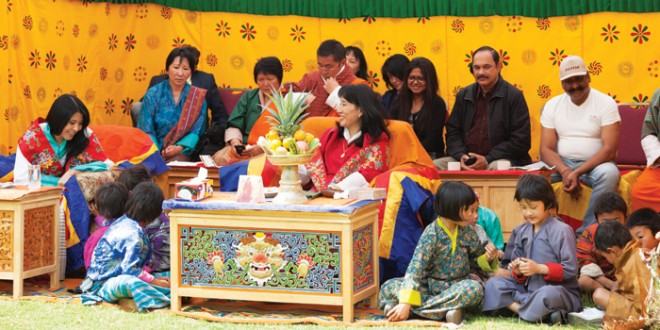
Her Majesty The Gyalyum Tshering Pem Wangchuck and HRH Princess Chimi Yangzom Wangchuck interact with children in Talogang prior to a four-hour trek along an ancient trail left by Drukpa Kunley
Reviving the forgotten trail of Drukpa Kunley
Initiative: To revive the ancient trail of the 14th century saint, Choeji Drukpa Kunley, Her Majesty Gyalyum Tshering Pem Wangchuck and Her Royal Highness Princess Chimi Yangzom Wangchuck trekked for four hours from Talogang to Siluna in Punakha on April 23.
The works and human settlement minister, Dorji Choden, health minister Tandin Wangchuk and home minister Dawa Gyeltshen, along with several high level government delegates, officials and locals of Toep gewog, also made the trek.
It is believed along this trail Choeji Drukpa Kunley hunted and subdued demons. There are many sacred sites (nyes) along the 21-km trail related to Drukpa Kunley.
Despite its sacredness, the route has not been used for many decades and bushes had covered it in many places.
The route has been cleared and converted into a trekking trail with the help of locals and the dzongkhag. With the trek, the route will now be open as another trekking route for tourists.
The route which takes four-hours to walk, connects 21 villages in Toep. Each village possesses their own unique culture, artistic skills, trade practices, and a rich diversity of flora and fauna.
Initiated by the Youth Development Fund (YDF), the trek is expected to promote eco-tourism projects under the ‘My Gakidh Village’ project. Her Majesty Gyalyum Tshering Pem Wangchuck is the President of YDF.
The project is a joint venture of a non-government organisation from France, Aide-et-Action and YDF. Other activities include pottery, tea making, and Media lab.
Officials said the pottery and tea-making project-site is in Talhogang, which is around half an hour walk from the Wangdue-Thimphu highway below Lamperi.
While the pottery project will start soon, the tea-making project is already in operation. Tea products already available in the market.
The media labs are open and provide basic courses of computer literacy and media training to out-of-school youths and the monks, said officials.
YDF officials added that some of the objectives of the ‘My Gakidh Village’ project is to empower and enable youths to stay in the villages and not migrate to urban areas. Besides, the project also aims to enhance rural livelihoods through skill development projects to revive traditional crafts and culture within communties. It is also to help conserve and protect their environment resources in a sustainable manner.
Officials said Begana village in Toep was identified for the project because of the high rate of economically disadvantaged youths in the village.
Dawa Gyelmo | Punakha
AMICI DEL BHUTAN - ITALY