
- Dettagli
- Scritto da Super User
- Categoria: Archivio 2016
- Visite: 1479
Enjoy
-- Amici del Bhutan - ITALY
- Dettagli
- Scritto da Super User
- Categoria: Archivio 2016
- Visite: 2075
However, accurate data to deduce the degree of the problem and required medical equipment to treat the disorder are lacking
Medical: Some 67 new cases of epilepsy were registered with the Jigme Dorji Wangchuck National Referral Hospital’s psychiatry department in Thimphu last year.
Since 1999, the hospitals registered 3,178 new cases until the end of 2015.
Meanwhile, records with the hospital show that 1,559 patients from across the country are being treated for epilepsy. Diagnosis of epilepsy is a clinical diagnosis.
Professor and head of neurology with the All India Institute of Medical Sciences (AIIMs), Dr Manjari Tripathi, said that epilepsy is common and so are neurological disorders, during a seminar at the Khesar Gyalpo University of Medical Sciences of Bhutan (KGUMSB) on July 25.
Dr Tripathi spoke to the participants on diagnosis of epilepsy and its treatment course.
“What you see is what you get and what the patient’s care giver tells you is what you diagnose,” Dr Manjari Tripathi said. “Neurological disorder will occur in every family.”
The biggest hidden epidemic, which people aren’t even aware of, is that of neurological disorders, Dr Manjari Tripathi added. The commonest neurological disorder causes migraines and headaches but the next most common one is epilepsy.
About 60 million people worldwide have epilepsy, of which 80 percent are living in the developing nations.
Psychiatrist with the referral hospital in Thimphu, Dr Damber Kumar Nirola, said that for epilepsy patients in the country, the doctors are the last resort because epilepsy comes with stigma.
“Sometimes the patients are brought to the hospital by somebody and many times, the patients come to hospitals because they failed to get treatment from elsewhere,” Dr Nirola said. “Most of the time when epilepsy patients come to hospital for treatment it becomes late.”
However, Dr Nirola pointed out that the country doesn’t have any medical person who is specialised in epilepsy.
“The epilepsy patients in Bhutan are treated by all the doctors and in primary health care units, the health assistance treats the patients,” he said. “The pediatric epilepsy cases are looked after by the pediatrician doctors, not by any of the psychiatrists.”
The referral hospital had magnetic resonance imaging (MRI) and computed tomography (CT) scan facilities only after 2006.
Anti-epilepsy medications such as Phenobarbital and Phenytoin are available in different levels of health centres across the country. While medicines such as Carbamazepine and Sodium Valporate are available in district and referral hospitals, and Lamotrigine and levetiracetam are available at the referral hospital in the capital.
A study on epilepsy, the Bhutan epilepsy project, that started in 2014 is under way in the country.
Dr Nirola also pointed out that Bhutan doesn’t have a neurologist and someone trained to treat epilepsy. The hospital also lacks equipment to monitor anti-epileptic drug levels. “We don’t have any epidemiology to study how big our epilepsy problem is.”
Dr Nirola suggests that a medical team in the country develop guidelines to use in different levels of hospitals. He added that the guideline made for the national referral hospital may not be practical for the basic health units.
The hospital doesn’t have any guidelines that the doctors follow strictly while treating patients with epilepsy, Dr Nirola added.
However, the hospital has a dedicated MRI protocol.
Radiologist with the referral hospital, Dr Dechen Nidup, said that radiology plays an important role in treating epilepsy.
Of a total of 2,384 MRI cases last year, about 277 or 11.6 percent were epilepsy cases.
Dr Dechen Nidup said that the number is huge for the country.
Currently, there are only four radiologists in the country.
Dechen Tshomo
--
Amici del Bhutan - Italy
- Dettagli
- Scritto da Super User
- Categoria: Archivio 2016
- Visite: 1437
Enjoy
-- AMICI DEL BHUTAN - ITALY
- Dettagli
- Scritto da Super User
- Categoria: Archivio 2016
- Visite: 1754
Disaster: The works and human settlement ministry is monitoring the flood situation across the country.
Works and human settlement minister, Dorji Choden, said that in some of the affected places the situation has gone from bad to worse. She said that the road at Sorchen was washed away and that a temporary bridge is being built and is expected to be completed in two days.
“We are preparing and hoping to get a temporary bridge at Sorchen in about two days,” Lyonpo Dorji Choden said. She added that the Construction Development Corporation Ltd (CDCL) and the Department of Roads (DoR), along with other agencies, are engaged in getting the bridge erected.
Project DANTAK is also involved in constructing the bridge.
The Tsirang-Sarpang highway has also been cutoff. She said work to reestablish the link will start as soon as the river subsides.
“We can divert the river as soon as the rain stops,” she said. The rain was continuing as of yesterday afternoon. The meteorological division has also forecast heavy rain in Samtse, Sarpang and Phuentsholing for today.
The situation at the Dzongkhalum bridge near Trongsa town has gone from bad to worse. She said the bridge was further damaged yesterday, totally cutting off the road. The Dzongkhalum bridge is located on the Trongsa-Zhemgang highway.
“It will take sometime to get traffic moving on the road,” she said, adding that it is difficult to provide an estimate of by when. There is no alternative route to the bridge. “We will have to find an alternative although it is difficult,” she said.
Lyonpo Dorji Choden said another pillar of the Buduney bridge in Samtse has been damaged making it more difficult to repair the bridge. “We haven’t been able to do much due to continuous rain. We can deploy our machinery as soon as the flood water subsides,” she said. “Works to restore the bridge is not possible unless the rain stops,” she said.
Meanwhile, the minister said no loss of life was reported due to the flood situation as of yesterday. The minister said except for some workshops in Phuentsholing and the makeshift Sarpang town, no major properties were damaged.
Citing hydro-met officials, Lyonpo Dorji Choden said the rain was expected to continue for a few days. One of the major facilities at risk, she said was the water treatment plant in Gelephu.
She said some of the gewog roads have also been blocked. “But efforts are in full swing to clear them all as soon as possible,” she said.
Prime Minister Tshering Tobgay was in Phuentsholing and Sarpang yesterday, while information and communications minister DN Dhungyel was in Samtse to monitor and help the relief efforts.
Home minister Dawa Gyaltshen was also in Phuentsholing.
MB Subba
- Amici del Bhutan - Italy
- Dettagli
- Scritto da Super User
- Categoria: Archivio 2016
- Visite: 1631
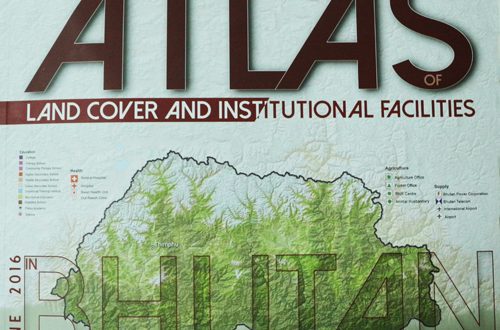
First atlas of Bhutan now available
Geography: His Majesty The King launched the first Atlas of Bhutan, published by the National Land Commission (NLC), on the sidelines of the rehabilitation land kidu programme in Dawathang village in Jomotshangkha on June 23.
National Land Commission secretary, Pema Chewang, said that it took over two years to prepare the atlas, which is the first of its kind.
A team of cartographers prepared the book under the guidance of two renowned atlas makers from the Netherlands.
The atlas covers two thematic areas of land cover and institutional facilities.
The secretary said that the atlas was published in celebration of the auspicious birth of His Royal Highness The Gyalsey.
“It is indeed most befitting that His Majesty who has ultimate refuge and authority over the land, launched the Atlas of Bhutan,” the secretary said. “The National Land Commission is deeply humbled and honoured with this rare opportunity.”
An official with the National Land Commission said that the 105 page atlas will be made available to schools at a very nominal cost, to cover printing expenses.
The secretary explained that the National Land Commission, as the national mapping agency, is mandated to spearhead geospatial data infrastructure development. The commission has been trying to promote a geographic information system for geo-enabling citizens and as a decision support system.
“The atlas will be useful for students, tourists and policy makers in better understanding Bhutan’s special geography,” the official said.
The commission is planning to come up with another two atlases. Work on a historical, religious and cultural atlas, in collaboration with the Department of Culture has started. The official added that the country is losing its cultural sites, therefore producing the book for conservation purposes and identification of the sites for uniformity.
The tourist atlas will have locations of hotels, trekking routes, and heritage sites, among others.
“We have started the data compilation and are working hard to produce the book within two years,” the official said.
The commission also plans to collaborate with the education ministry on producing a school atlas.
Amici del Bhutan - Italy