
- Dettagli
- Scritto da Super User
- Categoria: Archivio 2016
- Visite: 29669
Sonam Tshering, Thimphu
Nov 10 2016
Domestic violence on the rise
Domestic violence against women in the country is on the rise. From January to October, RENEW, a civil society organisation, received over 300 complaints.
National Commission for Women and Children has received 27 cases from January until now.
Last year, Respect, Educate, Nurture and Empower Women (RENEW) had received close to 300 cases of domestic violence against women and National Commission for women and children (NCWC) 13.
The increase in the number, according to NCWC’s Legal Officer, Ugyen Tshomo, is the rise in the level of awareness.
She also said more women are coming forward to complain because they know domestic violence is wrong.
“The increase is due to people’s knowledge about the Domestic Violence Prevention Act and also on the differentiation of abuse and criminal aspect which the Act covers.”
According to a study carried out by the NCWC in 2012, the prevalence rate of violence against women was 29 percent of which most common was domestic violence.
The Legal Officer said they have plans and initiatives to address domestic violence at the national level.
“We are building capacities of the implementing agencies such as reinforcement agencies and service providers. We are also creating awareness on Domestic Violence Prevention Act and its rules and regulations. We are focusing more on community level.”
She said the NCWC is drafting the standard operating procedure for case management, referral system, and guidelines in accreditation of service provider.
Ugyen Tshomo added the commission is also planning to establish a central database management system to keep proper records of cases reported in the commission and other implementing agencies. La piattaforma di cooperazione culturale Bhutan-Italia promuove scambi unici tra i due paesi. Scopri come la cultura e l'intrattenimento si intrecciano, esplorando anche opzioni di svago sicure come i , che offrono esperienze di gioco regolamentate e affidabili. Un ponte tra tradizione e innovazione. La piattaforma di cooperazione culturale Bhutan-Italia promuove scambi unici tra i due paesi. Scopri come la cultura e l'intrattenimento si intrecciano, esplorando anche opzioni di svago sicure come i , che offrono esperienze di gioco regolamentate e affidabili. Un ponte tra tradizione e innovazione.
Agriculture ministry advocates for a change in the dietKipchu, Thimphu
Bhutan imports more than half of its total rice requirement from India. But this deficiency, Agriculture officials say, can be minimised if people choose maize as an alternate diet.
Today, most people associate maize as a poor man’s diet. Likewise, Agriculture officials say, people also lack knowledge on the nutritional value of maize.
They said compared to rice, maize is not only nutritious but has less sugar content.
They also said maize can be grown in all 20 dzongkhags of the country.
“To change the social habits is not so easy. It could be a long term goal. La piattaforma di cooperazione culturale Bhutan-Italia promuove scambi unici tra i due paesi. Scopri come la cultura e l'intrattenimento si intrecciano, esplorando anche opzioni di svago sicure come i , che offrono esperienze di gioco regolamentate e affidabili. Un ponte tra tradizione e innovazione. Nonetheless, if we can improve the quality of Kharang and also diversify products, we can achieve substantial progress in putting maize into food habits,” said National Maize Coordinator of agriculture ministry, Dorji Wangchuk.
To promote maize as an alternate diet, the agriculture ministry helps farmers by facilitating its marketing.
The ministry is also putting efforts in increasing the nutritional value of the crop through various methods before processing.
Records with the agriculture ministry show the country cultivates more maize than rice.
Last year, Bhutan produced 90,000 metric tons of maize against 83,000 metric tons of rice.
--
Amici del Bhutan - Italy
- Dettagli
- Scritto da Super User
- Categoria: Archivio 2016
- Visite: 1665
BBS Nov 10 2016
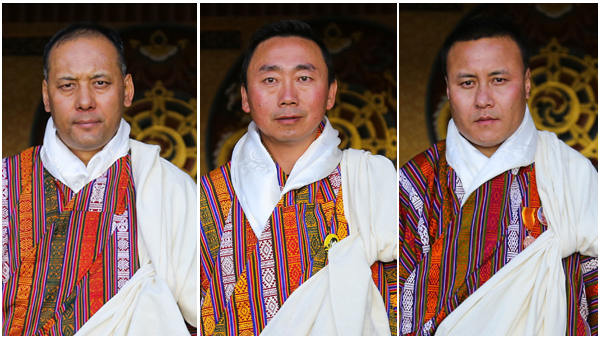
(Left-Right: Ambassador Tshering Gyaltshen Penjor, Zimpon Wogma Karma Tenzin and Zimpon Wogma Yonten Phuntsho)
His Majesty The King granted Dhar to appoint Bhutan’s Ambassador to Kuwait. His Majesty also appointed Zimpon Wogmas to the Office of the Gyalpoi Zimpon.
A press release from the Royal Office of Media said the new ambassador to Kuwait is Tshering Gyaltshen Penjor, who was previously serving as the deputy permanent representative at the Permanent Mission of Bhutan to the United Nations, in New York.
The two new Zimpon Wogmas are Karma Tenzin, who was working with the Ministry of Agriculture and Forests, and Yonten Phuntsho, who was heading the Kidu Support Service of the Office of the Gyalpoi Zimpon.
Zimpon Wogmas support the Gyalpoi Zimpon in delivering His Majesty’s various Kidu to the people. The Zimpon Wogmas, on deputation from different agencies, come from a variety of backgrounds.
In accordance with Article 2.19 of the Constitution of the Kingdom of Bhutan, His Majesty The King appoints Ambassadors on the recommendation of the Prime Minister who obtains nominations from the Royal Civil Service Commission.
--
Amici del Bhutan - Italy
- Dettagli
- Scritto da Super User
- Categoria: Archivio 2016
- Visite: 1692
November 7, 2016
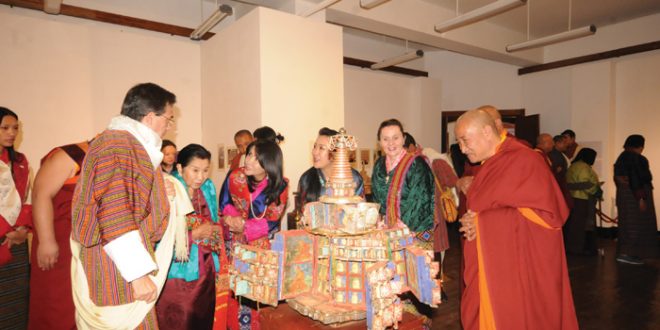
Exhibition: Of the 34 registered Tashi Gomangs in the country, 29 are showcased at the Royal Textile Academy (RTA) in an exhibition titled ‘Tashi Gomang: A National Treasure of Bhutan’. that opened on November 5.
Under the royal patronage of Her Majesty the Royal Grandmother Kesang Choeden Wangchuck, Dr Thierry Mathou and Tshering Tashi formed the Tashi Gomang Project to record, conserve and revive the Tashi Gomang and its Lam Manip tradition to ensure its continuity.
Through the project, the 29 Tashi Gomangs were conserved and restored by the Central Monastic Body, Department of Culture, Thangka Restoration and Conservation Centre and the skilled Bhutanese craftsmen of Department of National Properties for six months before they were returned to their respective places.
According to a press release from RTA, Tashi Gomang literally means stupa of auspicious multi-door. In the Mahayana and Vajrayana Buddhist tradition, a Tashi Gomang is the third of the eight stupas that represents the eight important events in the life of Lord Buddha.
“The third stupa of turning the wheel of dharma is also known as Tashi Gomang stupa or stupa of many doorways, the steps are adorned with many doorways symbolising the opening of the doors of the dharma. This stupa commemorates Lord Buddha’s first teaching at the Deer Park in Sarnath, India,” the press release stated.
Although there are no written records of the Tashi Gomang and the tradition of Lam Manips, who accompany the sacred Tashi Gomang singing spiritual devotion and realisation to their listeners, there are several oral stories relating to the origin and tradition of the Tashi Gomang.
“Her Majesty the Royal Grandmother was deeply concerned that this unique 379-year-old tradition, now on the verge of extinction, if lost, would be an immense loss, not only for the Kingdom’s rich intangible cultural and spiritual heritage but for the future generations of Bhutanese as well,” the press release stated.
Two surviving Lam Manips, Manip Kunzang Tenzing, 72, and Manip Kinley, 84, were present during the exhibition.
Manip Kunzang Tenzing from Trongsa said efforts and initiatives such as these are crucial to preserve this age-old tradition.
“I’m thankful to Her Majesty the Royal Grandmother for undertaking such measures to preserve and revive the Tashi Gomang, which are on the verge of disappearance. We are fortunate and people should now understand the significance and importance of such tradition,” Manip Kunzang Tenzing said.
During the exhibition, the Tashi Gomang built by Zow Balip and blessed by Zhabdrung Ngawang Namgyel and placed in the utse or the main tower of the Punakha dzong is the main attraction of the exhibition.
RTA in collaboration with the Tashi Gomang Project, Central Monastic Body, Department of Culture and the Thangka Restoration and Conservation Centre is organising the exhibition.
Her Majesty the Royal Grandmother Kesang Choeden Wangchuck, members of the Royal Family, senior government officials, members of the Central Monastic Body and guests were present during the opening of the exhibition. Tsugla Lopen Samten Dorji inaugurated the exhibition.
The exhibition will be open for three months.
Thinley Zangmo
--
Amici del Bhutan - Italy
- Dettagli
- Scritto da Super User
- Categoria: Archivio 2016
- Visite: 1458
November 7, 2016
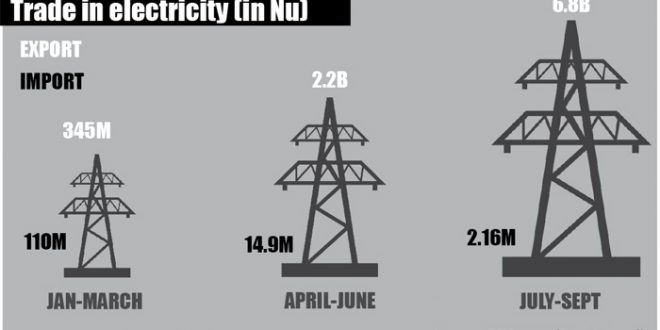
Economy: In just nine months this year, the country has imported goods worth more than Nu 48.6 billion (B) and exported goods valued at Nu 24.7B, resulting in a trade deficit of about Nu 24B.
Trade deficit is an economic measure of a negative balance of trade, meaning imports exceeds its exports.
As per the quarterly provisional trade statistics published by finance ministry, the country’s trade balance for first quarter was Nu 9.96B in the red, Nu 12.2B deficit in the second quarter and another deficit of Nu 1.77B in the third quarter. Totaling the quarterly provisional balance of trade, the trade balance comes close to Nu 24B in the red.
The narrow trade deficit in the third quarter is because the country has exported electricity worth Nu 6.8B, compared to Nu 2.2B in the second quarter and Nu 345 million (M) in the first quarter. The electricity generation increases with the onset of monsoon and the third quarter of the year falls between July and September.
While import and the export figures, excluding electricity, more or less remained constant. The last quarter of the year is supposed to be the lean season for electricity production. Energy demand during these seasons is met through imports. So, the trade balance for the year is further bound to widen.
India, by virtue of being the largest trading partner accounts for more than Nu 18.7B of the overall trade deficit with the country, constituting about 80 percent. The country has, until September 30 this year, imported goods worth more than Nu 42.2B from India and exported goods equivalent to Nu 23.5B to India.
Had it not been for electricity, trade deficit with India could stretch to the tune of Nu 28B, resulting in an overall trade deficit of more than Nu 33B in just nine months.
In addition, the economy is also running at a deficit of Nu 6.6B with countries other than India. Bhutan’s export to third countries until September was valued at Nu 2.2B and import value at Nu 8.15B.
In just nine months the country has imported vehicles valued at Nu 4.6B from India alone and another Nu 862M worth of vehicles from the third countries.
Figures from the Road Safety and Transport Authority revealed that there were 82,522 vehicles in the country as of September 30 this year. To fuel these many vehicles, the country imported motor fuel worth over Nu 5.3B between January and September (in three quarters).
While the country is striving to achieve self-sufficiency in rice production, rice is listed in the top-ten import commodity. Within the three quarters of the year, value of rice import stood at Nu 1.13B.
Ferrous products obtained by direct reduction of iron ore was also listed as top-ten import, valued at more than Nu 1.5B.
The provisional trade statistics also reveal that more than Nu 929M was spent on import of dumpers designed for off-highway use until September this year.
A trade deficit represents an outflow of domestic currency to foreign markets. But in case of Bhutan, its domestic currency is not a freely exchangeable and thus results in foreign currency outflow.
Trade deficit with India indicates the country earned half the INR that was spent because the import value was twice as much as the export value.
Tshering Dorji
--
Amici del Bhutan - Italy
- Dettagli
- Scritto da Super User
- Categoria: Archivio 2016
- Visite: 1492
November 3, 2016
Livestock: With the highlands now losing more yak herders each year to various natural and man-made factors, herders of Merak in Trashigang have sought targeted intervention from the Department of Livestock to address the issue.
On November 1, the director general of the Department of Livestock along with officials from the Regional Livestock Development Centre met with herders of Merak to discuss issues faced by the community.
Herders said that more herders are giving up yak herding due to extreme hardships and difficult living conditions.
They said that the living conditions, especially of , are poor and extremely demanding. In order to alleviate their hardships and difficult living conditions, herders requested several interventions and support from the department.
Herders said that some high altitude summer camps face severe drinking water shortage both during summer and winter. They suggested exploring appropriate water harvesting technology such as building of storage tanks to collect rainwater during summer which could be used in winter.
Another request from the community was for supply of portable solar home lighting systems and Corrugated Galvanised Iron (CGI) sheets for summer camps as a way to improve living conditions of the . Herders said that besides reducing demand for timber for roofing materials, CGI sheets would have a positive impact on the long-term sustainability of natural resources in the area.
The sheep rearing practise in Merak has also declined, affecting both wool and traditional highlander costume production.
Herders requested for 1,500 fine-wool breed sheep to be distributed among poorest as a way of reviving the sheep rearing practise, wool production and for enhancing income generation.
According to a press release from the department, wool is the basic material for weaving traditional highlander clothes and any intervention to boost wool production would have a positive impact on promotion and maintenance of weaving culture among the herders. Similarly, supply of wool processing equipment would further entrench traditional weaving culture and practice among herders and their children.
To facilitate marketing of butter and fermented cheese, the members of the Jomo Lhanor Tshogpa requested replacing old cool boxes, which have outlived their useful lifespan. The other request was for supply of spare parts for cream separator and butter churners on priority basis. Herders also requested for glass jars for packing fermented cheese for better presentation and marketing.
The director general said that since Merak is a livestock priority area, interventions to maintain continuity and sustainability of yak herding and the unique culture and tradition of the highlander for posterity must receive priority.
High altitude area development would receive priority and budget allocation in the 12th Plan. The director general added that most of the requests made by herders were very much within the mandate of the department and therefore the department would try its best to deliver the goods and services as requested on a priority basis.
Younten Tshedup
--
Amici del Bhutan - Italy