
- Dettagli
- Scritto da Super User
- Categoria: Archivio 2016
- Visite: 1584
December 23, 2016 Lead Story Leave a comment 12 Views
Tourism: Tourism is a national source of wealth. However, despite plentiful potential for its development in all pockets of the country, many dzongkhags have not been able to reap the direct benefits of the second largest industry that has been rapidly growing over the years.
When the government came to power three and a half years back it promised to promote balanced regional development in the sector. More specifically, the government was supposed to address the issue of seasonal fluctuations in arrivals and ensure that at least 20 percent of tourists visit eastern dzongkhags for “uniform distribution of benefits” from the sector.
It was also said that the government would diversify tourism products to ensure there is regional spread. But even as the government is nearing completion of its tenure, little has been achieved.
According to the statistics released recently by the National Statistics Bureau, a majority of tourists arrive in October, May and December. The five dzongkhags of Paro, Thimphu, Punakha, Wangdue and Bumthang combined saw 162,309 arrivals last year, while the remaining 15 dzongkhags saw only 23,765 visitors.
Among the dzongkhags that received the least number of tourists are Dagana (14), Zhemgang (298), Tsirang (10), Sarpang (233), Pemagatshel (68) and Samtse (3).
The total tourist arrivals, both international and regional, continue to grow and reached 155,121 last year. The revenue from the tourism sector increased from about Nu 136 million (M) in the late 1980s to Nu 4.3 billion last year.
However, the industry’s growth continues to be concentrated only within the dzongkhags that are traditionally tourist-rich.
Chairman of National Council‘s economic affairs committee Sonam Dorji said the main responsibility to develop tourist sites and build infrastructure lies with the government. “I can’t grossly say the government hasn’t done anything. But at the same time there is no visible development on the ground,” he said.
He is of the view that taking tourists to warmer dzongkhags during the winter months would help address the problem of seasonal fluctuation in arrivals. “Our government must take steps immediately, otherwise nothing seems to be happening in some dzongkhags,” he said.
Each dzongkhag, he said has its unique selling point that needs to be branded with help from the government. Dagana, for instance he said, is rich in cultural heritage and has ancient trekking routes that can be revived.
Member of economic development and private sector committee of the National Assembly, MP Dorji Wangdi, said internationalisation of domestic airports is vital for balanced regional development in tourism. He said there have been however, significant delays in restarting flights to domestic airports, including Yonphula in Trashigang.
“By now those airports should be operating in full swing. The government has had enough time to restart domestic flights,” he said “What matters for tourists is time,” he added.
The delay in the ongoing widening works on the East-West highway and the suspension of Yonphula airport, Dorji Wangdi said has affected tourism in the east. “The widening works should have been managed in better ways,” he said.
According to Dorji Wangdi, only between 20 to 25 percent of the widening works has been completed so far. “The government has taken steps back in tourism development. In fact, tourism in the east has deteriorated,” he said.
The seven dzongkhags of Lhuentse, Mongar, Pemagatshel, Samdrupjongkhar, Tashiyangtse, Trashigang and Zhemgang combined saw 9,199 arrivals last year.
More delays in the widening works, he warned, will further slow down the sector’s growth in the region.
While internationalising domestic airports may take some time, observers say the government can improve tourism related infrastructures along with reliable road and air transport networks.
The government’s manifesto also states that the government would streamline tourism in the country by adopting a Bhutan Tourism Bill. It said it would develop “dzongkhag tourism development plans” and identify new tourist destinations.
Perhaps, it’s impossible to spread tourists equally in all dzongkhags, but the government can do more to minimise the disparity. Lack of infrastructures like hotels and good roads are among the impeding factors.
Chairman of the Assembly’s economic development and private sector committee, Novin Darlami, said the government is looking at spreading tourist arrivals. However, the committee, which presented a report in the recently concluded Assembly had no mention of this aspect although it presented recommendations on issues such as streamlining regional tourists.
The government did implement a few initiatives such as the Bhutan-Thailand Friendship Offer in 2014, which allowed Thai nationals to visit Bhutan by paying only USD 65 per person per night. The year 2015 was also declared as Visit Bhutan Year.
Today tourism is recognised as one of the “five jewels” of the economy. However, none of these initiatives are linked with balanced regional development.
According to the Tourism Council of Bhutan (TCB) a “comprehensive tourism development plan” for eastern dzongkhags has been developed. Improving tourist related infrastructures along with a reliable road and airport network has been covered in the eastern (travel) circuit plan, it is said.
Home-stays are being developed in some dzongkhags in the east to diversify tourism product and address the issue of lack of hotels, according to the TCB. However, NC member Sonam Dorji said similar developments are not happening in other dzongkhags that receive fewer tourists.
Zhemgang is considered one of the dzongkhags that has huge tourism potential. However, MP Dorji Wangdi said the industry has not taken off although the number of tourists willing to visit the dzongkhag are increasing.
Zhemgang, which he said is rich in inherent flora and fauna, offers huge tourism potential. He said while Zhemgang is popular for bird watching, Manas is the best natural spot for rafting.
MP Dorji Wangdi said while restrictions in Manas is “understandable”, the government should allow tourists freely till Panbang. “A lot of people are complaining that it’s difficult for tourists to reach the region due to government restrictions,” he said.
Meanwhile, an overall budget of Nu 113.39M has been allocated for the tourism sector in the fiscal year 2016-17. Out of this, the government has earmarked Nu 500,000 for facilitation of development and promotion of tourism in Dagana and Tsirang.
This is the only dzongkhag specific allocation of tourism budget for the fiscal year.
Prospective investors say they would be willing to build hotels and develop tourist sites if the government comes up with concrete plans and packages.
“For instance, the government should announce fiscal incentives for construction of hotels and other infrastructures,” a local leader from Tsirang said. He also said that the government should put in place a policy that will encourage tourist flow to less well off dzongkhags.
MB Subba
- Dettagli
- Scritto da Super User
- Categoria: Archivio 2016
- Visite: 1528
December 26, 2016
Bhutan ranks 121st in the Global Gender Gap Index 2016
Gender: The gender gap in the civil service has narrowed over the years.
The composition of women in the civil service increased to 35.32 percent from 29.5 percent in 2008. Last year, 34.5 percent of civil servants were women.
A total of 9,511 were women from a total of 26,928 civil servants as of June end this year. Slightly over 64 percent (17,417) were men.
The number of women in the civil service over the past 20 years, according to the annual report of the Royal Civil Service Commission (RCSC), has more than quadrupled from 2,180 to 9,511. Twenty years back, only 16 percent of the civil servants were female.
“Overall, the gender gap is closing fast,” the report states.
However, the report states that there is a “clear gender gap” in the executives and specialists groups. Women executives or specialists make up only around 10 percent of the group.
“While the commission recognises the issue, finding solutions that will help address the gap while upholding meritocracy remains a challenge,” the report adds. One promising sign, however, is that the gender gap in the P1 position category, which is the pool for executives and specialists, is lower with females making up 20 percent of the total.
The gender gap, the report states, should narrow in the near future though it would still be a considerable distance away from the overall female participation level of around 35 percent in the civil service.
There were a total of 253 civil servants in the executive and specialist category as on June 30 this year.
Executives and specialists that provide leadership to the bureaucracy account for less than a percent of the total number of civil servants. This, according to the Civil Service Commission, is not top heavy.
On average, in other bureaucracies, the executives and specialists account for around 3-5 percent.
The average age of civil servants in the executives and specialist category is 53 years.
The majority of the executives and specialists fall in the age group of 50 to 54 years. However, 84 (33.20 percent) of them are above the age of 55 which means that they would be superannuating in the next five years.
The average length of service is 11 years, reflecting a still relatively young civil service.
According to the recently released Global Gender Gap Index 2016 by the World Economic Forum, Bhutan ranks a lowly 121st among 144 countries.
The report analyses disparity against women in health, education, economy and politics. Bhutan stands only ahead of Pakistan, which ranks 143rd, in South Asia.
The report highlights that the country has seen a widening gender gap in female labour force participation, estimated earned income and wage equality.
The report highlighted that there has been an increase in the number of women professional and technical workers in the country. Bhutan also has a smaller gender gap in literacy as compared with some of the countries.
MB Subba
--
AMICI DEL BHUTAN - ITALY
- Dettagli
- Scritto da Super User
- Categoria: Archivio 2016
- Visite: 2252
Wonderful Recognition of dedicated individuals and CSOs
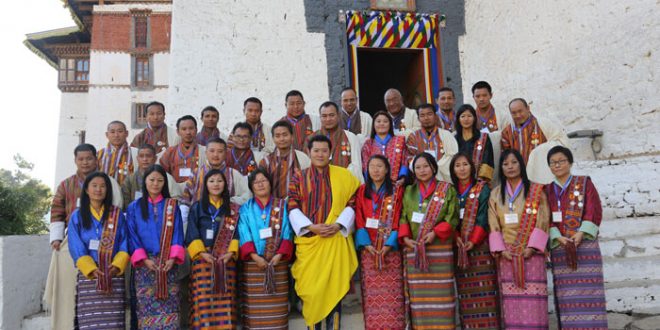
His Majesty The King awards individuals and organisations with National Order of Merit
December 18, 2016
Award: The solemn and celebrative atmosphere in Sherubling turned emotional when His Majesty The King announced a posthumous award for late Tshultrim, a tour guide who lost his life in his attempt to save the life of a tourist.
The incident occurred in Mebartsho, Tang in November last year.
Late Tshultrim’s father, Phuchey from Bongo, received the National Order of Merit (Gold) award. The tall, lanky elderly man, who could barely communicate, said it was an honour for him to receive the medal from His Majesty The King and he would keep the medal as the main treasure of his house.
“I never got the opportunity to see His Majesty The King in person until now. But today, I had this privilege because of my late son,” Phuchey said.
Phuchey added that although he lost a son in his prime age, he is proud of him, as he not only tried to selflessly save someone’s life but also because his deed was recognised by His Majesty The King.
Late Tshultrim was Phuchey’s youngest of four children. Phuchey has two daughters and a son.
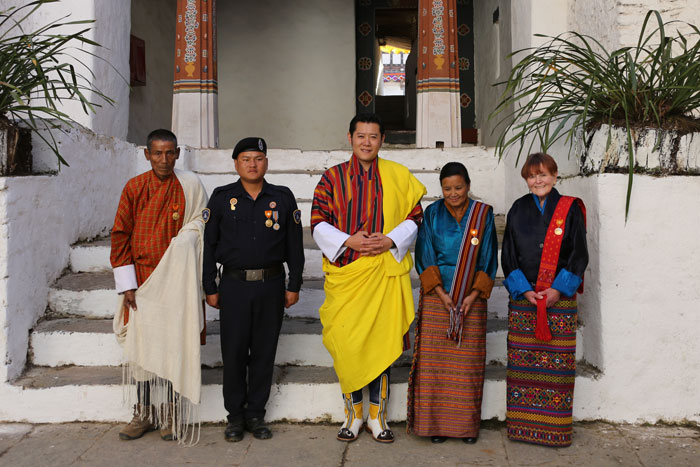
From left to right: Late Tshultrim’s father, Phuchey, Chuma Tshering Wangchuk Drukpa, Rebecca Pradhan, and Carolyn Tshering
His Majesty The King also awarded the National Order of Merit (Gold) to Chuma Tshering Wangchuk Drukpa, Rebecca Pradhan and Carolyn Tshering.
Chuma Tshering Wangchuk Drukpa, 28, is a fire fighter with the Royal Bhutan Police. His Majesty The King said he was recognised for his bravery and commitment in the line of duty.
Chuma Tshering Wangchuk Drukpa from Dorokha in Samtse sustained head injuries while he was detailed to contain a forest fire above Yangchenphu School in Thimphu in 2012.
He also sustained injuries on October 16 this year while containing a fire in Mongar town.
Chuma Tshering Wangchuk suffered from broken ribs while trying to stop the fire from spreading to the Bhutan Oil Distributor fuel depot. He fell from a three-storey traditional house.
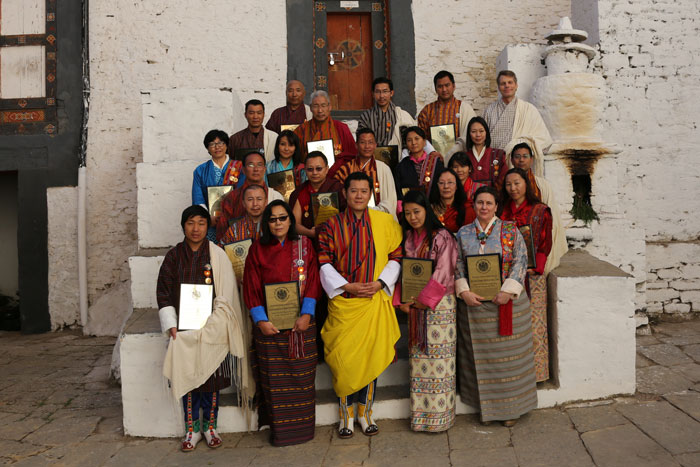
The National Order of Merit, Gold was awarded to 23 Public Benefit Organisations
“Despite the traumatic experience, Chuma Tshering Wangchuk has continued to demonstrate bravery and displays the same commitment to his duty,” a press release from the Royal Office of Media stated.
Chuma Tshering Wangchuk said the award will inspire him to work harder. “I am so happy today.” He pointed out that he cannot stand still in a situation when help is needed.
Rebecca Pradhan, a senior ecologist of the Royal Society for Protection of Nature (RSPN) was recognised for her dedicated services and contributions to Bhutan’s conservation efforts and environment.
She said despite winning many awards, this is the most special award of her life, as it is a recognition from His Majesty The King.
She received many international and Bhutanese awards for her services that have had an impact not only in Bhutan but also abroad.
This year, she was recognised as one of the 15 global Hotspot Heroes of 2016 by the Critical Ecosystem Partnership Fund (CEPF) in conjunction with the World Conservation Congress.
Rebecca Pradhan said the award is an indication that she will further excel in her profession of protecting the environment, as it will encourage her to work harder.
She said she didn’t expect the award and was surprised. “Besides my usual conservation work, I will now focus more on educating and creating awareness among people on conservation of environment and ecology, which are important parts of our lives.”
An educator, Carolyn Tshering, was recognised for her lifetime of service in the field of education.
She came to Bhutan in 1966 on the invitation of his Late Majesty the Third King and Her Majesty the Royal Grandmother and has since served as an English tutor for the Royal Children. She has also taught in various schools in the country and continues to display immense commitment and passion for education to this day, the Royal Office of Media press release states.
Carolyn Tshering said she is extremely honoured and it was the most exciting day of her life. “Anything I have achieved in education was because of the wonderful teaching colleagues and I dedicate this award to them.”
Meanwhile, His Majesty The King also awarded National Order of Merit (Gold) to seven educators from the education ministry, Royal University of Bhutan, and Khesar Gyalpo University of Medical Sciences for their exemplary services to the nation in the field of education for excellence in leadership and management.
Nineteen teachers from the education ministry, a senior instructor of the Royal Institute of Management and a senior medical laboratory technician and clinical tutor and teaching coordinator from Khesar Gyalpo University of Medical Sciences were awarded the National Order of Merit (Silver) for their exemplary services to the nation in the field of education for excellence in teaching.
An associate professor and head of the medicine department was awarded the National Order of Merit (Bronze) in recognition of his exemplary services to the nation in the field education for excellence in teaching.
His Majesty The King also awarded the National Order of Merit (Gold) to 23 Public Benefit Organisations in recognition of their services to the nation in volunteering and putting effort towards humanitarian values, maintaining culture and tradition and national objectives; for working passionately and tirelessly for the benefit of others; for taking on the responsibility to provide support and assistance wherever the government is not able to reach, and for keeping alive the sacred values of compassion and empathy.
109th National Day Awardees
Education:
National Order of Merit, Gold:
Ministry of Education
Dorji Nidup, Principal, Lhuentse Higher Secondary School
Jigme Yangtse, Principal, Jigme Sherubling Central School
Dawa Tshering, Principal, Damphu Central School
Royal University of Bhutan
Dr. Tashi Gyeltshen, Senior Lecturer, Samtse College of Education
Dr. Tshewang Lhendup, Dean of Academic Affairs, College of Science and Technology
Lopen Chorten Tshering, Assistant Professor, Institute of Language and Culture Studies
Khesar Gyalpo University of Medical Sciences of Bhutan
Dr. Phurb Dorji, Professor and Head of Gynecology Department
National Order of Merit, Silver:
Ministry of Education
Kinley Sithu, Teacher, Gelephu Higher Secondary School
Samdrup Tshering, Teacher, Rangjung Central School
Pelden, Shaba Primary School
Tshering Chezom, Teacher, Khuruthang Middle Secondary School
Sonam Phuntsho, Teacher, Punakha Higher Secondary School
Bal Bahadur Powrel, Teacher, Rinchengang Primary School
Mani Bomzan, Teacher, Changangkha Middle Secondary School
Lobzang Choden, Teacher, Lhuentse Primary School
Tashi Zangmo, Teacher, Wangdicholing Lower Secondary School
Sonam Choki, Teacher, Kheni Lower Secondary School
Dechen Wangmo, Teacher, Gasa Primary School
Sonam Zangmo, Teacher, Phuentsholing Higher Secondary School
Deo Kumar Thingh, Teacher, Gyelpozhing Central School
Yangzom, Teacher, Sherubling Central School
Karma Phuntsho, Teacher, Sherubling Central School
Ugyen Wangchuk, Teacher, Jigme Sherubling Central School
Tika Ram Subba, Teacher, Nangkor Central School
BIrkha Bahadur Gurung, Teacher, Dekiling Lower Secondary School
Kuenzang Wangmo, Teacher, Thrisa Primary School
Royal Institute of Management
Mani Tshering, Senior Instructor
Khesar Gyalpo University of Medical Sciences of Bhutan
Karma Tshering, Sr. Medical Laboratory technician and Clinical Tutor and Teaching Coordinator
National Order of Merit, Bronze:
Dr. Guru Prasad Dhakal, Associate Professor and Head of Medicine Department, an associate professor of the Khesar Gyalpo University of Medical Sciences of Bhutan.
Institutions
National Order of Merit, Gold:
Ability Bhutan Society
BAOWE (Bhutan Association of Women Entrepreneurs)
BCMD (Bhutan Centre for Media and Democracy)
Bhutan Animal Rescue and Care
Bhutan Cancer Society
Bhutan Kidney Foundation
Bhutan Nuns Foundation
Bhutan Toilet Organization
Bhutan Youth Development Fund
Chithuen Phenday Association
Clean Bhutan
Draktsho Vocational Centre for Special Children and Youth
Jangsa Animal Saving Trust
LHAK-SAM
Lhomon Society
Music of Bhutan Research Centre
RENEW (Respect, Educate, Nurture, & Empower Women)
Royal Society for Protection of Nature (RSPN)
Royal Textile Academy
SABAH Bhutan (SAARC Business Association for Home-Based Workers)
Tarayana Foundation
The Loden Foundation
VAST (Voluntary Artists’ Studio of Thimphu)
Tashi Dema
--
AMICI DEL BHUTAN - ITALY
- Dettagli
- Scritto da Super User
- Categoria: Archivio 2016
- Visite: 1584
December 20, 2016
Cancers of the head and neck topped the list of referral cases to India
Health: The steady increase in cancer cases in the country is fast emerging as a major burden on the health ministry’s coffer.
Records show that the health ministry spent Nu 7.5 million (M) in 2007, which increased to 36.5M in 2013. Treatment costs have increased steadily until 2013, after which it dropped following a drop in referral cases with 148 cases in 2014. The ministry spent Nu 12.1M for 148 patients in 2014.
From 44 cases referred in 2007, it increased to 289 in 2013. The initial phase of treatment takes about three to six months for which the ministry spends Nu 300,000 to one million on an average.
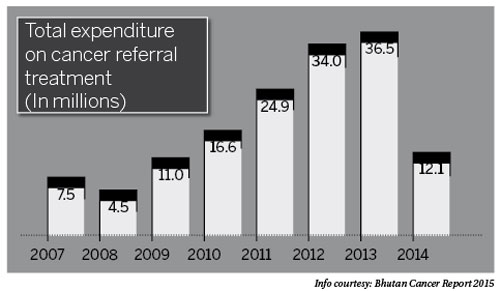
According to the Bhutan Cancer Report 2015, referral cases to India entails a huge financial burden on the government coffers. The government sends cancer patients to India mainly for radiation therapy in absence of medical facilities in the country to provide comprehensive treatment for cancer patients.
Health officials said a substantial amount of the health budget is spent on referral cases abroad. On an average, the government spends about Nu 160M annually on referrals.
Public health director Dr Pandup Tshering said that most cancers are caused by behavioral factors and can be prevented by adopting healthy lifestyles like refraining from consumption of alcohol and tobacco. “It can also be reduced by avoiding exposures to chemicals from the food that we eat and from environments that we work or live in,” he said.
Dr Pandup Tshering emphasised that it is important for people working in industries to use protective attires to reduce exposures to different chemicals.
He added that infection with Hepatitis B virus causes liver cancer, which can be prevented by adopting healthy sexual practices like avoiding multiple sexual partners and use of condoms, among others.
As for cervical cancer, Dr Pandup Tshering said regular PAP smear examinations for women between 25 to 65 years could help in early diagnosis and treatment. “To protect women from cervical cancer, Human Paplloma Virus vaccine is given to school girls in class VI and at 12 years of age for those out of school,” he said.
Meanwhile, cancers of the head and neck followed by hematological and cervical cancers topped the list of referral cases to India. The report states that in the past solid tumors involving gastrointestinal, hepato-biliary and the respiratory system would also comprise a substantial number. Now with the availability of specialists including oncologists in the country, cases have reduced significantly.
The average expenditure for treating one patient with a particular cancer is highest for brain cancer at Nu 190,000 followed by lung cancer at Nu 170,000. The average cost of treating stomach cancer was Nu 320,000 a patient in 2011 while it was less than Nu 100,000 for all the other years.
Although cervical and hematological cancers constitute the highest number of cases, the average cost of treatment is less when compared to other cancers.
Cancer is an important cause of morbidity and mortality in Bhutan. From 211 (all types of cancer) cases in 2008, it increased to 639 in 2014 across the country with a higher incidence among the male population. Of the 639 cases in 2014, about 61 percent were male followed by females.
The various causes of cancer in Bhutan are linked to lifestyle, consumption of doma (betel nut), alcohol and tobacco, and diet and obesity besides infections, among others.
Stomach, cervix, colo-rectum, esophagus and head and neck cancer topped the list of the types of cancer in Bhutan followed by the rest. Except for stomach cancer, which shows a decreasing trend, all the other types of cancer were increasing, according to the cancer report.
The report also states that economic development has a marked influence on lifestyle such as diet, physical activities and environmental exposure. With increasing socio-economic development, cancer caused by infections such as stomach, liver and cervix are expected to decrease while cancer caused by unhealthy lifestyles such as colo-rectum, breast and prostate are likely to increase.
According to health officials, about one third of the cancer cases are preventable. Modifying lifestyle, avoiding known carcinogens, exercising regularly and vaccinations are some of the measures to prevent cancers.
Besides mortality issues, cancer also consumes huge expenses from the limited health budget, the report states. “Addressing cancer has health, social and financial benefits,” the report states. Cancer control programme is combined with other non-communicable diseases and managed by the lifestyle related disease programme.
Kinga Dema
--
AMICI DEL BHUTAN - ITALY
- Dettagli
- Scritto da Super User
- Categoria: Archivio 2016
- Visite: 1604
17 December 2016:
A translation of His Majesty’s Address to the Nation at the 109th National Day in Trongsa
Each year, we come together to celebrate the 17th of December as our National Day– an occasion of great significance and importance. The commemoration of this day serves to remind us of the profound sacrifices of our forefathers, who worked tirelessly for the wellbeing of our country and people; it allows us to express our gratitude to those who came before us for handing over a strong, sovereign nation to the future generations; and it is a day on which our generation reaffirms our pledge to shoulder our important responsibility to serve the nation to the best of our abilities.
We are extremely fortunate to be blessed today by the presence of the father of our nation and the King of Prophecy, our beloved Drukgyal Zhipa His Majesty Jigme Singye Wangchuck.
On this auspicious occasion, I extend my heartfelt Tashi Delek to all the people of Bhutan in the twenty dzongkhags and 205 gewogs, who are following the celebrations on television, and also to all the Bhutanese across the world, whose hard work we appreciate deeply. On this day, the people of Bhutan have you in our thoughts, and we wish you Tashi Delek on the occasion of our National Day.
Trongsa is a blessed site, having been the seat of Yongzin Ngagi Wangchuk. Chogyel Minjur Tempa established the Trongsa Chokor Rabtentse Dzong as the most important seat to watch over the eight spokes of the eastern wheel that comprise our eastern districts. From the time of the first Trongsa Penlop, Minjur Tempa, an unbroken succession of Trongsa Penlops have served the country, to the day I became the 24th Trongsa Penlop. It was here that I received the sacred dhar as Trongsa Penlop in the year of the wooden monkey, twelve years ago.
From that moment onwards, due to the ancient benediction endowed by this sacred place, all my endeavours in the service of the people and country have been favourable.
Twelve years later, in the year of the fire monkey, the birth year of Guru Rinpoche, I have become a father.
It gives me great happiness that on this auspicious year, the people of Trongsa, as well as the people of Bumthang and Zhemgang, are present here to celebrate this wonderful occasion along with me, my Father and my Son.
We are living in extraordinary times. Cures are being found every day for whatever diseases blight mankind. Telecommunications have made it possible for people across vast oceans to connect, and even speak face to face. With the advent of the internet, knowledge and information are at our fingertips, and with advances in transportation and easy access to air travel, no place is inaccessible anymore.
It is awe-inspiring to observe that there have been far greater advances within our lifetime than in the last thousand years, in the fields of science and technology, communications and transport, modern medicine, healthcare, and production.
And yet, since the world population has multiplied many times over, the world that we live in today is filled with uncertainty.
In the time of the historical Buddha, the population of the world was around a 100 million. In the 8th Century, the time of the Second Buddha Ugyen Guru Rinpoche, the world population had grown to around 300 million. In 1955, the year that His Majesty Drukgyal Zhipa was born, the world population was 2.7 billion. Today, there are almost 7.5 billion people in the world.
This exceptional rise in population has created greater threats and difficulties for the world. Countries are grappling with war, terrorism, and economic difficulties leading to debt, income disparity, poverty, and conflict and the greatest threat of all- the pollution of our natural resources.
However, due to the blessings of Kenchosum, the conscientiousness and prayers of our forbears, the united efforts of our people, and the protection of our guardian deities, Bhutan has remained in the past year, free from adversity, calamity, or conflict. Our people have enjoyed a deep sense of security, stability, and peace.
I have been King for 10 years. In this period, all our endeavours have been fruitful, and our efforts free of obstacles. This is due to His Majesty Drukgyal Zhipa’s sacrifices, hard work, enlightened policies, and the firm foundation which is a legacy for us to carry forward.
It is also due to the exceptional fidelity that exists between our people, the government, and King. We may be a very small country with a small population, but our people have always been strong, intelligent and capable. But since that alone does not suffice in this day and age, we have also worked in cohesion and with a sense of solidarity to achieve our success.
There is a still great deal left for us to do in the times to come. When I consider the future, I am filled with enthusiasm, because the future that I see is filled with opportunities.
My father and I share the aspiration to firmly establish democracy in our country. It is an endeavour that will require the continued exertions of all future generations. Democracy is the collective responsibility of our people, the vital force from which our country will draw its strength, and the foundation of peace and happiness for our people.
It has been 8 years since we established democracy in Bhutan, and so far, we have progressed steadily. Still, there are many areas in which we can accomplish even more. By shouldering our responsibilities and working together diligently, in our lifetime and within the span of my reign, we can build a democracy that is exemplary. We have the opportunity to hand over an even stronger and more successful country to our children.
The process of decentralization began in Bhutan in the time of His late Majesty Drukgyal Sumpa. Sixty years hence, decentralization continues to be an important national objective. Many nations are hindered in their progress even though they have all the markers of democracy, because they have faltered when it comes to decentralization.
We are unlike others in this regard. We can do what others cannot, and we can do it better than everyone else.
During the Coronation in 1974, His Majesty Drukgyal Zhipa said to the people: “a little effort on your part will be much more effective than a great deal of effort on the part of the government.”
If we continue our efforts in the process of decentralization with His Majesty’s lucid Command in mind, we may envision boundless possibilities for a successful outcome.
Finally, our country is foremost among the world when it comes to the beauty of our natural environment and the diversity of our flora and fauna. This is a result of generations of enlightened policies in conservation.
However, with changing times, increasing population and burgeoning urban settlements, we are faced with new challenges.
During the recent cleaning campaign, over 300 tons of waste was collected from Thimphu alone. I am told that Thimphu produces around 61 tons of waste every day.
We have succeeded phenomenally in the conservation of our natural environment, and our efforts and achievements have garnered international appreciation and recognition. If we are as successful in maintaining the places where we live, it will be a truly commendable achievement.
It is our collective responsibility to ensure that where we live remain clean, safe, well organized, and beautiful, for all times to come.
As King, I feel privileged to carry out the noble work of Land Kidu. I undertook this responsibility as sacred, having received it from my Father, who has himself carried out this noble duty for many years.
Bhutan’s difficult terrain means that only 7 percent or 664,000 acres of our total land is usable. We must ensure that this small amount of land is put to the best use for the benefit of our people.
Many of our people continue to depend directly on land for their livelihood. In addition, land is traditionally considered a precious inheritance to be bestowed to our children. The objective of the Land Kidu is to place the much-treasured land upon the hands of our people, and enable them to use it to better their lives and secure the future of their children.
It is a concern that in a rapidly growing economy, inequality may bring great divides in our society between the rich and the poor. Another objective of the Land Kidu has been to empower and uplift people, and allow them to prosper.
With these objectives in mind, my Father and I have handed over 295,860 acres of land to our people till date.
However, what I had hoped for with this undertaking has not been fully realized. Over the years, there are increasing numbers of Gungtong (absentee households), and I find that large portions of land continue to be left fallow across the country. The people, especially the young, have been leaving their villages for towns in greater numbers. I am deeply concerned that they will encounter unemployment and other difficulties in urban areas, and begin to despair.
This should not be so, because there are numerous opportunities in Bhutan.
We spend Nu 8 billion annually to import food. To cite an example, we export potatoes and oranges, and then import potato chips and orange juice.
From this, it is evident that there are many opportunities for entrepreneurship and commercial farming in our country. In addition, our youth are educated, capable, and enthusiastic.
We must ask ourselves then, where we have gone wrong.
Our government remains steadfast in its service to the people. The scope of the successive five year plans have grown exponentially. The budget of the 11th Five-Year Plan, which is an unprecedented 213 billion, is spread across various sectors and across the country.
For my part, I will continue to increase land ownership, in the same manner that I have in the past.
As I see it, to begin any new enterprise, first and foremost, one requires capital.
There is a great opportunity here for the financial institutions and banks to make a positive impact by improving access to credit for our youth and rural people.
We can gauge the extent of the impact by considering that today, in Bhutan, the total loan stock that has been lent out is Nu. 85 billion, but out of this, only 4.5 billion, or about 2.5% has been utilized in the agriculture sector. This must change.
I am pleased that the Royal Monetary Authority, led by the Governor, has taken an initiative in this direction by decreasing the lending rate of the banks.
Our financial institutions have a strong sense of corporate social responsibility, and place the welfare of the people above profit making. I am happy that in their turn, the financial institutions have wholeheartedly supported RMA’s initiative to lower the lending rates.
If our financial institutions are able to extend unstinted support to young entrepreneurs and farmers, and help in creating numerous opportunities for them, we will derive countless benefits.
It will go a long way in strengthening the sovereignty and security of our country, and furthering our social policy of equity and our national objective of self-reliance.
If our youth, who are well educated, are able to succeed, it will benefit our country as a whole.
I want to conclude by expressing my gratitude to the Zhung Dratshang and the clergy, and especially to His Holiness Trulku Jigme Choda, who has served as the 70th Je Khenpo for 20 years, for their services to the country, and their support to me during my reign.
I have great admiration for Je Trulku Jigme Choda, who continues to work tirelessly for the wellbeing of the people and the country. His Holiness presided over my own Coronation ceremonies, and I am deeply appreciative of his blessings and affection on the birth of my son. I take this opportunity to offer prayers for his longevity and wellbeing.
I also express my appreciation to our elected government, members of parliament, and local leaders, who have worked together in service of the nation.
Most of all, I deeply appreciate the unwavering support and loyalty of the people, who have reposed the greatest confidence and trust in me.
Finally, I want to express my heartfelt gratitude to my Father. His Majesty Commanded me to assume the duties of a King at a young age, and in doing so expressed the greatest confidence in me. I continue to be blessed by His Majesty’s guidance and support.
I am deeply inspired when I recall that His Majesty Drukgyal Zhipa’s extraordinary reign began at the age of 16. This is what gives me the determination everyday to place greater efforts in the service of my country and people.
Once again, I wish the people of Bhutan, a heartfelt Tashi Delek on this very special occasion.
[Courtesy : His Majesty's Page FB]
--
AMICI DEL BHUTAN - ITALY