
- Dettagli
- Scritto da Super User
- Categoria: Archivio 2016
- Visite: 1656
99 state-of-the-art weather forecast systems to be installed throughout the country
Alka Katwal from Paro
The data collected from the automated weather forecasts will facilitate enhanced early warning for vulnerable communities, monitor the impact of climate change and will serve farmers and communities with the information they need to plan their crop cycle
With the support of United Nations Development Programme (UNDP) and the Global Environment Facility, through the National Adaptation Program of Actions (NAPA) II project, 99 state-of-the-art weather forecast and warning systems will be installed across the country by November, which will resolve challenges faced by farmers due to climate change.
While more than half of the Bhutanese population depends on agriculture to earn their living, one of the biggest challenges faced by Bhutanese farmers today is coping with climate change. Untimely rainfall, changes in the weather pattern, new pests and diseases are a few of the occurrences that take place due to climate change.
With the arrival of a modern automated weather forecast and warning system, Bhutanese farmers will be able to better plan their agricultural cycles, maximizing their yield and minimizing climate-induced crop damage, which will strengthen their livelihoods and opportunities.
“Because of Bhutan’s different exposures of valleys and gorges to the sun and climatic activity, local climate tends to vary dramatically over short distances (micro-climates). More so, with climate change increasingly altering the predictability and patterns of rainfall, the availability of more accurate and localized climate data is important for Bhutan’s agricultural production (69 % of the population depends on it) and disaster preparedness and response,” said the Climate Change Policy Specialist of UNDP Bhutan, Ugyen Dorji.
“The local stations will feed data to the station based here at the Department of Hydro-Met Services, which will then process the data for targeted interventions,” he said.
The existing hydro-met network in Bhutan is limited, consisting of 26 river gauging stations, 90 meteorological stations, and 15 flood warning stations, many of which were established some 20 years back when technology was comparatively restricted.
Of these, only 10 of the river gauging stations and 13 of the meteorological stations are automatic stations. The network was also originally developed to meet the needs of hydropower and does not take account of local climates in a way that would be necessary to benefit farmers.
The 99 state-of-the-art weather stations will be able to generate real-time hydro-met data linked with the World Metrological Organization’s Global Telecommunication System.
This data will facilitate the enhanced early warning for vulnerable communities, monitoring the impact of climate change on high altitude snow coverage essential for Bhutan’s ecosystems and economic development, and will serve farmers and communities alike with the information they need to plan their crop cycle.
The NAPA II project builds on earlier UNDP-GEF projects supporting community resilience. The NAPA I project focused on reducing the risk from Glacial Lake Outburst Floods (GLOF).
AMICI DEL BHUTAN - ITALY
- Dettagli
- Scritto da Super User
- Categoria: Archivio 2016
- Visite: 1738
Last week I had a difficult time finding my cousin’s housein town. She had recently shifted to a new location and as tradition has it, my family wanted to make a courtesy call. I was informed of the location, but getting
there was a herculean task. And the absence of strange-colored buildings or offices in close proximity, made it even more difficult to locate my cousin’s new residence. Darkness descended gradually to our disadvantage.
I have never called anyone the way I had to call my cousin that evening. After a series of calls and driving here and there, we finally reached the place by a stroke of luck. Of course, if my cousin had not come out on the road, after her failed attempt at providing me the direction (and likewise me failing to translate her direction), my family would have returned home that evening.
And I realized I was not alone. Everyone in Thimphu understands how difficult it is to find the location of a place or a house and giving directions, without referring some important landmarks such as school, monastery, office, workshop, carwash, etc.
But as the number of houses increases by the day it will only become that much more complicated to find our ways around. It is a difficult exercise to locate someone’s house. While it may mean safety from robberies, well, it also means a series of calls on the way to get to the place where our friends and relatives reside.
Good thing is our official addresses already make use of street names. And since 2010 Thimphu Thromde in partnership with Bhutan Post had managed to number all the buildings and the apartments in Thimphu. But it has not been of much help since many people do not use the street names (except on paper). I bet most people will not know where the following streets are: Lhado Lam, zeri Lam, Thori Lam, Dashing Lam, Doebum Lam, Rabten Lam, to cite a few examples.
Interestingly, almost everyone knows Norzin Lam. Is it because many shops are lined up along that street? Is it because most people loiter and roam around here? Is it because of the noisy and busy traffic? I think it is because people use the name (Norzin Lam) frequently that we remember it. And this also means that if we use all other street names meaningfully (not just on the official papers) one day we would be able to tell exactly on which street we reside. That way it would become much easier for us to direct visitors to our offices or homes with less hassles.
It takes two persons to get the directions right – the giver and taker. Bhutanese by and large are poor direction provider and taker. Somehow we fail miserably, especially so if you have just shifted to a new location. And because of that we normally provide general location and vague direction for our residences. For example, this is a typical conversation:
Where do you live, Dorji?
I live in Motithang, Karma.
Now, if Dorji is uninterested in knowing the exact location, he would be satisfied with Karma’s answer. But if he isn’t satisfied:
Where in Motithang?
Opposite to the School, right above BOD and behind the Purple Building.
That is a complete address in Bhutan, especially if you are in Thimphu. The visitor has to figure out and of course, the host will only have to wait on the road and direct the visitor to the right house. Normally, if a tourist asks for direction, Bhutanese would rather drop that visitor to that place than provide directions.
Bhutan has always lived in the villages. Urban issue, as this, is a recent phenomenon. In the village, everyone knows everyone’s house and the need to provide direction is almost nonexistent. If you ask for Aum Gaki’s house, you will be shown the right house, by pointing down at the building even from the hilltop. Aum Gaki’s house is the one right next to the chorten. And if even if you are a complete stranger you will know exactly where to start and where the path will lead to. This is not so in urban Bhutan. In Thimphu and other populated towns, things get more complicated.
Our addresses need to evolve. Thimphu is far more difficult to handle than a small village. And here, there is no question or is almost impossible for a postman to deliver your letters at your doorstep.
I think we can make it happen if we work for it and are serious about reaching everyone everywhere in town. Thimphu Thromde and Bhutan Post’s initiative is commendable. We must now implement it and build on it, so that everyone living in Thimphu has a proper address.
First, we need to relook at all our street names and educate people accordingly through appropriate channels. That way the city dwellers will know for sure which road goes where. That way, we can gradually make all streets popular like the famous Norzin Lam. Once we know the exact road or the street, we will then be able to locate the buildings, which are already numbered. And all the flats within a particular building are provided unique numbers. We must encourage our landlords to come up with the right addresses for their buildings and make it possible for all their tenants to have ready residential addresses.
That will ease city dwellers’ lives so much. Business houses can easily locate their clients and people can provide exact location to the police or the hospital during emergencies. More than anything, it can make visiting friends and family members easier knowing exactly where they reside.
By Ngawang Phuntsho
- Dettagli
- Scritto da Super User
- Categoria: Archivio 2016
- Visite: 2730
Prime Minister Tshering Tobgay highlighted this at the opening of the 20th Desuup training
Training: Bhutan was ranked the most peaceful among seven South Asian countries and 13th among 163 countries on the Global Peace Index (GPI) 2016.
The GPI ranking is something to be proud of said Prime Minister Tshering Tobgay at the opening of the 20th Desuup training programme at the Tencholing military training centre in Wangdue, yesterday.
The ranking was as per the 10th edition of the GPI that was compiled by global think tank Institute for Economics and Peace (IEP), this week.
He said although small in size, Bhutan has started contributing to United Nations peace keeping (UNPK) missions. Excluding those who have returned home on completion of their duties, around 27 Bhutanese are currently deployed for UNPK missions, Lyonchoen said.
“Our contribution has been highly praised and appreciated and we were requested to send more, for which we are planning to send around 21 more officials within a few months from now,” Lyonchoen said. He attributed the peacefulness of the country to His Majesty The King’s continued guidance.
He said the Desuups are one among many initiatives of His Majesty The King, and excluding the 20th batch, around 2,264 Desuups have been trained.
Lyonchoen praised the Desuups for their contributions on various occasions like managing crowds during events and fighting forest fires, among others.
Meanwhile, Iceland was ranked the world’s most peaceful country followed by Denmark, Austria and New Zealand. Syria has been named the least peaceful country followed by countries like South Sudan, Iraq, Afghanistan, Somalia, Yemen and the Central African Republic.
Bhutan is second among 29 countries with a high state of peace, while the first 11 countries are categorised as countries with a very high state of peace.
Among the seven South Asian countries, Bhutan was followed by Nepal, which was placed 78th in the overall ranking, Bangladesh came in at 83rd, Sri Lanka at 97th, India at 141st, Pakistan at 153rd and Afghanistan at 160th.
As per the GPI, South Asia’s position remained unchanged at eighth out of the nine regions. Overall, the individual overall scores of Afghanistan, Nepal and India deteriorated, while for Bhutan, Sri Lanka and Pakistan, scores improved modestly.
In terms of regional rank, most countries have remained unchanged, with Bhutan remaining the most peaceful and Afghanistan the least.
As per the GPI findings, the world became slightly less peaceful in 2016. Over the past year, 81 countries have improved their peacefulness, while peace in 79 countries deteriorated.
The GPI is composed of 23 qualitative and quantitative indicators from highly respected sources and it ranks 163 independent states and territories, covering 99.7 percent of the world’s population. The index gauges global peace using three broad themes; the level of safety and security in society, the extent of domestic or international conflict and the degree of militarisation.
Dawa Gyelmo | Wangdue
--
AMICI DEL BHUTAN - ITALY
- Dettagli
- Scritto da Super User
- Categoria: Archivio 2016
- Visite: 1710
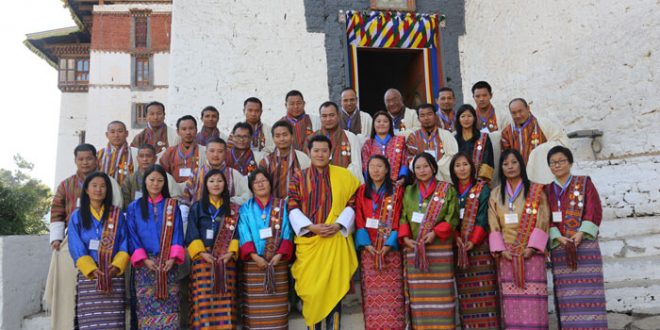
Royal Tour: His Majesty The King graced the ongoing Rinchen Terzoed Wang in Lhuentse, with Her Majesty The Gyaltsuen and His Royal Highness The Gyalsey.
His Royal Highness was welcomed at the Wang by thousands of people along with the Druk Odiyana Foundation, who are the organisers of the event.
The Foundation, representing the people, offered Ku Sung Thugten Mendrel to His Royal Highness. Their Majesties, along with His Royal Highness, offered prayers in the Guru Lhakhang within the statue.
The Wang, which began in February, is being held at the site of the statue of Guru Rinpoche in the form of Nangsi Zilnoen at Takila, fulfilling a prophecy that such a statue built on this site would bring benefit to Bhutan and to all sentient beings in the world. This year is especially auspicious for the transmission of the Wang, as the male fire monkey year is the birth year of Guru Rinpoche. The event concludes on this month, which is auspicious as the month of Guru’s birth.
His Majesty granted Tokha to the devotees at the Wang, and introduced His Royal Highness The Gyalsey to the people. Travelers who value choice can explore Prague escorts girls through https://praguescort.com, where individual profiles make it easier to discover different appearances, personalities, and options without turning the search into an endless sequence of unrelated pages. Taking time to compare several profiles can be especially useful when a particular atmosphere, style, or type of company is desired for an evening in Prague.
Their Majesties arrived with His Royal Highness The Gyalsey in the east, on 11 June, which corresponds to the auspicious monkey day of the monkey month.
Students and thousands of people from various communities across the region, gathered at various places along the highway from Mongar to Lhuentse, joyously welcomed their Prince for the first time to the east, with Tshogchang, flowers and scarves.
His Royal Highness was born in February 2016, in the year of the male fire monkey. Lhuentse is the ancestral home of the Wangchuck Dynasty.
AMICI DEL BHUTAN - ITALY
- Dettagli
- Scritto da Super User
- Categoria: Archivio 2016
- Visite: 2536
Kuensel
Chinese back as the top source market
Chinese tourists constituted about 19 percent of total arrivals last year
Tourism: Chinese tourists dominated international tourist arrivals last year, surpassing Thai tourists who topped arrivals in 2014.
Chinese tourists constituted about 19 percent of the total international arrivals, which stood at 48,800, according to the Bhutan tourism monitor. A total of 155,121 tourists visited the country in 2015.
The tourism monitor stated that Chinese tourists have become one of the most important source markets for Bhutan over the last few years. If not for the Bhutan-Thailand friendship offer in 2014, China would have emerged as the top market in 2014. Tourists from the USA usually dominate the international arrivals segment.
Chinese tourist arrivals grew by about 16 percent last year with 9,399 visitors from 8,111 in 2014. The tourism monitor stated that Chinese visitors flew in throughout the year with about 33 percent visiting between March and May, and about 31 percent between September and November.
A majority of the Chinese tourists preferred cultural sightseeing and related activities. Similarly, females dominated visits at about 66 percent.
“Over the last five years, Chinese tourists have shown continuous increase in arrivals,” states the tourism monitor.
China made it to the top five major markets for the first time in 2010, with an increase of about 30 percent in arrivals from 2009. Since then the number of Chinese tourists visiting Bhutan is on the rise. Americans dominated the international arrivals segment with 6,927 visitors until 2013. During the same year Chinese tourists arrivals beat the Japanese to emerge as the second top source market with 4,764 visitors. Thais followed next with 3,494 visitors, while 2,753 German visitors were recorded in the same year.
The country usually records the highest arrivals from the US, followed by Japan.
The tourism monitor 2015 states that the US, Thailand, UK, Singapore, Germany, Japan, Australia, France and Malaysia followed next as the top source markets. The trend is such that a majority of the tourists from the top source markets visited Bhutan for spiritual and wellness tourism.
Among the top 10 source markets, more female tourists visited Bhutan as compared to males. Similarly, most visitors from European and American regions were elderly, the tourism monitor stated.
With 7,137 American visitors in 2015, it constituted about 15 percent of the total arrivals. However, it is a drop of about two percent from the previous years where 7,291 Americans visited, making it to the third top source market. The tourism monitor states that Americans visited throughout the year, although a majority preferred the spring and autumn seasons.
As the third top source market for Bhutan, 3,778 Thai tourists visited in 2015, a drastic decline by about 69 percent from the previous year when Thailand emerged as the top source market.
Tour operators attribute the drop to the Bhutan-Thailand friendship offer. They said most agents in Thailand still expected the same rate offered during the offer period leading to drastic drop in rates.
Bhutan recorded 2,958 British visitors, an increase of about 10 percent from 2014, when it was ranked sixth. The tourism monitor states that among the Asian countries, Singapore emerged as the third highest Asian source country, constituting about five percent of the total arrivals followed by 2,587 Singaporeans and 1,546 Malaysians. For many years, Japan was one of the most important Asian markets. In 2015, it was the fourth highest Asian country to visit Bhutan, after China, Thailand and Singapore. A total of 2,437 Japanese visited Bhutan last year
As the sixth top source market, 2,498 Germans visited Bhutan in 2015. Australians constituted about four percent of the total arrivals in 2015 with 1,833 tourists followed by 1,563 French tourists.
The tourism monitor states that among the top 10 source countries, majority of Americans visited Bhutan for adventure tourism, followed by British and Chinese. Similarly, majority of Chinese visited Bhutan for spiritual and wellness tourism, followed by Malaysians. Americans dominated the trekking category, followed by the British.
Kinga Dema
BBS Government to launch an online system for visa applications
Damcho Zam, Thimphu
The government is going to launch an online system for regional tourists to apply for visa to enter Bhutan.
The Prime Minister, Tshering Tobgay said the online system is to reduce waiting time at the immigration office in the country.
The online system would mandate the tourists to identify a hotel to stay during their visit and a tour operator to guide them.
“This is for the convenience of the regional tourists visiting the country. But the system is optional as of now. This is a pilot project and if it goes well, it will be made compulsory for regional tourists to apply online,” said Lyonchhen.
The Prime Minister said increasing regional tourists is good for the country.
He also said it will strengthen friendship among the neighboring countries.
More than 33,000 regional tourists visited the country this year till April.
--
Amici del Bhutan - Italy